A Phoenix pest control company that would rather show you the licence than the slogan
Every pest control company says it is licensed, experienced and trusted. Almost none of them tell you how to check. This page does, including how to check ours.
Get a free quote
No obligation. We reply within 2 hours.
How we work
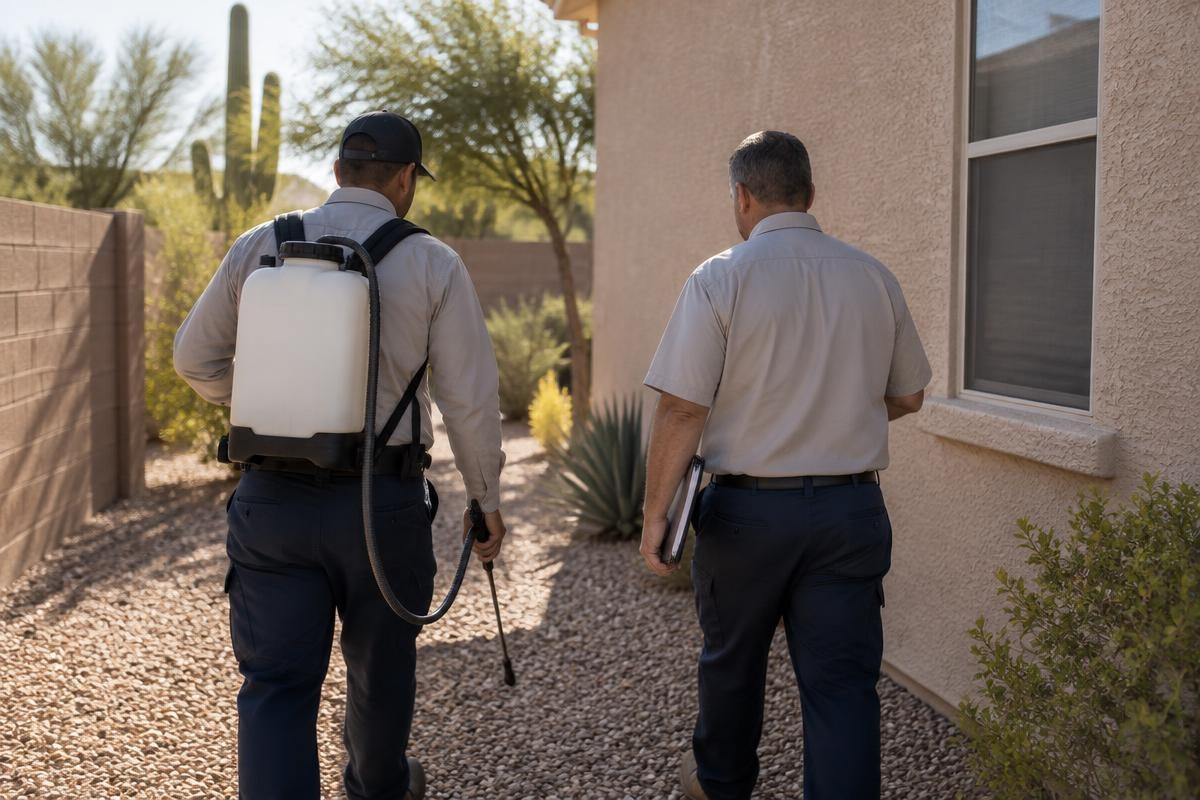
There is not much mystery to good pest control. It is mostly about doing the boring parts properly and not overselling the rest.
Inspect before quoting
We look at the property before we put a number on it. A price quoted over the phone without seeing the building is a guess, and guesses get corrected upwards later.
Seal, do not just spray
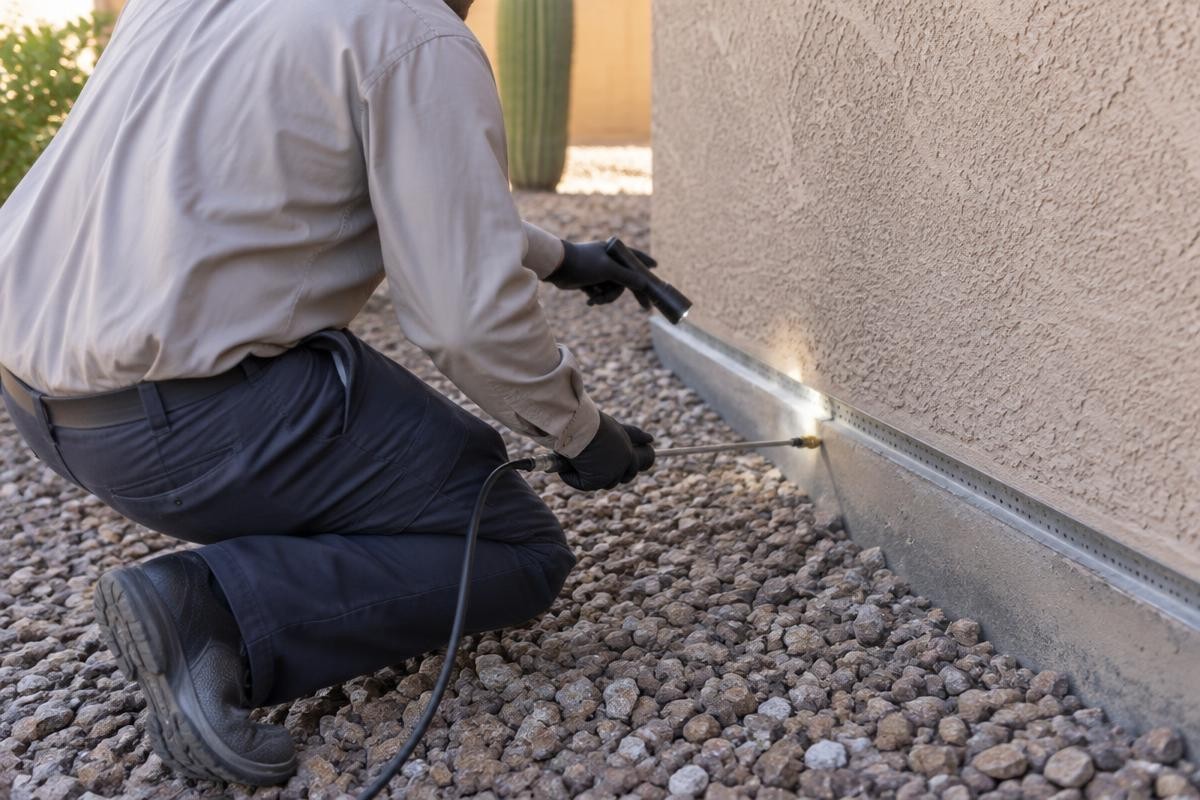
Product deals with what is on the property today. Sealing weep screeds, thresholds, roof vents and utility penetrations is what stops the next lot. Most repeat problems are unsealed buildings, not weak chemicals.
Flat pricing, agreed first
You get the number before work starts and it does not move on the day. If the scope genuinely changes once we are in the attic, we stop and ask.
Say when you do not need us
A single large roach from a dry drain does not need a treatment programme. We would rather tell you to run water down the trap than sell you a contract.
Open seven days
6am to 9pm, every day. Most Valley competitors run Monday to Saturday. Weekend and early-morning appointments are normal here, not a favour.
Written record
What was inspected, what was found, what was treated and what needs your action. For commercial sites that record is what an inspector asks to see.
How to check a Phoenix pest control company is licensed
In Arizona, structural pest control businesses and the individual applicators who work for them are licensed through the Office of Pest Management at the Arizona Department of Agriculture. It is not a voluntary badge or a trade-association logo — it is a state licence, and it is public.
Search the register
The department runs a public licence search at searchagriculture.az.gov, with separate lookups for business licences and individual applicator licences.
Or just call them
The Licensing Desk is on (602) 542-3578. They will confirm whether a business or an applicator is licensed and in good standing.
Ask for the number
Any legitimate company will give you its licence number without hesitating. Reluctance to hand it over is the answer to your question.
Check the person, not just the firm
The business holds a licence and so does the technician standing at your door. Both are searchable.
Ask us for our licence number when you call, and then check it against the state register rather than taking our word for it. We would far rather you did, and the same applies to whoever else you are getting a quote from — a company that hesitates when you ask for it has told you something useful.
What to look for when comparing quotes
Having seen a lot of properties that were treated badly before we arrived, these are the things that actually separate companies.
Did they inspect?
A quote given without walking the property tells you the plan is generic. For scorpions, termites and rodents that is close to useless.
Do they talk about sealing?
If the entire proposal is spraying, the problem is coming back. Ask specifically what exclusion work is included.
Is the price flat and written?
Estimates that become invoices are where the complaints come from. Get the number in writing before work starts.
Are follow-ups included or extra?
Rodent, bed bug and German cockroach work needs return visits. If those are not in the quote, the quote is not complete.
Do they explain the products?
You should be able to find out what is being applied, roughly where, and how long to stay off it. Vagueness there is a bad sign.
Do they overpromise?
Nobody can guarantee a desert property will never see another scorpion. A company that promises that is either inexperienced or not being straight with you.
Why we treat Phoenix differently
Most national pest control protocols are written for a temperate climate and applied here unchanged. That is why so many Valley homeowners feel like their service is not working.
Bark scorpions climb
They are not a ground-level pest, and they flatten through a gap about the width of a credit card. A perimeter spray on the soil misses them entirely.
Termites work under the slab
Desert subterranean termites reach the structure through slab cracks and expansion joints. It is a soil and perimeter job before it is anything else.
Most roaches here are outdoor species
American and Turkestan roaches live in drains, irrigation boxes and meter boxes and walk in. Treating them like an indoor German cockroach infestation wastes everyone’s money.
The season drives everything
Scorpions peak with the heat, mosquitoes follow the monsoon, roof rats move with the citrus. A fixed-script quarterly visit is always a step behind.
Where we work

We are based at 13832 N 32nd St, Suite D-141, Phoenix, AZ 85032 and cover the city of Phoenix and the surrounding Maricopa County communities — Scottsdale, Mesa, Tempe, Chandler, Gilbert, Glendale, Peoria, Surprise, Goodyear, Avondale, Paradise Valley, Queen Creek, Buckeye, Cave Creek and Anthem among them. The complete list of communities is set out on the service areas page.
We are a Phoenix-metro company and we stay inside Maricopa County. We do not claim to cover the whole state, because a technician driving two hours is a technician who is not doing the job properly when they arrive.
Who turns up, and what to expect
Letting a stranger walk your property is a reasonable thing to be careful about, so here is what a legitimate visit looks like — ours or anyone else's.
You should be told who is coming and roughly when, and the person who arrives should be able to identify themselves and name the licensed business they work for before they start. Ask. A technician who cannot produce that, or who becomes evasive about it, should not be treating your home. Products applied at your property are applied by someone licensed by the state to do it, and you are entitled to know that before the work rather than after.
The visit itself starts with a walk of the perimeter, and it is normal for that to take a while before anything is applied. You will be asked what you have seen and where. You should be shown what was found rather than told about it — if there are mud tubes on a footing or droppings behind the water heater, ask to see them. At the end you should have a written record of what was inspected, what was applied and where, and any re-entry time you need to observe.
What should not happen: pressure to sign on the spot, a price that changes once someone is already inside, an unnamed product, or a technician who will not put the scope in writing. None of those are how this trade is supposed to work, and they are the most common complaints people bring us from previous companies.
What we will tell you even when it costs us the job
Most pest control complaints are not about a treatment failing. They are about someone selling work that was never going to fix the problem. So there are a few things we say out loud, knowing what they cost us.
You may not need a plan
If a single treatment and some sealing will do it, we say so. Recurring service earns its money on properties with ongoing pressure — a desert edge, heavy irrigation, a commercial kitchen — and not on every house.
That is not our trade
Wildlife trapping, structural repair, roof work, landscaping, plumbing and drain repair, and mould are all real fixes for problems that arrive looking like pest problems. We will name the trade you actually need.
Nobody can promise zero
Anyone guaranteeing you will never see another scorpion is selling something that does not exist. What is achievable is a large, sustained reduction and a property that stops being easy to get into.
The fix is not chemical
Very often the thing that ends the problem is a door sweep, a repaired valve, a trimmed branch or a cup of water down a dry drain. We would rather tell you that than sell you a quarterly visit around it.
If a treatment does not work
Sometimes it does not, and how a company behaves at that point is the only part of this that really matters.
The first thing we do is come back and look rather than reapply. A treatment that has not worked is information: either the identification was wrong, or there is a source we did not find, or something is undoing the work between visits — a neighbouring property, a leak, a route we missed. Repeating the same application without answering that question just spends your money again.
So the return visit starts with the report from last time and works through what changed. If we got the identification wrong, we say so and re-treat correctly. If the source turns out to be outside your property or in a trade that is not ours, we will tell you that plainly, even though it is not the answer anyone wants.
Tell us early rather than at the end of a season. Two weeks of an unresolved problem is a straightforward return visit; four months of it is a re-established population, and that costs everyone more.
What an Arizona licence does and does not tell you
It is worth understanding what you are actually confirming when you check a licence, because it answers some questions and not others.
Arizona regulates structural pest control through the Arizona Department of Agriculture, and there are two separate things to look for. The business holds a licence to operate. The individual who applies product holds their own certification, in the categories they are qualified for — general pest, termite and wood-destroying organisms, and weeds and vegetation are treated as different competencies, which is why a company may be perfectly legitimate and still not be the right one to issue you a termite report.
Checking both matters. A licensed business can send an uncertified person, and an experienced individual can be working for a business whose licence has lapsed. Only a licensed business can legally issue a WDIIR for a property sale, which is the point at which most people discover this distinction the hard way.
What a licence does not tell you is whether the work is any good. It is a floor, not a recommendation: it confirms the training and examination were done, the required insurance is in place, and there is a regulator who can act if something goes wrong. It says nothing about whether anyone will show up on time or diagnose your problem correctly. Use it to rule companies out, then judge the rest on whether they inspect before quoting and put the scope in writing. What that looks like in practice is set out on the services page, and you can check what you have found against the identification guide first.
It also gives you somewhere to go. If a treatment goes wrong — product misapplied, damage, a report you believe is false — the Office of Pest Management takes complaints and can investigate the licence. Keep your service reports; they are the evidence any complaint would rest on, and they are the same records that are useful in escrow years later.
Questions about us
Are you licensed?
Yes. Structural pest control businesses and applicators in Arizona are licensed through the Office of Pest Management at the Arizona Department of Agriculture. You can verify any company, including us, through the department’s public licence search or by calling the Licensing Desk on (602) 542-3578.
What areas do you cover?
Phoenix and the surrounding Maricopa County communities, roughly within forty minutes of our base. The complete list is on our service areas page, and if you are near the edge of it we will tell you rather than quoting a long drive into the price.
What are your hours?
6am to 9pm, seven days a week, including weekends. Scorpion inspections run after dark, so those are booked in the evening.
Do you work with businesses?
Yes. Restaurants, warehouses, offices, rentals and multi-family buildings, on scheduled programmes with a written report after every visit. See commercial pest control.
What products do you use?
EPA-registered materials chosen for the pest and the setting, applied to targeted zones rather than broadcast across living space. Your technician will tell you what is being used, where, and when each area is clear — and can provide safety data sheets on request.
Do you guarantee your work?
Recurring programmes include return visits between scheduled services at no extra charge if a problem comes back, and the exact terms are put in writing before any work starts rather than being left to memory. What we will not do is promise a desert property will never see another pest, because that is not a promise anyone can keep.
How do I get a quote?
Use the form on this page, or call us. Tell us what you are seeing and where on the property, and we will tell you what it likely is and what an inspection involves.
Want to check us out first?
Look us up on the Arizona Department of Agriculture licence search, then call and ask us anything. We would rather answer questions than chase a signature.