Pests commonly found in Phoenix, Arizona
Desert pests move with the heat. Here is what shows up in Valley homes, when it peaks, and the treatment that actually ends it.
Get a free quote
No obligation. We reply within 2 hours.
Pest identification guide
Two things narrow an identification faster than any field mark: where you found it, and what month it is. The desert runs on three seasons rather than four, and each one pushes a different set of pests towards the house.
Spring, from about March, is when the ground warms and everything that spent winter deep comes back up. Scorpions resume hunting after dark, the first paper wasp queens start eave nests that will be full colonies by midsummer, and ants begin foraging in the open again.
The monsoon, from late June into September, is the loudest part of the year. Rain floods the shallow soil and drives ground-dwelling insects up and out, which is why a porch in August collects things nobody sees the rest of the year. Water standing in a saucer or a low spot becomes habitat within days, and the humidity lets indoor populations grow faster than they otherwise would.
From late October the pressure reverses and the movement is inwards: rodents into attics and garages, cockroaches towards whatever is warm and damp, spiders into sheds and stored boxes. So the same find means different things in different months. A large insect on the patio after a July storm is ordinary. The same insect indoors in January is telling you there is a way in.
Bark Scorpions
Nighttime stinger
Subterranean Termites
Structural threat
Roof Rats
Attic and citrus trees
German Roaches
Kitchen invader
Black Widows
Block walls and garages
Fire Ants
Mound treatment
Paper Wasps
Eave nesting
Bed Bugs
Travel-borne
Crickets
Scorpion food source
Mosquitoes
Monsoon season
Pigeons & Birds
Solar panel nesting
Silverfish
Bathrooms and boxes
Scorpions
Every scorpion in Arizona glows blue-green under ultraviolet light, which is how a night inspection works, but only one of them is a real medical concern.
Where you find one matters more than that you found one. A scorpion in the yard at night is ordinary, because the desert is full of them. A scorpion indoors means there is a route in, and routes in are physical problems rather than chemical ones.
They do not need a hole. A bark scorpion climbs, and it passes through gaps most people would never think to seal: the weep screed along the base of a stucco wall, a garage door seal that has hardened and lifted at the corners, the point where a patio roof meets the fascia, block wall weep holes, gaps around pipe and conduit penetrations, and the underside of a poorly fitting exterior door. Because this is the one that climbs, a roofline gap or an upstairs window is as usable an entrance as a doorstep.
Outside, they shelter under anything flat that sits on the ground and stays cool: pavers, flagstone, stacked timber or brick, pool equipment, bags of soil, decorative rock. Block walls are close to ideal, because the cavities hold cool air and moisture and connect one yard to the next.
Count rather than react. One sighting in July tells you very little on its own. Several found along the same wall on the same night tells you a population is living in the yard, and that indoor sightings will keep arriving until the yard and the perimeter change. That is why most of the useful work on a scorpion problem happens outdoors and is physical: sealing, weatherstripping, clearing harbourage and reducing what they are hunting, with treatment supporting that rather than replacing it.
The practical distinction is body shape. A bark scorpion looks slender and delicate; the two harmless ones look heavier and more robust. Size will not separate them either, and a small or pale one raises a different question — see baby scorpions in Arizona. If you are unsure, photograph it and ask — and for anything to do with a sting, Poison Control on 1-800-222-1222 is free and staffed around the clock. More on scorpion control.
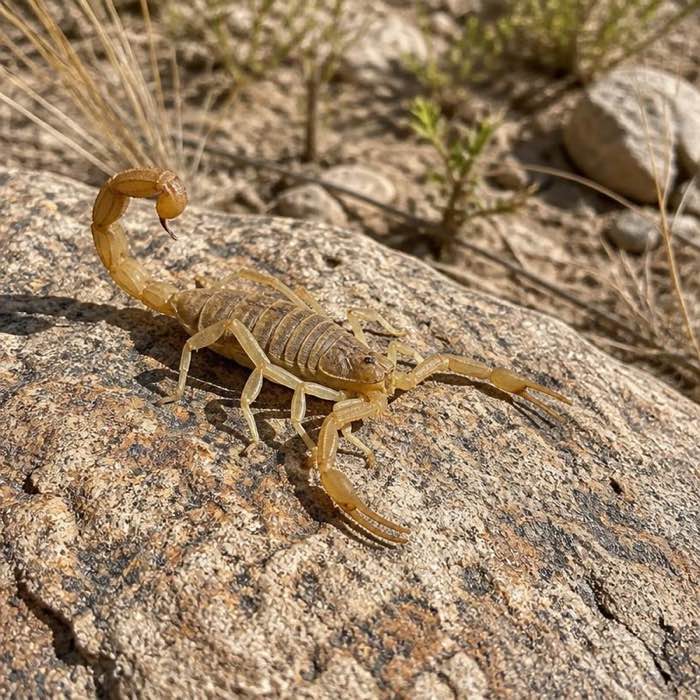
Arizona bark scorpion
Two to three inches, light tan to yellowish, with slender pincers and a thin tail held curled to one side. The only one in Arizona whose sting is medically significant, and the only one that climbs.
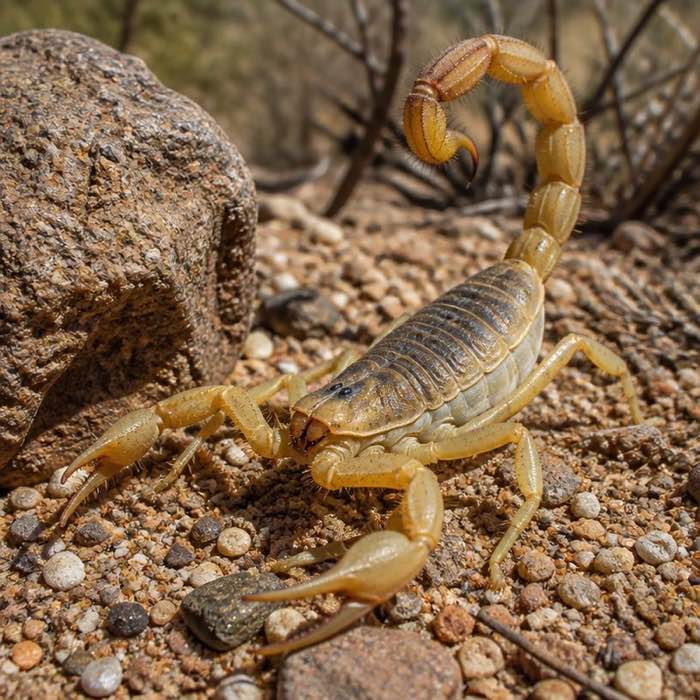
Desert hairy scorpion
The biggest scorpion in the United States, up to five or six inches, yellowish with a dark back and noticeably thick pincers. The sting is comparable to a bee sting for most people.
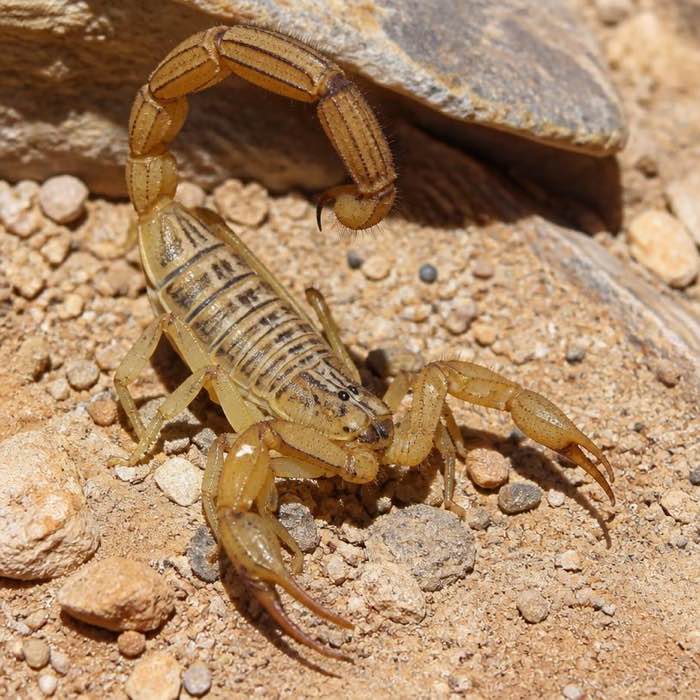
Stripedtail scorpion
Around two and a half inches, tan with distinct dark stripes along the tail segments and stouter pincers than a bark scorpion. Extremely common in Valley yards. The sting is painful but not dangerous.
Termites
Phoenix has two that matter, and they are reached in completely different ways. Telling them apart from the evidence is usually straightforward.
Neither species announces itself, and by the time damage is obvious it has usually been running a while. Desert subterranean termites eat from the inside out and leave the surface of the timber intact, so the first sign is rarely a hole. It is a mud tube on a footing or a pier, paint that looks faintly blistered or rippled, a skirting board that gives when you press it, or a door frame that sounds wrong when tapped. Sound timber rings; hollowed timber thuds.
A swarm is the most alarming sign and one of the least informative. Swarmers are the colony reproducing, not the colony feeding, and a swarm outside in the yard after a storm is a normal desert event. A swarm emerging inside the house is a different matter, because it means a colony has already reached the structure.
The two are reached from opposite directions, which is why identifying which one you have is not academic. Subterranean termites live in the soil and have to return to it, so they are dealt with through the ground and the foundation, and a treated perimeter is what stands between the colony and the timber. Drywood termites have no soil contact at all, so ground work does nothing for them and the treatment has to go into the wood itself. A misread here does not slow the job down, it means the job does not work.
More on termite control and WDIIR inspections. Termites get their own page because seventeen species live in this state and only three matter — which ones, and how to tell them apart.
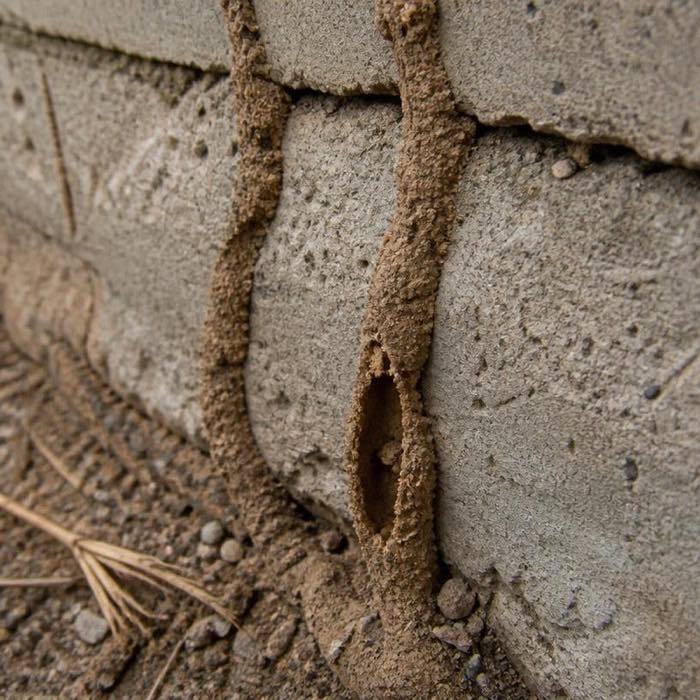
Desert subterranean termite
The one behind most Phoenix structural damage. It lives in the soil and cannot survive exposed, so it builds pencil-width mud tubes up footings and piers to reach timber. Evidence: mud tubes, and timber that sounds hollow when tapped.
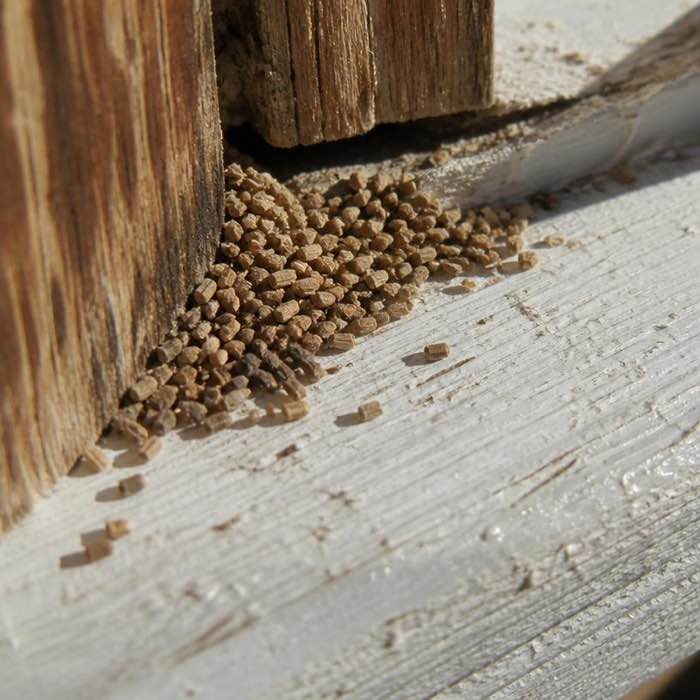
Western drywood termite
Lives entirely inside the wood with no soil contact, so there are no mud tubes. Its sign is frass — hard six-sided pellets the colour of the timber, kicked out of small holes into neat piles on a sill.
Rodents
A rodent problem is a building problem before it is a pest problem, and the order matters: find the way in, close it, then deal with what is already inside. Trapping on its own empties an attic for a few weeks and then it refills.
The route is usually above head height. Roof rats climb, and Phoenix gives them ladders: mature trees touching the roof, palm skirts, oleander hedges, bougainvillea trained up a wall, and the pipes and conduits that run up the outside of a house. From the roof they take whatever is open, which is normally a lifted tile edge, an unscreened vent, a gap where the fascia meets the roof deck, or the chase around a plumbing stack. Mice come in lower, through the garage, weep holes and the gaps under doors.
What you hear narrows it before anyone goes into the attic. Scratching and running overhead after dark points upstairs. Noise inside walls at floor level or behind kitchen units points to mice. Movement that stops the instant you make a noise and starts again a minute later is a live animal rather than timber settling.
Outside, the attractants are usually obvious once they are pointed out: fallen citrus left on the ground, dog or bird food stored open in the garage, an uncovered compost heap, a leaking drip line or a pet water bowl, and dense ground cover that lets them travel without crossing open ground. Clearing those will not end an established infestation on its own, but leaving them guarantees the next one.
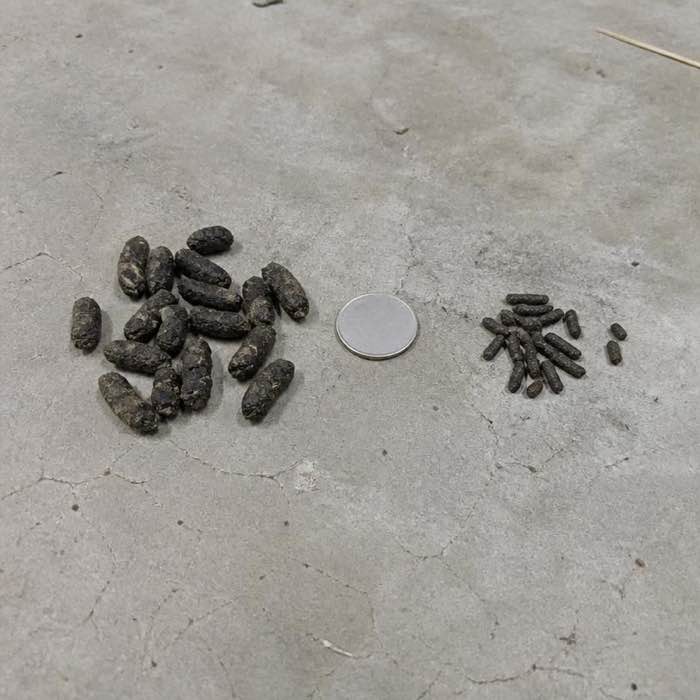
Rodent droppings should never be dry-swept or vacuumed with a household machine. More on rodent control. Before you buy anything to deal with them, it is worth reading what rat poison actually does and where the animal tends to die afterwards.
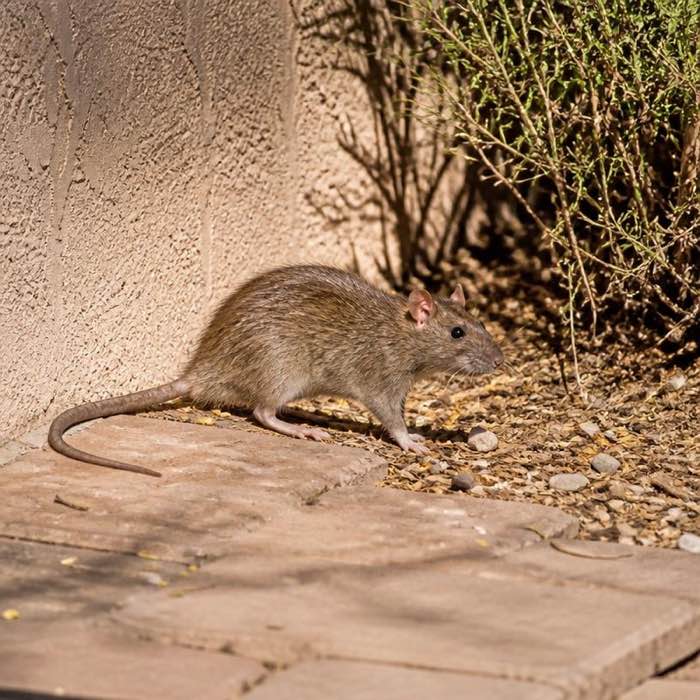
Roof rat
Body six to eight inches with a tail longer than the body, slender, dark, an excellent climber. Concentrated in the older irrigated neighbourhoods with mature citrus. Droppings are around half an inch with pointed ends.
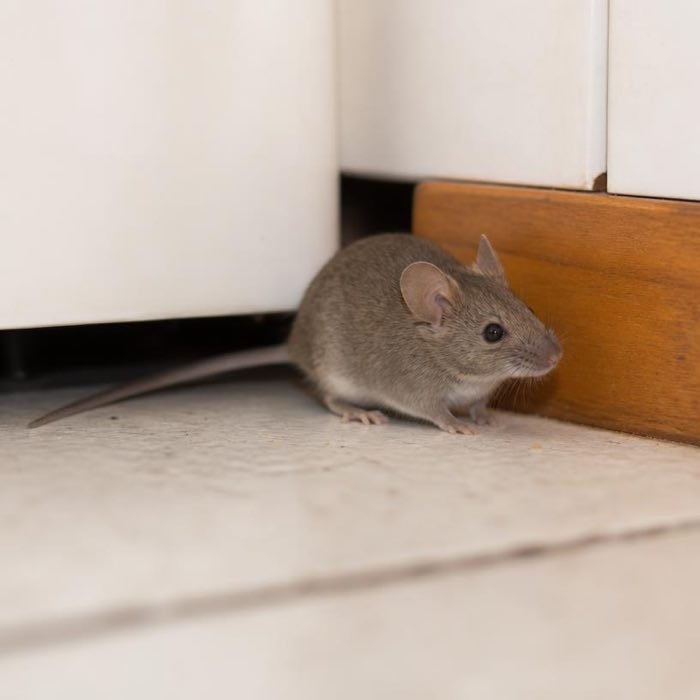
House mouse
Body around three inches, greyish-brown, gets through a gap the width of a pencil. Stays lower in the structure — pantries, under appliances, the garage. Droppings are the size of a grain of rice.
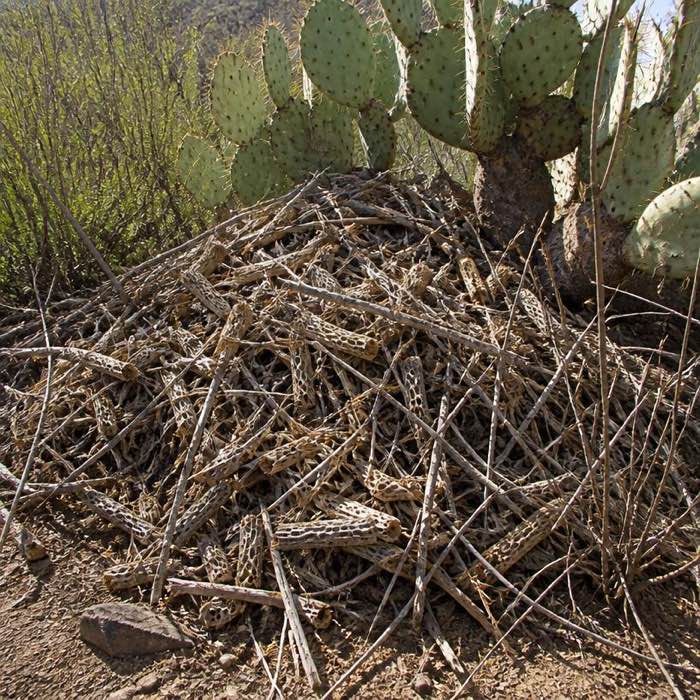
White-throated woodrat
The pack rat. Builds large untidy stick middens under sheds, around pool equipment and in dense prickly pear, and collects shiny objects. The damage people notice is chewed vehicle wiring. Its nests are also where kissing bugs live.
Cockroaches
This is the identification that changes the treatment most, because three of the four common Valley species live outdoors and walk in, and only one is a true indoor infestation.
The outdoor species are not really coming from outside so much as from the parts of the plot nobody looks at. Irrigation valve boxes, sewer and drain lines, water meter boxes, the void inside a block wall, the space under pool decking and the gap behind an outdoor kitchen all hold the damp and the dark they want. From there the way in is short: a dry floor waste, the shower trap in a spare bathroom nobody uses, a gap around a pipe under a sink, or simply the underside of a door on a warm night.
That is why one large cockroach in a bathroom usually points at plumbing rather than housekeeping. Running water into an unused drain for a few seconds refills the trap and closes that route, and it costs nothing to try before anyone is called out.
A small striped one in a kitchen carries a different rule with it: do not reach for an aerosol. Contact sprays kill what they land on and drive the rest deeper into voids and appliance housings, which spreads the population and makes everything after that harder. Baiting works with the behaviour instead of against it. The same warning applies to shop-bought foggers, which are the most reliable way to turn a problem contained under one counter into a whole-kitchen one.
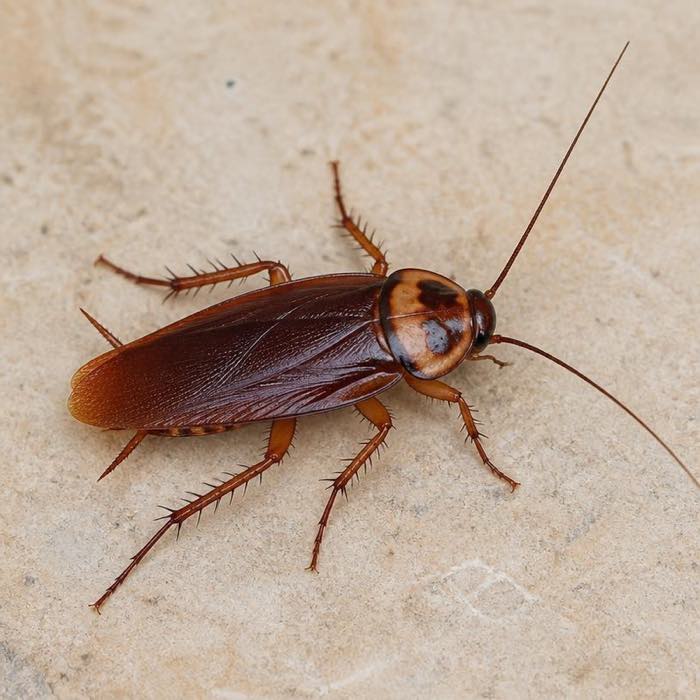
American cockroach
The big one — often over an inch and a half, reddish-brown, with a yellowish figure-of-eight marking behind the head. Lives in sewers, storm drains and meter boxes, and comes up through dry P-traps.
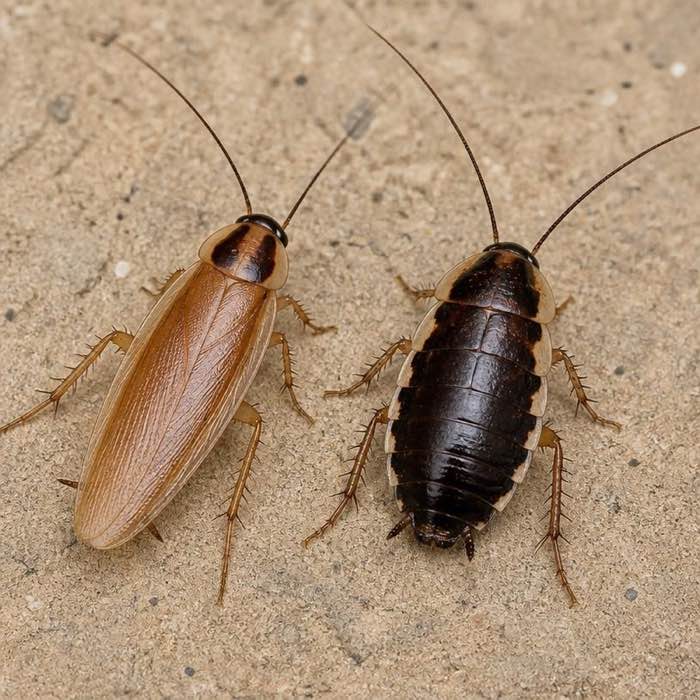
Turkestan cockroach
Males are reddish-tan with pale wing edges and fly to porch lights, peaking in early summer; females are darker and stouter with cream markings. Lives in irrigation boxes, water meter boxes and leaf litter.
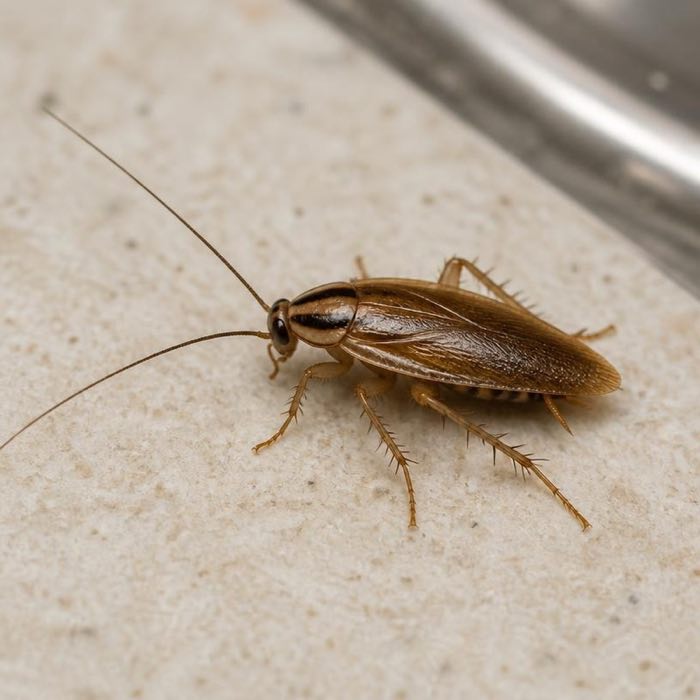
German cockroach
Small, around half an inch, tan, with two dark parallel stripes running back from the head. The one that genuinely breeds indoors, in kitchens and bathrooms, and multiplies fast — how fast, and why it matters for allergies, is worked through separately.
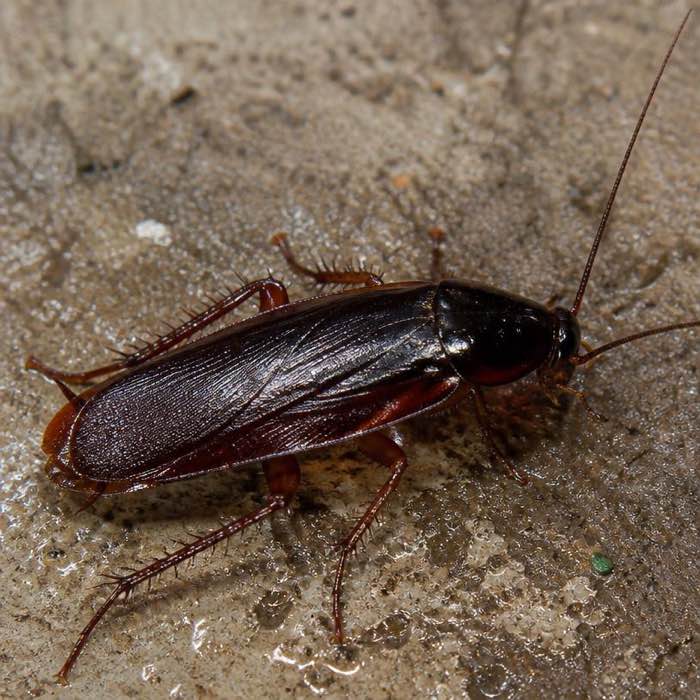
Oriental cockroach
Dark, glossy, slower-moving and fond of damp. Less common here than the other three, but shows up around drains, crawl spaces and damp storage.
Spiders
Most spiders in a Phoenix house are harmless and are eating the insects you would rather not have. Two are worth knowing on sight, and one widespread belief is simply wrong.
The web tells you more than the spider does, and you will usually meet the web first. A widow web is not the neat wheel people picture. It is an untidy, three-dimensional tangle, noticeably strong, and it is almost always low down and somewhere that never gets brushed against: block wall weep holes, water meter and irrigation boxes, the underside of patio furniture and barbecue lids, the back corners of a garage, stacked pots, the space behind a bin. Clearing those sites properly, sacs included, is what spider control is mostly made of.
If you find the web but not the occupant, look for egg sacs, which are pale papery spheres suspended in the tangle. A web cleared with the sacs left behind is not a cleared problem.
Almost everything else in this group is doing you a favour. Crab spiders and wolf spiders hunt rather than trap, which is why you meet them walking across a wall or a floor instead of sitting in a web, and why they appear indoors on summer nights. Removing them one at a time achieves very little. What actually reduces spiders is reducing the insects they are eating and the clutter they shelter in, particularly anything stacked against an exterior wall.
A wolf spider is the one people most often get wrong. Two of its eight eyes are large and forward-facing and throw back a green shine in torchlight, which settles it in a second after dark. A female carries her egg sac attached behind her and later carries the spiderlings on her back, which is what makes a big one look so alarming. It is not a tarantula and it is not a recluse. If you need to settle which species you are actually looking at, our guide to spiders in Arizona covers identification down to the eye pattern.
The practical response to any of them is the same, and it is not spraying. Clear stored items off garage floors, keep firewood and boxes away from walls, shake out shoes and gloves that have been left outside, and wear gloves when you move anything that has sat undisturbed.
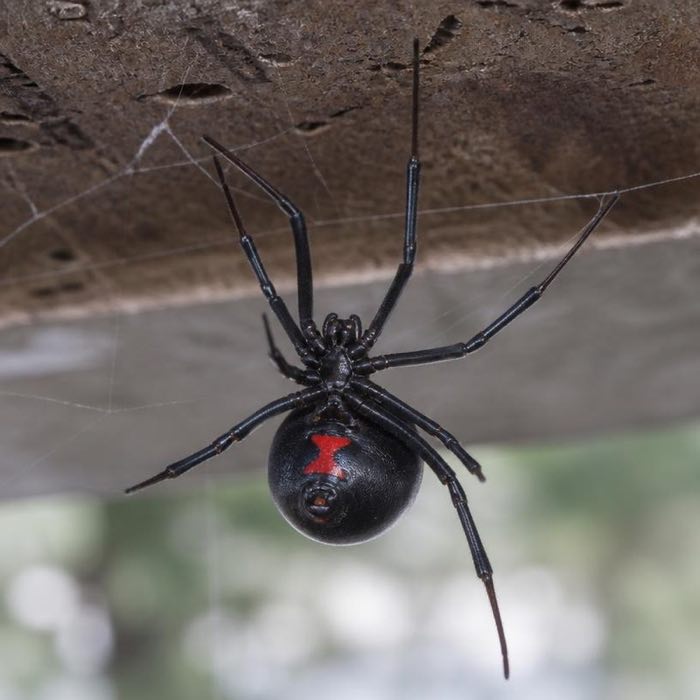
Western black widow
Glossy black, round-bodied, with a red hourglass on the underside of the abdomen. Builds a messy, irregular, strong web low down — block wall cavities, under garden furniture, meter boxes. Medically significant.
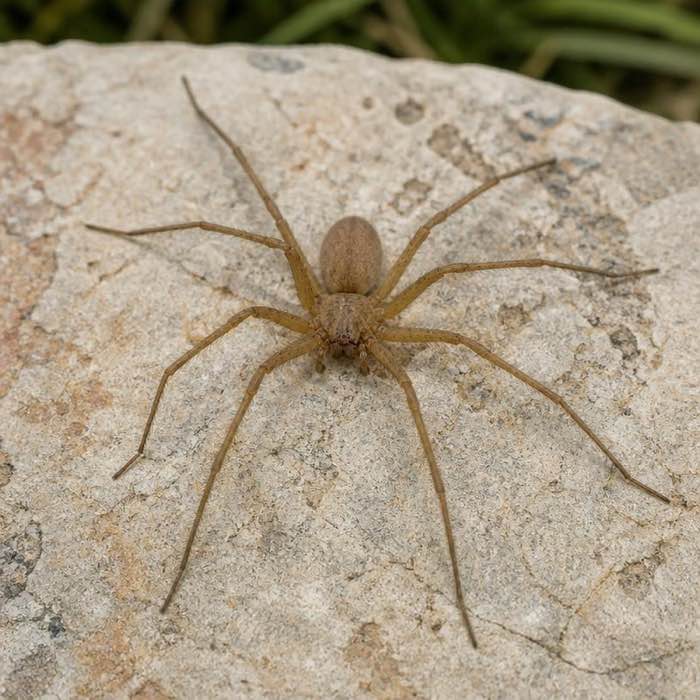
Arizona brown spider
Small, uniformly light brown, long-legged, with a faint violin shape behind the head. Native to Arizona and reclusive, found in undisturbed storage and outbuildings. Bites are rare because it avoids people.
Giant crab spider
Large, flat, fast, pale brown, and startling when it moves across a wall at night. Harmless, and one of the better things to have around: it hunts cockroaches. Sometimes called a huntsman.
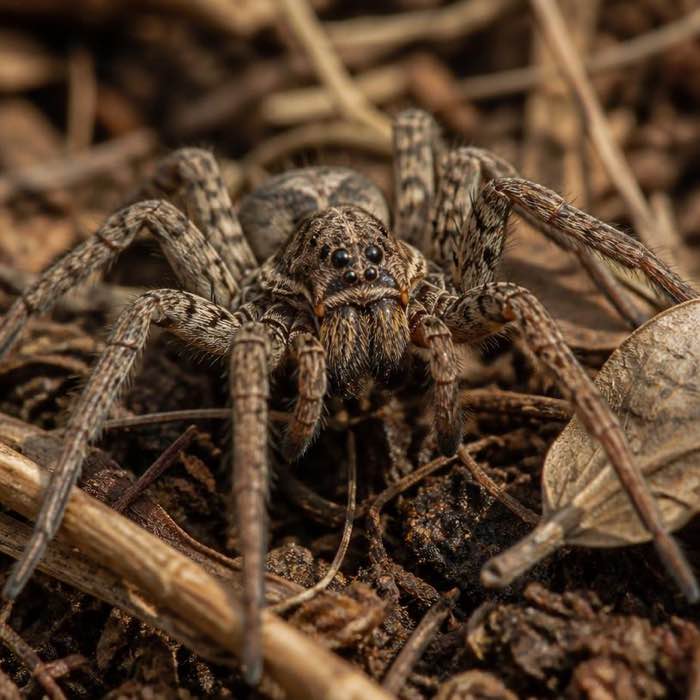
Wolf spider
Large, hairy, grey-brown and fast, and the one most often mistaken for something worse. It builds no web but hunts on the ground. A bite is painful and not medically significant.
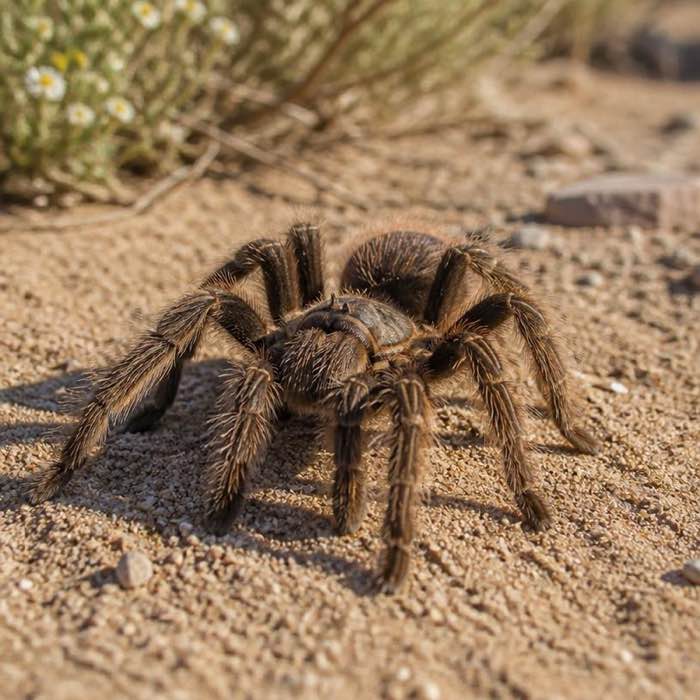
Desert tarantula
Big, hairy, slow and docile. Males wander in late summer looking for mates and end up in garages and pool areas. Not dangerous, and does not need killing.
Ants, bees and wasps
These three sit together because they are the ones that sting, and it is the nest rather than the insect that decides what happens next.
With ants, the nest is the identification. A southern fire ant nest is a loose crater in soil, often at a lawn edge or beside a path, and the response to disturbance is immediate and collective, so the stings arrive in numbers rather than one at a time. A harvester ant nest is unmistakable in a different way: a wide, deliberately cleared circle of bare gravel around a single entrance, usually out in the open and away from the building. Harvester ants are not aggressive and rarely come indoors, but one sting is genuinely painful and it lasts.
Bees are the case where identification stops mattering and location takes over. Feral colonies in Arizona should be treated as colonies that will defend the nest vigorously, and established comb inside a wall void, a water meter box, a shed or a chimney is not a do-it-yourself job. A swarm resting in a tree and comb built into a structure are two different situations handled two different ways, but neither of them is a case for a hose, a spray can or smoke. Bee removal sets out what each of them involves.
Paper wasps are the common eave nest in the Valley: an open, downward-facing comb on a short stalk, under a patio roof, a soffit, a shade sail fixing or the top of a door frame. They are defensive within a short distance of the nest and largely indifferent beyond it. A nest started in spring is small and straightforward. The same nest in August is a colony, and that is a different conversation.
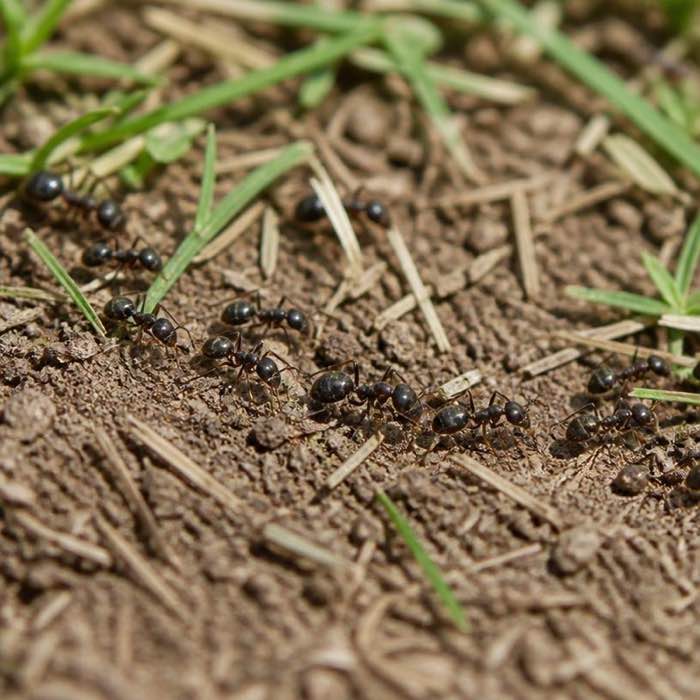
Common yard ants
Pavement and pyramid ants trailing across patios and into kitchens. A nuisance rather than a hazard, and a baiting job — spraying the trail kills the workers you can see and leaves the nest producing more. See ant control for how that is treated.
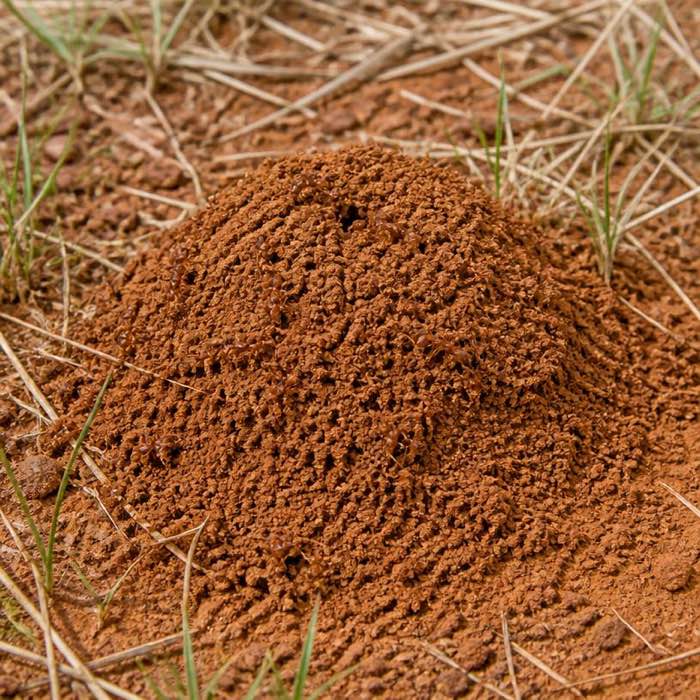
Southern fire ant
Native, reddish, and it stings. Mounds in irrigated lawns and along damp edges. Worth dealing with properly if children or pets use the yard.
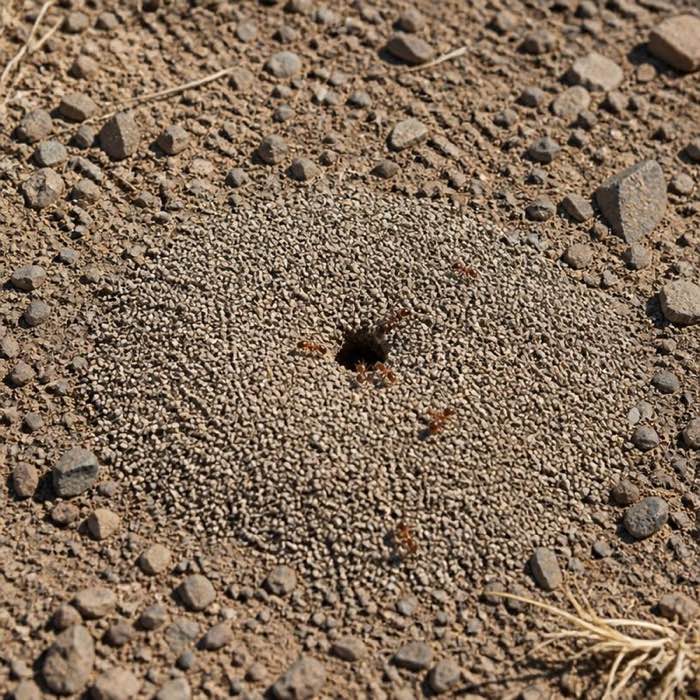
Harvester ant
Large, red, and the most painful sting of any ant here. Easy to identify by the nest: a bare cleared disc of ground, often a foot or more across, with a central hole and seed husks around it.
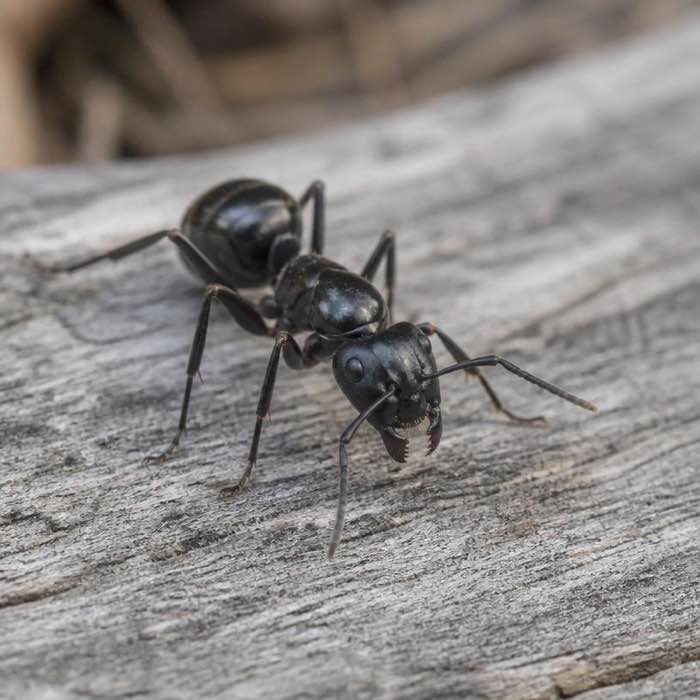
Carpenter ant
Large and black. Nests in wood but does not eat it — it hollows out galleries, usually in timber that is already damp. Finding them often means finding a leak.
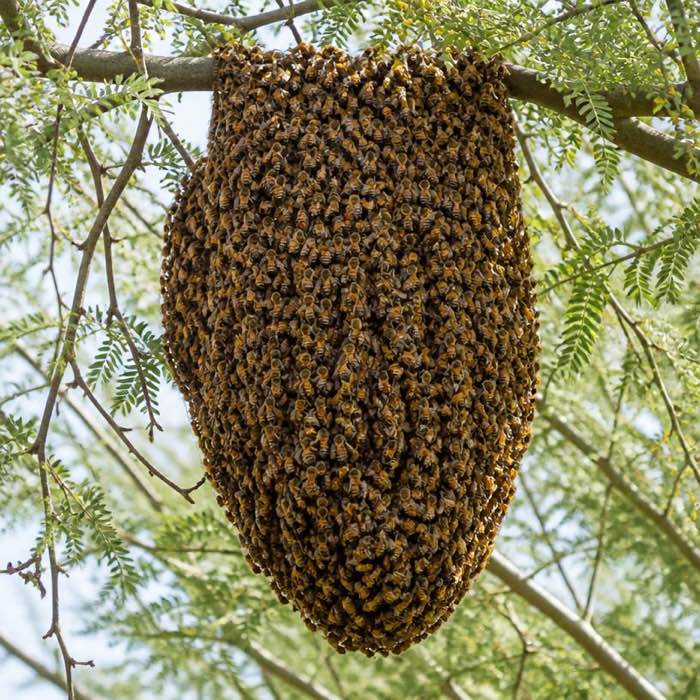
Honey bees
Colonies in the Valley are generally Africanised. That does not make the venom stronger, but it makes the colony much more defensive and likely to respond in numbers — the published figures behind that difference are worth a look. Comb in a wall or meter box is specialist removal work.
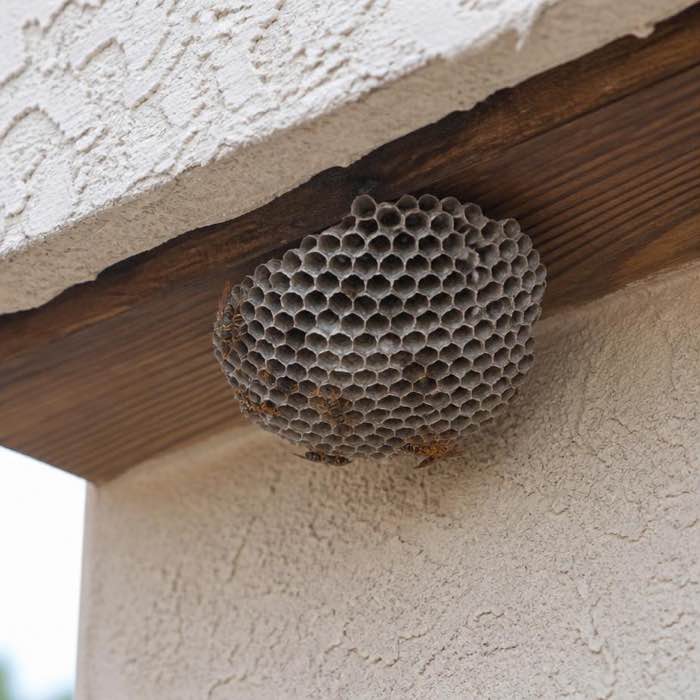
Paper wasps
Open, umbrella-shaped nests under eaves, in patio corners and inside grills. Defensive close to the nest. Small, accessible nests are manageable; anything large or awkwardly placed is worth handing over.
The ones that bite you
Bites are the least reliable evidence on this page. Reactions to the same insect vary enormously between people in the same house, some people show nothing at all, and several unrelated things produce marks that look alike. Treat bites as a reason to go looking for physical evidence, not as the identification itself.
Where and when does narrow it. Bed bug bites appear on skin left uncovered in bed and are noticed on waking, and what confirms it is not on you but on the bed: dark specks along a mattress seam or piping, in the seam of a headboard, or on the underside of a slat. There is more on verifying and treating them on the bed bug control page. Mosquito bites happen while you are awake, outdoors or near an open door, and the Valley runs two patterns, the container breeders that bite low on ankles and legs in daylight and the ones that come at dusk and after dark. Kissing bugs feed at night and are drawn to lights, and they are tied to pack rat middens, so a yard with stick middens under a shed or around pool equipment already contains the explanation. With mosquitoes the useful detail is that the daytime biters do not travel far, so being bitten in your own yard in daylight means the water is almost certainly on your own property, and mosquito control starts with finding it.
For any bite that is spreading, unusually painful or making someone unwell, the right call is a doctor rather than a pest control company. Our part is finding and removing the source. What bit you becomes a medical question the moment it stops being an identification one. Bed bugs are the one group here where the biology does most of the explaining, and our guide to the bed bug life cycle sets out why they are so hard to shift. And if it is mosquitoes, the question is usually what to buy rather than what it is — our guide to mosquito repellents that actually work sorts the useful products from the rest.
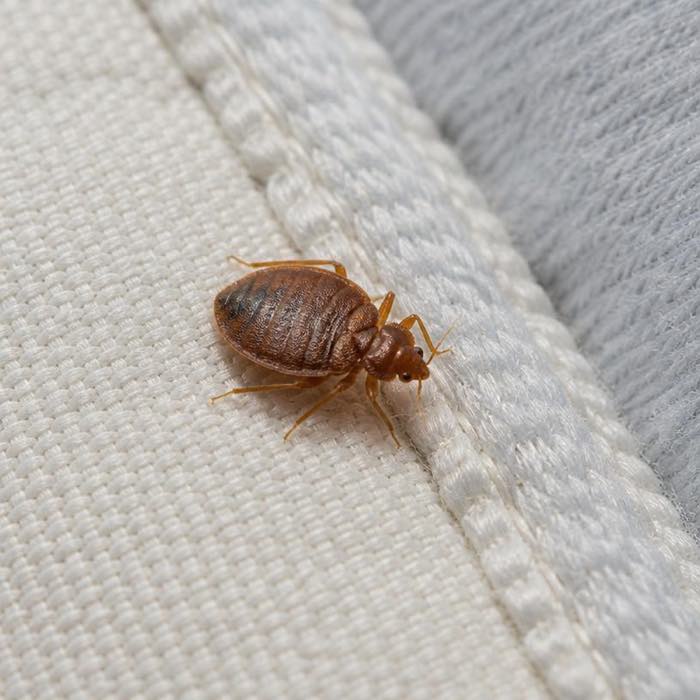
Bed bug
Adults about the size and shape of an apple seed, flat, reddish-brown and wingless. The evidence usually shows before the insect does: dark spotting along mattress piping and shed skins in the seams.
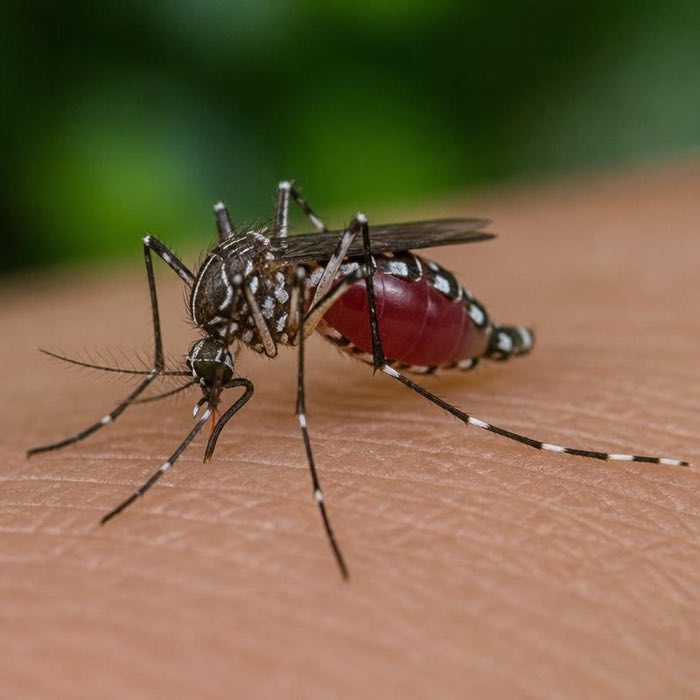
Aedes mosquito
Bites during the day, small and dark with white markings on the legs and body. Breeds in tiny containers — a pot saucer, a bottle cap of water — and does not travel far.
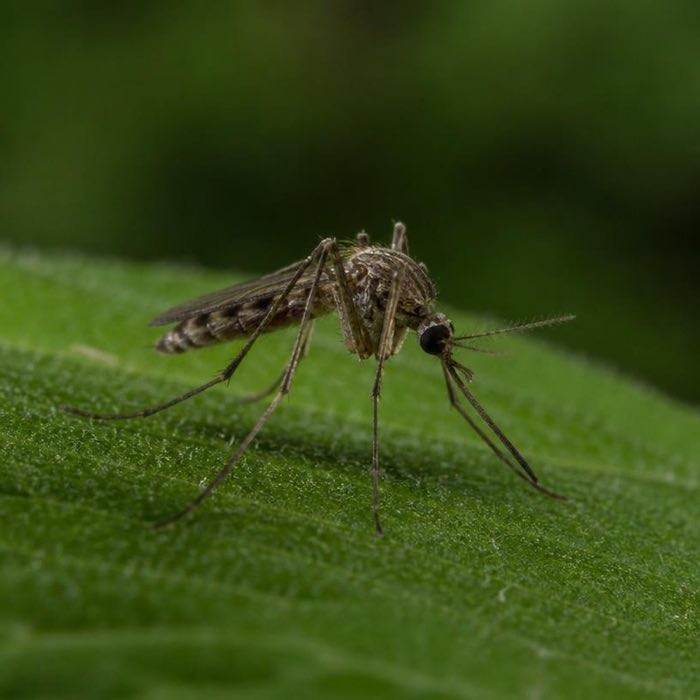
Culex mosquito
Bites from dusk to dawn, plain brown, and breeds in larger stagnant water — a green pool, a neglected fountain, a retention basin. The West Nile virus vector in Maricopa County.
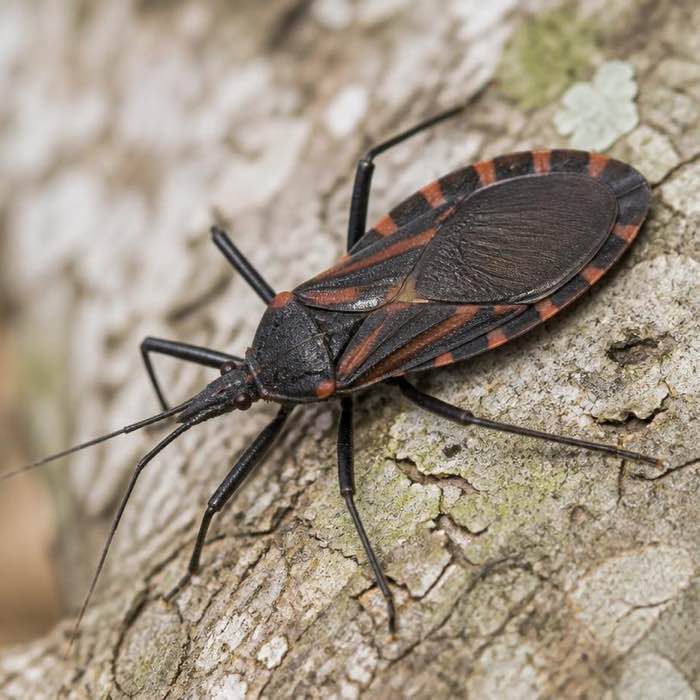
Kissing bug
A conenose bug, dark, with orange or red markings around the flattened edge of the abdomen. Feeds at night on sleeping people and animals, and lives in pack rat nests. Bites can cause serious allergic reactions.
The nuisance ones
These rarely need a dedicated treatment. They matter mostly as a signal — each one is telling you something about moisture or harbourage.
None of these needs a chemical answer on its own, which is why they are grouped. Each one is a reading on the building rather than a pest problem in its own right.
Silverfish mean humidity together with paper or starch: a bathroom that does not vent properly, a cupboard on an exterior wall, cardboard stored flat on a garage floor. Earwigs and pillbugs mean damp organic material in contact with the structure, usually mulch banked against stucco, leaf litter in a window well, or a drip line running along the foundation. Springtails mean water, normally a leak or an over-irrigated bed, and they turn up in numbers suddenly rather than gradually. They are also the commonest thing behind a search for white mites, which is usually neither white nor a mite.
Fix the moisture and the harbourage and this whole group thins out on its own, which is the honest answer even though it is not a treatment.
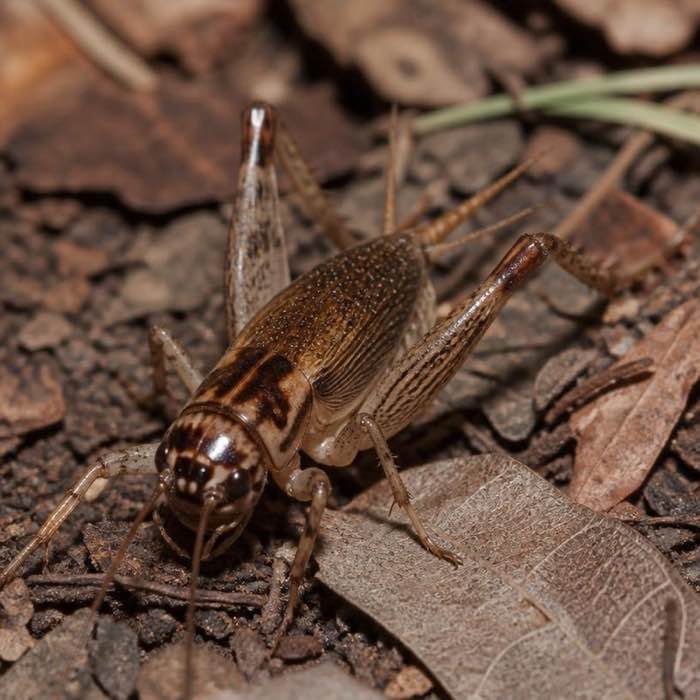
Crickets
Not a problem in themselves, but they are the main food supply for scorpions. A property with a heavy cricket population at night, usually around outside lighting and irrigated planting, is feeding its own scorpion problem. If one has got inside and is keeping you awake, finding it is a different exercise, and our cricket control page walks through it.
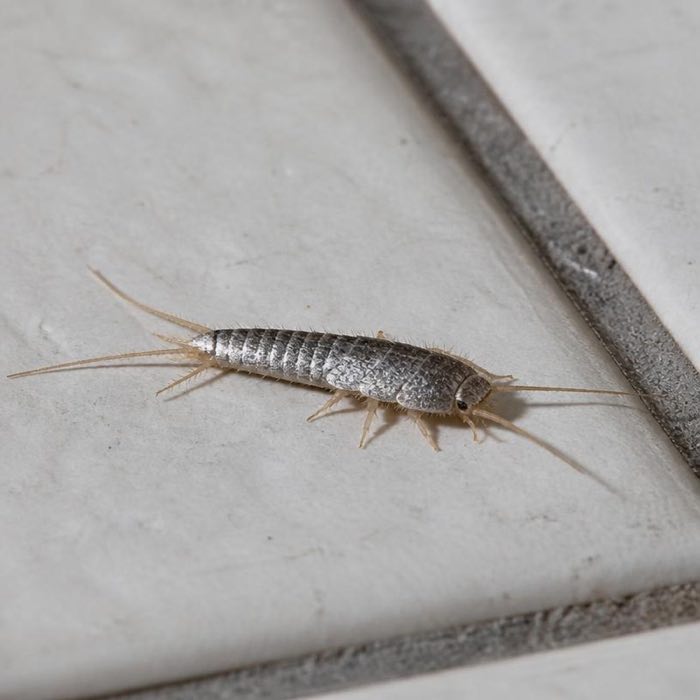
Silverfish
Teardrop-shaped, silvery, fast, with three tail filaments. They need humidity, so finding them indoors in Phoenix usually points at a bathroom that does not ventilate, a leak, or damp cardboard in storage.
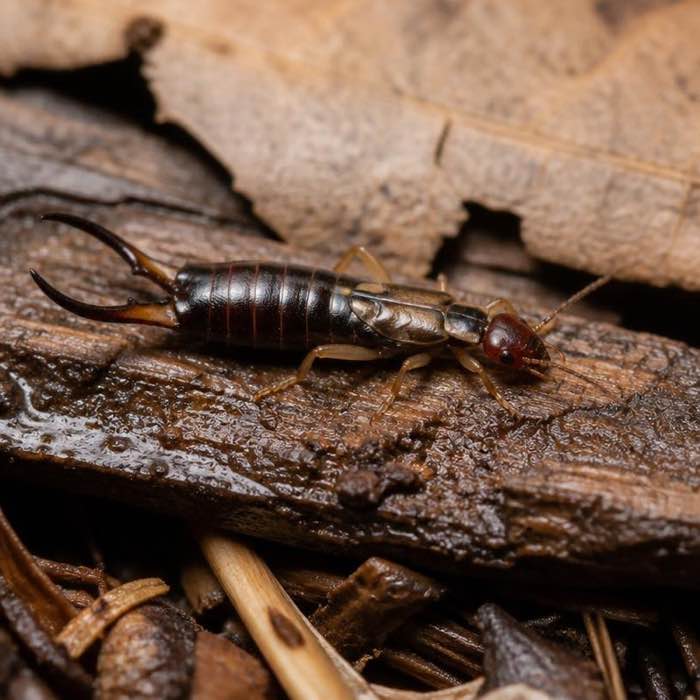
Earwigs
The pincers are for other earwigs, not for you. They live in damp mulch, under pots and in irrigation boxes, and come in when the outside dries out. A moisture and harbourage issue.
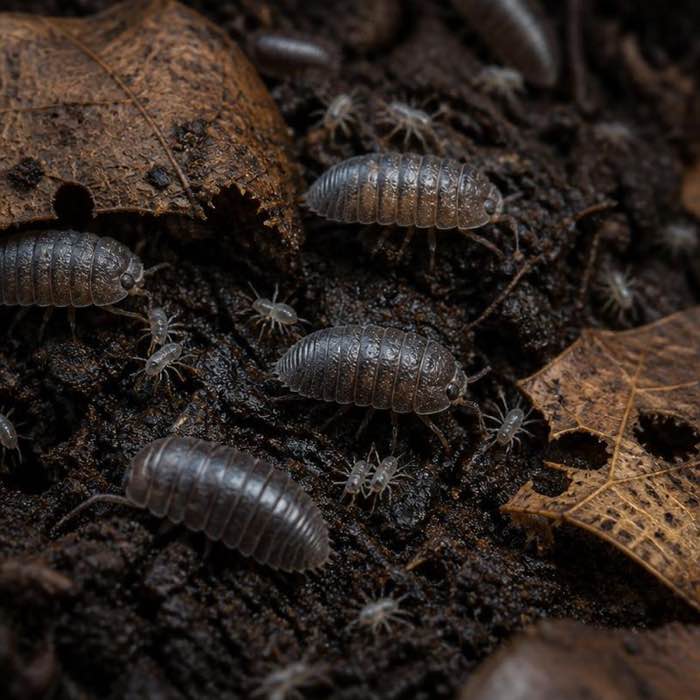
Pillbugs and springtails
Both need constant damp. Indoors they mean water — over-irrigation against the wall, a leaking valve, or grade that pushes moisture towards the slab. Fix the water and they leave on their own.
The big ones that look dangerous and are not
These are the finds that produce a 2am phone call, and almost none of them deserve one. They are the largest invertebrates most Phoenix households will ever meet, they turn up suddenly after summer rain, and every one of them is harmless to people. Knowing them on sight saves a lot of alarm.
There is a pattern in this group worth remembering. In the Sonoran Desert, size is a poor guide to danger. The three-inch beetle is harmless and the two-inch scorpion is the one to take seriously.
Three of these are worth a little more detail, because they are the ones people search for by name and struggle to find.
The Jerusalem cricket answers to at least four names — child of the earth, potato bug, Jerusalem beetle — which is most of the reason it is so hard to look up. It is not a cricket and has nothing to do with Jerusalem. It lives underground eating roots, tubers and other insects, and surfaces when rain or irrigation softens the soil, or when someone turns a bed over. It drums its abdomen on the ground to find a mate, which is why people sometimes hear a faint tapping at night. It can pinch hard with its jaws if you pick it up, so do not, but that is the whole story. We have written it up properly in Jerusalem crickets in Arizona, including why nobody can agree where the name came from.
The palo verde beetle spends the interesting part of its life out of sight. The adult barely eats and lives only a few weeks, and its entire job is to mate. The grubs spend two to four years feeding on the roots of palo verde, olive, rose and other stressed trees, so a heavy emergence in your garden is telling you something about a tree rather than about your house.
The pinacate beetle’s headstand is a bluff worth knowing: the spray is foul and can sting the eyes, and that is the limit of it. Both it and the palo verde beetle sit in a wider group we have written up in Beetles in Arizona, along with the handful that are actually worth acting on. The centipede is the one real exception here — though the small, delicate, very long-legged house centipede you find in a bathroom is a different animal entirely, harmless, and a sign of damp rather than anything else.
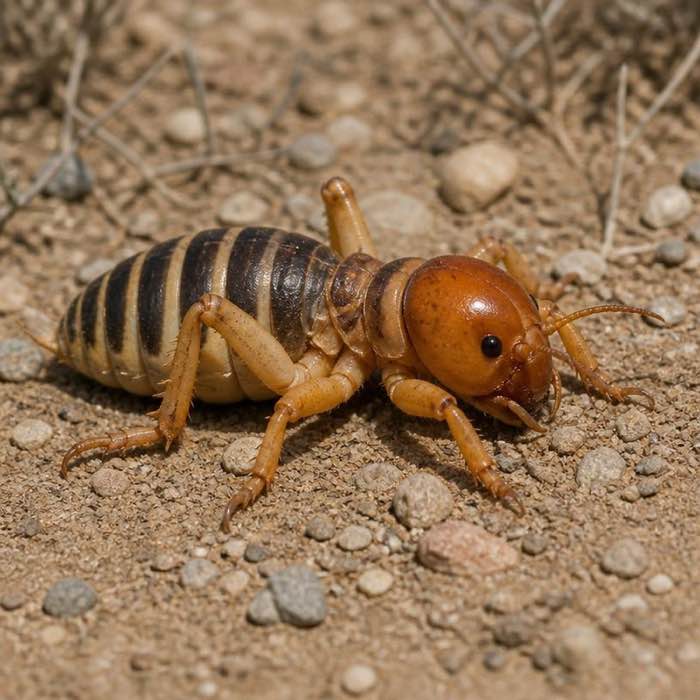
Jerusalem cricket
One to two inches, amber to honey-brown, with a glossy oversized head, dark bands across the abdomen and thick digging legs. Also called a child of the earth or a potato bug. No venom, and it cannot fly.
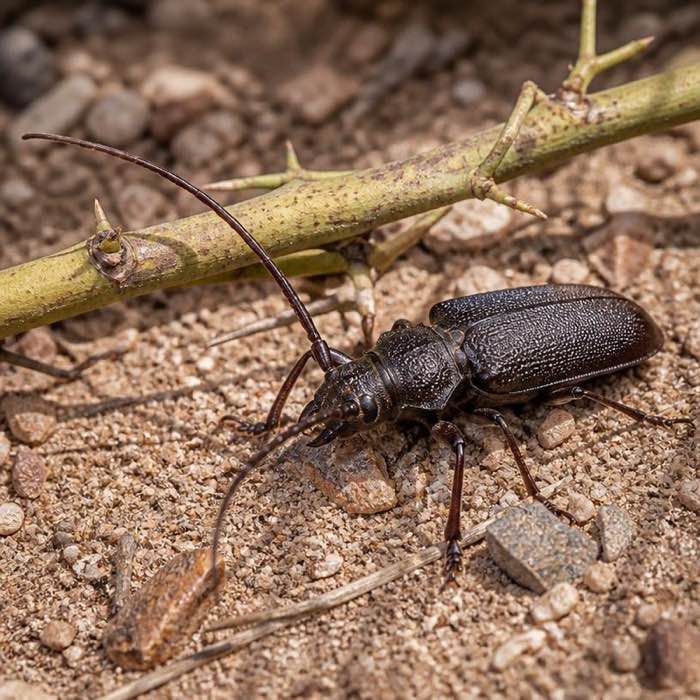
Palo verde beetle
Up to three and a half inches, dark brown to black, with antennae almost as long as the body. One of the largest beetles in North America, and completely harmless.
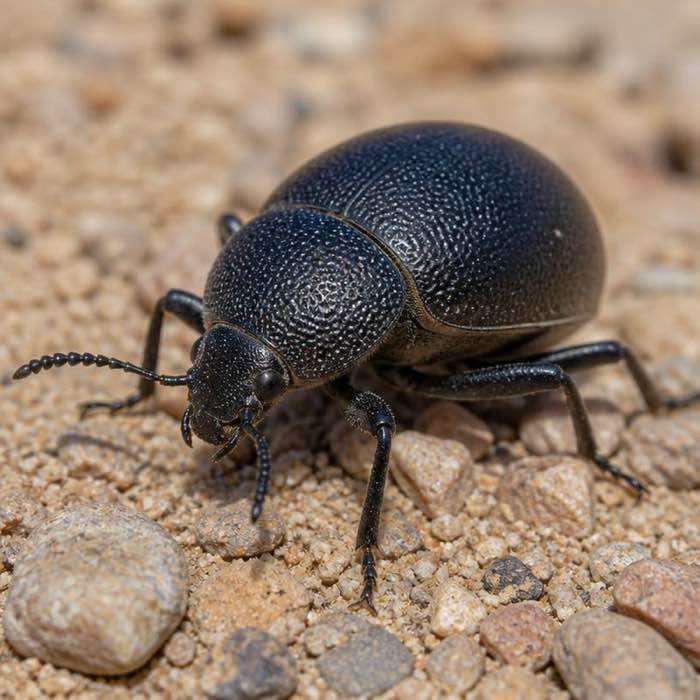
Pinacate beetle
The stink beetle. Matt black, an inch or so, slow, and unmistakable for what it does when you get close: it stops, plants its head down and points its rear end at you.
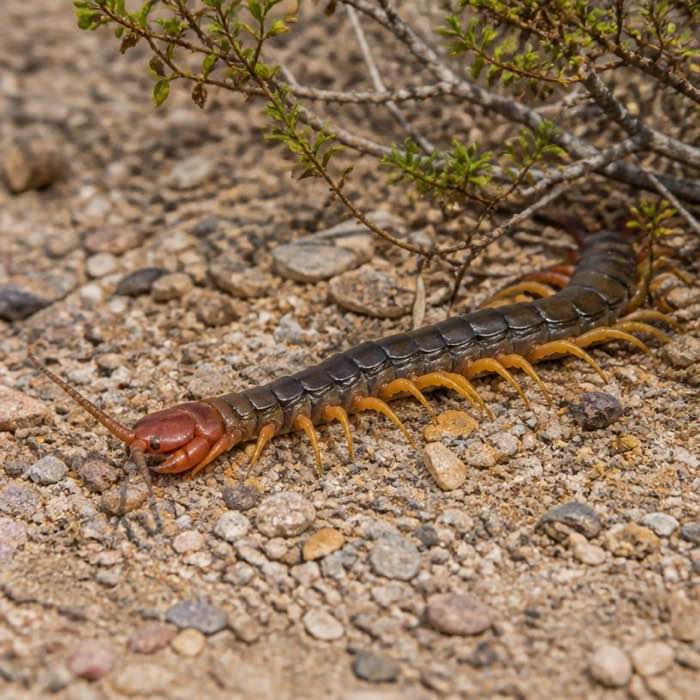
Centipedes — the exception
The giant desert centipede reaches six inches or more, the common desert centipede four to five, both banded and fast. Unlike everything else here these do have venom and a bite is genuinely painful. Our full guide to centipedes in Arizona covers all three species and what one indoors means.
Where you found it narrows it down
Before the field marks, the location does a lot of the work. This is the shortcut we use on the phone.
In a bath, sink or shower tray
Almost always a bark scorpion. They climb well but cannot grip smooth porcelain, so one that wanders in at night is stuck there by morning. It did not come up the drain. why they end up in the bath.
Coming up a drain at night
A large reddish-brown American cockroach, from a P-trap that has dried out. One insect, not an infestation.
Small, tan, striped, in the kitchen
A German cockroach, and those are never alone. Different problem, different treatment.
Flying at the porch light in summer
Turkestan cockroach males, palo verde beetles, or termite swarmers after rain. The wings tell you which.
Heard above the ceiling at night
Roof rats. Mice stay lower in the structure.
In the yard after rain
Centipedes, Jerusalem crickets and pinacate beetles all surface when the ground is wet.
On the wall or ceiling indoors
Bark scorpion or giant crab spider. Both climb; almost nothing else here does.
Mud tubes on a footing
Not an insect you will meet — subterranean termites. See termite control.
How to photograph what you found
Almost everything above can be identified from a phone photograph if it is taken with a little care, and that saves you a visit.
Put something ordinary beside it for scale — a coin, a pen lid, a fingertip at a safe distance. Size settles more identifications than colour does, and it is the thing that is impossible to judge from a photo without it. Get the light from the side rather than straight on, so texture and markings show instead of washing out in the flash. Take one close shot and one wider shot showing where it was, because location is often as diagnostic as the insect: a drain, a mattress seam, a footing, a wall cavity.
If it is damage rather than a live pest, photograph the pattern — mud tubes on a footing, frass pellets on a sill, rub marks along a beam, gnawed fruit. And if it is dead and intact, keep it in a sealed bag or a jar. A specimen settles the question in seconds.
Identification questions
How do I tell a bark scorpion from a harmless one?
Body shape. A bark scorpion looks slender and delicate, with thin pincers and a thin tail, and it climbs. The stripedtail and desert hairy are visibly stouter and stay low. If you have found one on a wall or ceiling, it is almost certainly a bark scorpion.
Is it termites or flying ants?
Look at the waist and the wings. Termites have a straight-sided body, straight antennae and four wings the same length. Ants have a pinched waist, bent antennae and front wings longer than the back. A pile of matching dropped wings on a windowsill points at termites.
Are brown recluse spiders a problem in Phoenix?
No. The brown recluse is not established in Arizona. There is a native relative, the Arizona brown spider, which is reclusive and rarely encountered. Most bites attributed to recluses here turn out to be something else entirely.
Rat or mouse?
Droppings are the quickest answer. Rat droppings are around half an inch; mouse droppings are the size of a grain of rice. Sound helps too — roof rats are heard above you at night, mice stay lower in the structure.
I found one cockroach. Do I have an infestation?
It depends entirely which one. A single large reddish-brown American cockroach in a bathroom usually means a dry drain trap, not an infestation. A small tan one with two dark stripes in a kitchen is a German cockroach, and those are never alone.
Does everything on this page get treated the same way?
No, and that is the point of identifying it first. The treatment for an outdoor cockroach walking in and an indoor one breeding under a kitchen counter are close to opposites, and getting it wrong wastes the visit.
What if I cannot find my pest here?
Send us a photograph. This page covers what we get called about most across the cities we cover, not everything that lives here, and the seasonal guides go deeper on the ones that turn up at particular times of year, and we would rather identify something harmless for free than have you treat for the wrong thing.
When are scorpions most active?
At night, and mostly between spring and early autumn. They are nocturnal all year, but activity climbs as night temperatures rise, peaks through the hottest months and drops off once nights turn cold. A property that looks completely clear during the day can be busy at 11pm, which is why inspections are done after dark with a UV torch.
Do scorpions travel in packs?
No. Bark scorpions are the one Arizona species that will tolerate others of its kind, so you can find several sheltering in the same wall void or under the same paver, and people reasonably read that as a nest. But they do not hunt or move as a group. Finding two in a night means you have suitable harbourage, not a colony.
What do bark scorpions eat?
Crickets, cockroaches, small spiders and other soft-bodied insects. That matters more than it sounds: a yard with a heavy cricket population at night is feeding its own scorpion problem, and reducing the insects around outdoor lighting and irrigated planting does more over a season than extra spraying.
Do palo verde beetles bite?
Not in any way that should worry you. They have strong jaws and a large one can give you a nip if you hold it, but there is no venom and no sting, and they do not go for people. If one flies into you at dusk it is because it is a poor navigator heading for a light, not because it is aggressive.
Are Jerusalem crickets poisonous?
No. There is no venom and no sting. They can bite with surprisingly strong jaws if picked up, which is uncomfortable rather than dangerous, and they may produce a faint hissing sound or a smell when handled. The safe answer is to slide a card underneath, take it outside, and let it go.
Why are there so many crickets in Arizona?
Warm nights, outdoor lighting and irrigated landscaping in a place that is otherwise dry. Lights concentrate them, damp planting gives them cover, and there is no hard winter to reset the population. They are harmless in themselves — the reason we pay attention to them is that they are the main food supply for scorpions.
Ready to seal out the desert pests?
Book your free inspection today. Serving Phoenix and the entire Valley.