Pest control in Queen Creek, AZ
On a lot with a barn on it, most of the pest problem is outside the house: the feed room, the manure pile and the water trough. Those three are not on any standard perimeter service, and they are usually what is actually producing the rodents, the flies and the mosquitoes.
Get a free quote
No obligation. We reply within 2 hours.
A Queen Creek address can come with outbuildings, and that changes the job
Queen Creek grew faster than anywhere else in the state and still kept the thing that makes it different: room for animals. That combination is the whole reason this page is not a copy of the others.
The scale of the growth is easy to state. The 2020 census counted 59,519 residents, and census estimates put the town up around eight per cent in the single year to July 2024, which was enough to make it the fastest-growing town in Arizona and one of the fastest in the country. Most of that is ordinary subdivision building, and on those streets we do ordinary suburban work.
What has not gone away is the rural half. The town keeps a thirty-eight acre equestrian centre of its own, Horseshoe Park, which runs English and Western events and rodeos, and the zoning ordinance still deals in agricultural animals: stables have to sit behind the front face of the main building, with five-foot side and rear setbacks and a fifteen-foot height limit where they sit inside a setback. Those are not the rules of a town that has finished being rural.
For pest work that produces two very different visits at the same postcode. On a standard lot, the job is the building: the perimeter, the entry points, the harbourage. On a property with animals, the building is often the least interesting part. The feed store, the hay, the tack room, the muck heap, the trough and the outbuildings are the actual food, water and shelter, and a service that only walks the house has been paid to look at the wrong structure. An unused outbuilding is also where a colony can settle without anybody noticing for a whole season, and bee and wasp removal covers what to do once one has.
Feed and hay are a rodent supply with a roof over it
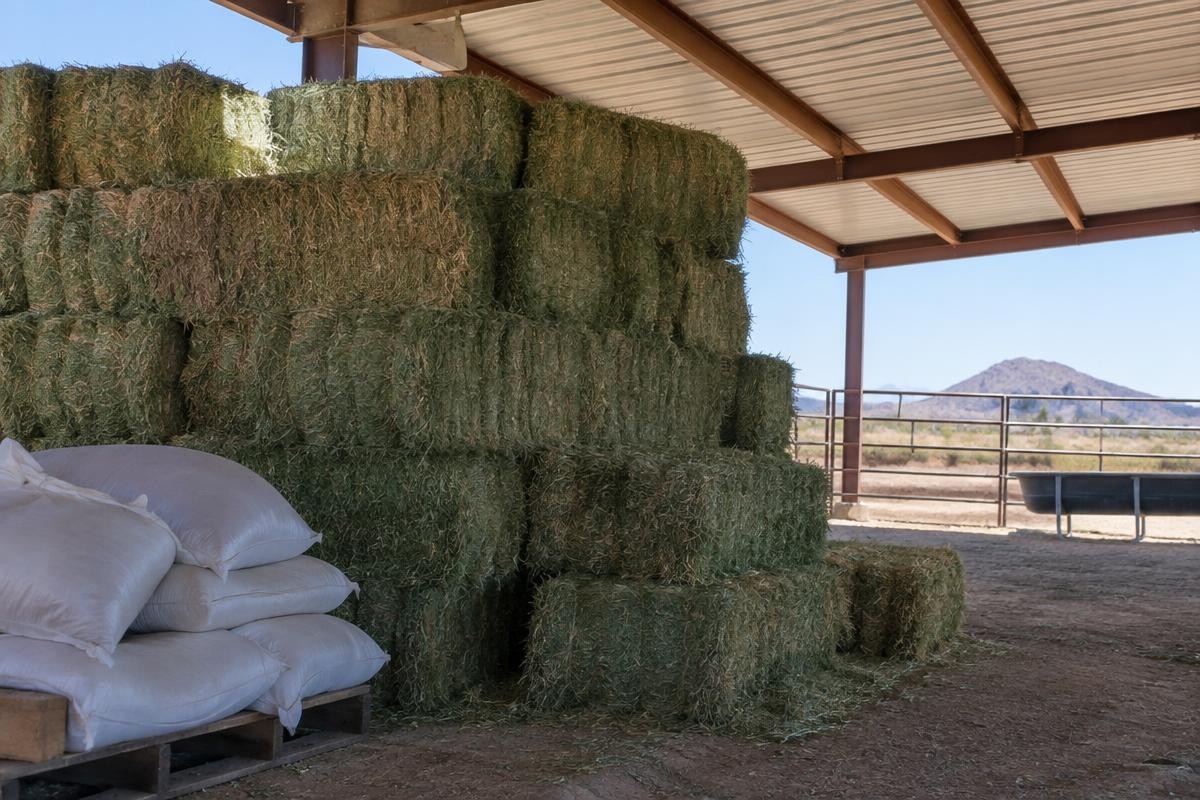
Everywhere else in the Valley, rodents are working for scraps. On an animal property the food is deliberate, it is in bulk, it is dry, and somebody put a roof over it.
That single difference explains most of what we find here. A mouse in a subdivision kitchen is opportunistic. A mouse in a feed room has a grain store, a hay stack to nest in, water twenty feet away in a trough and a building nobody sits in after dark. The population it can support is not comparable, and the reason people often do not notice for months is that nothing has any reason to go into the house at all.
So the work starts at the store rather than at the wall. Grain and pellets belong in metal bins with lids that seat, not in sacks on a pallet or in a plastic tub something can chew through in a night. Spillage matters more than it sounds: a daily half-cup on the floor is a food supply that no amount of treatment outside the building can compete with. Hay stacked directly against a wall gives both harbourage and a route up; stacked off the floor and away from the wall it gives neither.
The treatment itself is different too, and the difference is the animals. Anything we place goes into tamper-resistant stations, sited where horses, dogs, barn cats and poultry cannot get to them and where a curious muzzle cannot reach. On a property with livestock we also want to know what else is hunting: a resident barn owl or a pair of gopher snakes are doing free work, and a programme that ignores them is worse than one that accounts for them. Rodent control covers the survey and exclusion side in full.
Manure, flies, and the one-week clock
This is the complaint we get most often from animal properties in summer, and it is the one where spraying does the least and a wheelbarrow does the most.
The numbers are what make the point. A house fly lays eggs in fresh manure in batches of around a hundred, and those eggs hatch in twelve to twenty-four hours. The larvae feed for a few days, pupate, and in warm conditions the whole cycle from egg to flying adult can finish in about a week. In a Queen Creek July it is at the fast end of that. So a pile that sits for ten days is not storage, it is production, and the flies you are swatting in the tack room were laid in it before the weekend. The stage-by-stage timings behind that are set out in our guide to how long flies live and where maggots come from.
Which is why fly work on an animal property is a management job first and a treatment job second. Muck out on a cycle shorter than the fly cycle, and you break the chain rather than the adults. Keep the heap where it can dry rather than sit damp, keep it away from the buildings people actually use, and get it off the property or spread on the same schedule. Published fly-management guidance is consistent on this point: source reduction beats adult knockdown by a wide margin, and baits, traps and residual work are a top-up on good muck discipline rather than a substitute for it.
There is a neighbour dimension too, and it is worth knowing before it becomes a letter. Maricopa County Environmental Services runs a vector control division that investigates fly complaints as well as mosquitoes, feral bees and roof rats, on 602-506-6616. Most fly problems never get that far, but on a road where the properties sit close together, a heap that is producing is visible to everyone downwind of it.
A trough is the most reliable standing water in the desert
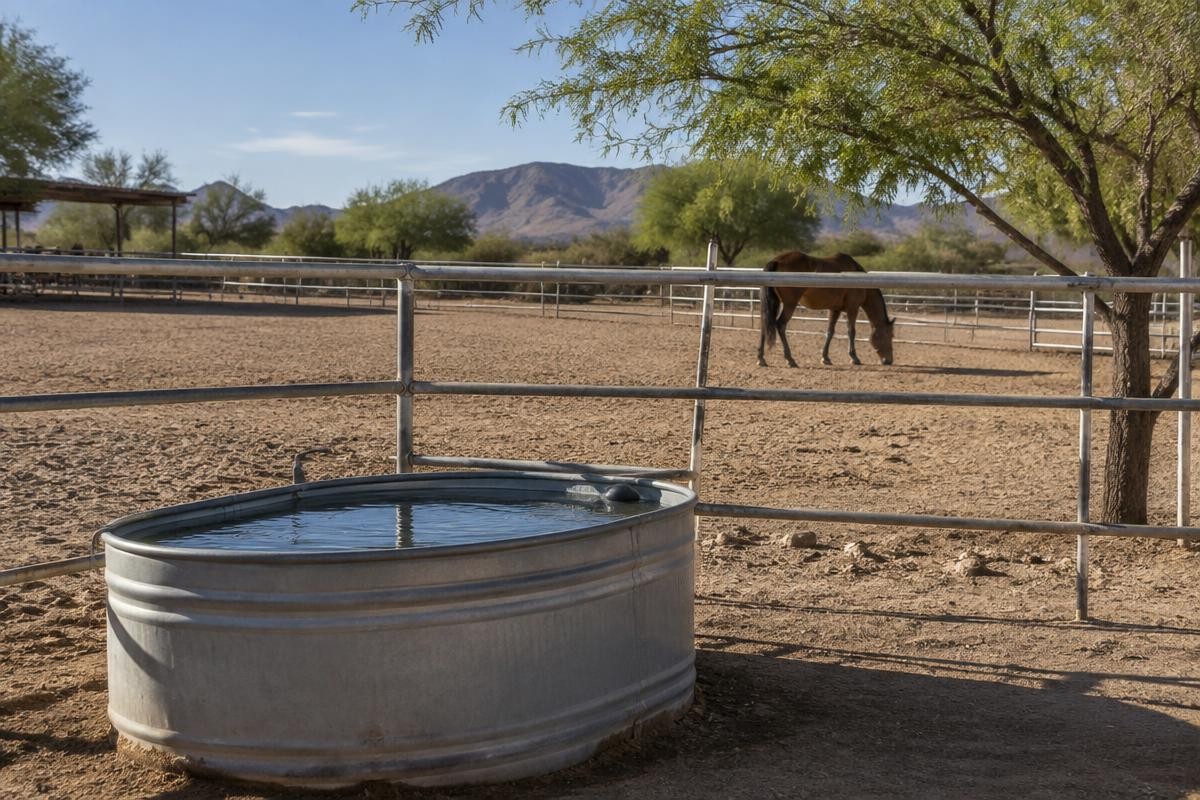
Mosquitoes need standing water and nothing else. A property that keeps animals is a property that keeps water available on purpose, all year, in the open.
The county is blunt about where responsibility sits: everyone is responsible for eliminating and preventing mosquito breeding on their own property. Maricopa County Environmental Services runs year-round surveillance behind that, with routine traps set every week and more added where complaints come in, and it tests what it catches — Culex for West Nile and St Louis encephalitis, Aedes aegypti for dengue, chikungunya and Zika. The trapping map is public.
On the ground it comes down to a short list. Troughs emptied and refilled weekly never hold water long enough for larvae to finish. The same goes for buckets, wheelbarrows left out, the saucer under a plant, a tyre by the fence and the corrugated sheet leaning against the barn. Misters and coolers put water where nobody looks, and a leaking line at a hydrant makes a permanent damp patch that behaves like a small pond. Where the water has to stay, such as a stock tank in use, that is where the treatment goes rather than a fog across the yard. Mosquito control sets out how we survey a property for the sources.
Outbuildings are where termites get found late
Termite work on a lot like this is rarely about the house, which somebody inspects when it is bought or sold. It is about everything else on the property, which nobody inspects at all.
A barn, a shade structure, a tack room, a hay store, a set of corral rails and a run of fence posts have three things in common: timber, ground contact and no reason for anyone to look closely at the base of them. Subterranean termites in Arizona need soil contact and moisture, and an animal property supplies both in quantity, because the ground around a trough, a hydrant or a wash-down area stays damp in a way the rest of a desert lot never does.
What that means on a visit is that the survey covers the whole property rather than the dwelling. Posts get checked at ground level where the damage starts. Timber sitting on soil gets flagged whether or not it is currently active, because it will be. Stored lumber, pallets and old fence rails stacked behind a barn are both a food source and a bridge. Termite control covers treatment routes and warranties, and termite inspection covers what a formal report does and does not include.
The perimeter is longer than the house
A quarter-acre subdivision lot and a one-acre property with a barn are not the same amount of work, and the difference is not the square footage of the house.
Pest pressure arrives at boundaries, and on a larger lot there is more boundary, more of it is fence rather than block, and what sits on the other side is more often open ground than another back garden. Scorpions and ants travel that ground at night and arrive at whatever is standing at the edge of it, which on these properties is usually an outbuilding rather than the house. Treat only the dwelling and you have treated the last thing they reach.
So the programme is drawn around the structures people and animals actually use. That means the barn and the tack room as well as the patio, the run of wall behind the hay, the gap under a feed room door that was built for a tractor rather than a seal, and the lines where irrigation meets a building. Scorpion control and ant control cover the species side; on a property this size what changes is how much of it gets walked before anything is applied.
What we actually do on a Queen Creek property
The first question decides the visit: is this a house, or is this a property with animals on it?
On a standard lot in one of the newer subdivisions, the work is the same good suburban service we run anywhere in the Valley. A perimeter survey, entry points and conditions, the species you are actually seeing, and a written scope with a figure on it before anything is booked.
On a property with animals it is longer and it starts in the outbuildings. We want to see how feed is stored and whether anything has been into it, where hay sits in relation to walls and floor, where the muck heap is and how often it moves, what water is standing and whether it is supposed to be, and where timber meets soil. Treatment is placed with the animals in mind: stations that nothing can open, products chosen and sited for a building with livestock in it, and anything we cannot make safe simply not used there.
You also get the findings that are not our work. A hydrant leak, a feed bin with a split lid, a hay stack that wants moving a foot off the wall and a heap that needs a shorter cycle are all cheaper than a treatment and they do more. Where we cover the rest of the south-east Valley, including San Tan Valley next door, is on the service areas page.
What changes the price in Queen Creek
Two properties on the same road can be quoted very differently here, and the reason is almost always the number of buildings rather than the size of the house.
Structures come first. A house, a barn, a tack room and a hay store is four buildings to survey and treat, not one. Lot size follows, because the boundary and the walked distance grow with it. Then animals, which do not add a charge in themselves but do constrain where and what can be used, and constraints take time.
After that it is what the survey finds. A feed room that has been feeding a rodent population for a year is a different piece of work from a clean store with one mouse in it, and a fly problem that turns out to be a manure cycle is fixed with scheduling rather than with product. The quote separates the two so you can see which part is treatment and which part is housekeeping you may prefer to do yourself. To the north-west, pest control in Gilbert covers the opposite situation — dense master-planned housing built around engineered water rather than acreage and outbuildings.
Queen Creek pest control questions
Is it safe to treat around horses, chickens and dogs?
It is, provided the treatment is designed for it rather than adapted on the day. That means tamper-resistant stations sited out of reach, products and placements chosen for a building animals live in, and anything that cannot be made safe in that setting not being used there at all. Tell us what is kept on the property when you book, not when we arrive, because it changes what goes on the van.
Why do the flies come back a few days after spraying?
Because spraying removes the adults and the next batch is already developing. Eggs laid in fresh manure hatch within a day, and in summer heat the cycle to a new flying adult can be done in about a week. Unless the manure moves on a shorter cycle than that, you are treating the visible end of something that is still running.
How many animals am I allowed to keep?
Ask the town rather than us, and ask recently. The council revised the agricultural rules in April 2026 and removed a proposed animal-unit count for lots of an acre and above, so anything written before that is out of date. What has not changed is the requirement that stables sit behind the front face of the main building with five-foot side and rear setbacks.
The mosquitoes are coming from the property next door. What can I do?
Deal with your own sources first, because a trough or a leaking hydrant on your side will keep a population going by itself. Beyond that, Maricopa County Environmental Services takes mosquito complaints on 602-506-6616 and investigates them, and it runs its own trapping and testing across the county. We will treat your side of it and set out in writing what is producing the rest.
Do you cover San Tan Valley as well?
Yes. San Tan Valley sits immediately south-east of Queen Creek and the properties are much the same: large lots, outbuildings and animals on a good number of them. The service is identical, and on that side of the line the drive is often shorter than people expect.
My house is in a new subdivision with no animals. Is any of this relevant?
Only the boundary part. On a standard lot the work is the ordinary perimeter service, and the things that matter are the same as anywhere in the Valley: entry points, harbourage against the wall, and whatever sits beyond the fence line. If the lot behind you is still open ground, that is the direction everything arrives from.
Related services
Rodent Control in Phoenix
Feed rooms, hay and outbuildings: where the food is deliberate, the survey starts at the store rather than the skirting.
Mosquito Control in Phoenix
Troughs, misters and a leaking hydrant are standing water that never dries up. Finding the sources is the job.
Termite Control in Phoenix
Corral rails, fence posts and barn timber in ground contact, which is where damage is found late.
Scorpion Control in Phoenix
Longer boundaries and open ground next door change where a perimeter programme has to run.
Ant Control in Phoenix
Spilled feed and irrigation lines are two of the most reliable ant supplies on a property like this.
Pest Identification Guide
Photographs of what you have found, from barn rodents to the scorpions that arrive from open ground.
Tell us what is kept on the property
Horses, chickens, a feed room, a hay store, or none of the above. That answer decides how long the survey takes and what can be used where, and you will have the findings and the figure before anybody books a visit.