Ant control in Phoenix starts with knowing which ant you have
Four completely different jobs arrive under the same three words. The treatment that ends one of them does nothing to another, and the spray that looked like it worked is usually the reason they came back.
Get a free quote
No obligation. We reply within 2 hours.
The ants on your worktop almost certainly do not live in your house
This is the most useful thing to understand before anybody treats anything, and it is why ant work looks so different from a roach job. In a Phoenix house the nest is nearly always outdoors, and the ants indoors are shoppers rather than residents.
The University of Arizona makes the same point about our native fire ants: they will forage indoors, but the colony itself stays outside. That holds for most of the ants people call us about. The nest sits under a paver, in the soil against a footing, inside an irrigation valve box, along a drip line, in the damp strip at the edge of a lawn, or under the mulch somebody laid against the wall two summers ago. A line of workers crossing your kitchen is a supply route running from that nest to something in your house worth carrying home.
That changes what a treatment has to achieve. The workers in the trail are the most visible part of the colony and the most replaceable part of it. Killing them changes the picture on your floor for a day or two and changes nothing underground, which is exactly what people describe when they call us after trying a can from the hardware store.
Spraying the line is the mistake that costs you a month
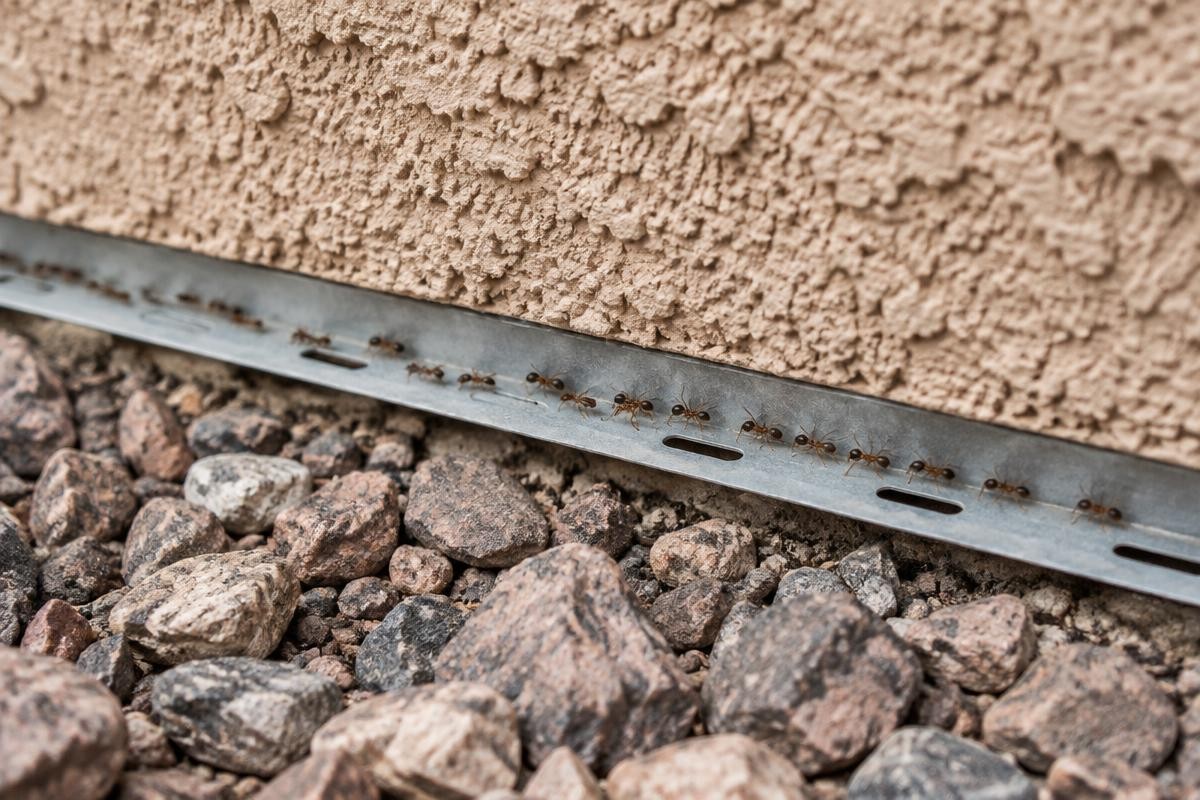
Arizona Cooperative Extension puts it about as plainly as a university ever does: you can spray a contact pesticide and kill a lot of worker ants, but unless you are changing the conditions that suit them and using bait, you are not managing your ants.
The reason sits in how a colony is built. The queen does not forage. She is underground, fed by the workers who do, and nothing you put on a worktop reaches her unless a worker carries it down. A contact spray removes the carriers, leaves the part of the colony that replaces them untouched, and destroys the one mechanism a treatment could have used to get to her.
The Extension also warns that using the wrong method for the ant you have can make the problem worse rather than simply fail. Most ants in an Arizona yard are harmless and several are useful, so treating everything with six legs is both wasted money and, on some species, counterproductive.
One piece of do-it-yourself work genuinely helps, and it is not spraying. Ants navigate on a chemical trail, and wiping the worktop leaves the part of it running along the skirting and up the wall. Our field note on sealing a foundation gap and breaking an ant trail covers clearing a run properly and which gaps to close first.
Four ant problems, four different visits
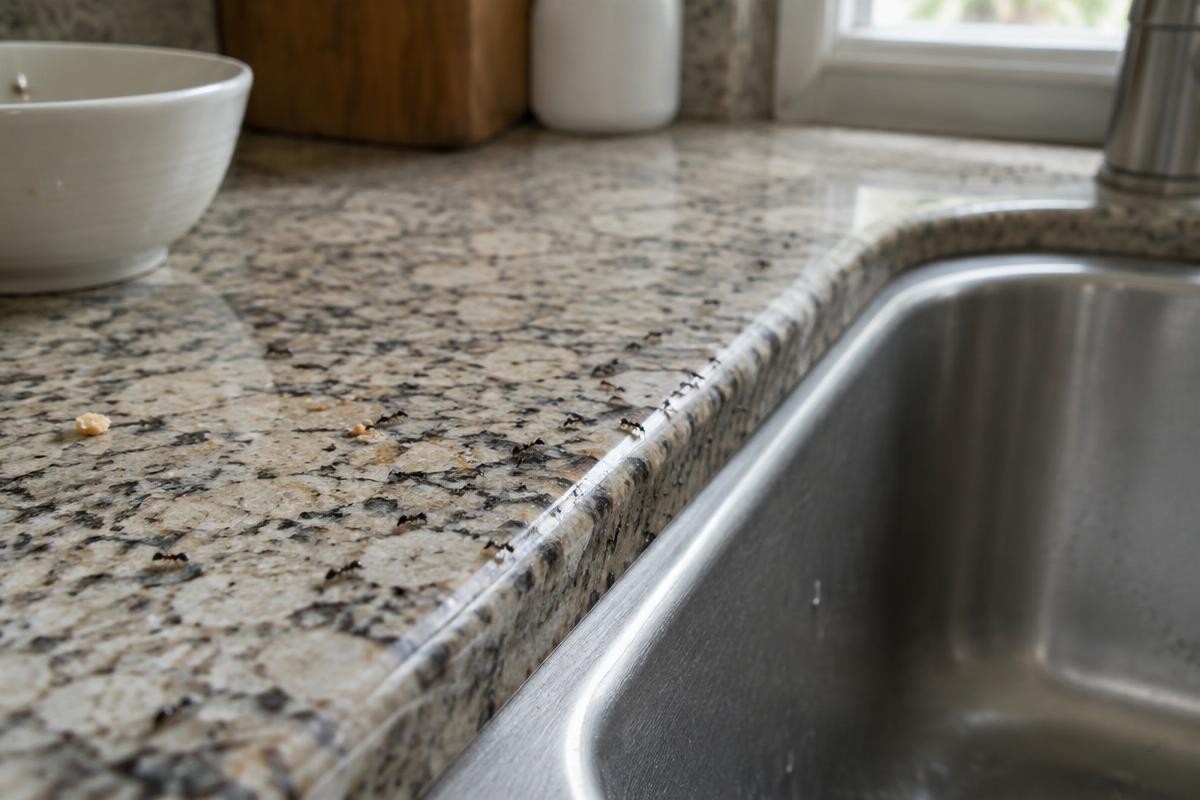
These four cover almost every ant call we take in the Valley. Our pest identification guide is the place to work out which one you are looking at; this is about what each one changes on the day.
Trailing house ants: pavement, pyramid and the very small dark ones
This is the kitchen and bathroom job, and the one bait was designed for. The smallest of them is worth knowing by name: the dark rover ant, a South American species that reached Phoenix and Tucson in the 2000s and is now among the ants most often found indoors here. About two millimetres long, plain dark brown, and tied closely to damp ground, so irrigated lawns, drip lines, valve boxes and leaking hose bibs are where its colonies sit. Most people describe a moving line of specks rather than ants.
What it changes: bait matched to what the colony is collecting, placed on the run rather than sprayed across it, plus a hunt for the damp keeping the colony there. If a valve box is holding water twelve feet from the door, the bait is half the job.
Southern fire ants: this one is a safety job, not a nuisance job
Our native fire ant nests in bare, sunlit soil and in turf: lawn edges, the strip beside a path, anywhere watering keeps the ground softer than the yard around it. It stings collectively when the nest is disturbed, which is why people usually discover one by standing on it.
The reason this is treated differently is risk. Arizona Cooperative Extension notes that roughly one per cent of children and three per cent of adults are allergic to stings from bees, wasps and ants, which is why schools and childcare settings rank fire ants as a priority pest rather than a tolerable one. On a home visit that becomes two questions before anything is applied: do children or pets use that part of the yard, and how many nests are out there. A single mound gets an individual treatment; scattered mounds are a broadcast job, because chasing them one at a time does not work on a large lot.
Harvester ants: one nest, out in the open, and it stays outside
Large, red, and unmistakable once you see the nest: a cleared disc of bare ground with one hole in the middle and seed husks at the rim. Harvester ants are not trying to get into your kitchen and generally do not. They matter only where the nest sits somewhere people walk barefoot, because the sting is severe.
What it changes: a single point treatment on a known nest rather than a perimeter programme, and often the cheapest ant job on this page. It is also the one where we will sometimes tell you to leave it alone. A harvester nest in the far corner of a large lot, away from the pool and the path, is doing nothing to you.
Carpenter ants: the ant that is telling you about water
Large, black, and the only one of the four that is a building problem. They do not eat timber, they hollow galleries in it, and they overwhelmingly choose wood that is already damp. A carpenter ant indoors is usually a symptom, so the useful part of the visit is finding the water: a slow roof leak, a shower pan, a planter against the wall, a cooler line, timber sitting in wet soil.
Because they turn up in damaged timber, they are also the ant most often mistaken for a termite. If what you found was in mud tubing rather than clean galleries, start with termite control instead. Treating carpenter ants and leaving the leak gets you a repeat visit in the same room, which is why our report will name the moisture fault even though fixing it is a job for a plumber or a roofer rather than for us.
Bait is slow on purpose, and the timetable is not a secret
Ants feed each other. A worker that finds food carries it back and shares it, and that sharing is the whole mechanism a bait exploits: the goal is for workers to collect it happily and deliver it to the queen. Something that kills on contact never gets that far.
Because of that, speed and thoroughness pull against each other, and Arizona Cooperative Extension publishes the ranges. A fast active ingredient such as indoxacarb usually works in three to ten days. The middle group, which includes hydramethylnon, spinosad and abamectin, takes one to four weeks. Insect growth regulators such as methoprene and pyriproxyfen take one to two months, because they work by stopping the colony producing replacements rather than by killing the ants in front of you, and they tend to hold longest.
Two consequences follow, and both surprise people. Seeing more ants for a day or two after bait goes down is normal; it means they found it. And this is the one time to leave the trail alone, because cleaning the run removes the route carrying bait home. Clear trails when nothing is down, not during a treatment.
Heat matters too. In a Phoenix summer, bait put out on open ground in the middle of the day sits on a surface hot enough to spoil it before anything collects it, so the Extension advice is to wait until late afternoon. It is a small detail that explains a lot of failed home attempts in July.
Why the calls cluster after a storm
Ant enquiries in the Valley are not spread evenly through the year, and the pattern is weather rather than luck.
Heavy rain floods shallow nests, and Arizona Cooperative Extension describes the result directly: ants and cockroaches are displaced by excessive rain and move into homes and buildings looking for food and shelter. After a monsoon storm a house with no ants in it on Monday can have a line across the laundry on Wednesday. Nothing about the property changed. The ground did.
So a sudden trail is not evidence you have done something wrong, and the days straight after a storm are when the work is easiest, because the route the colony took is still in use. Heat shifts things the other way: in summer, foraging moves to the cooler end of the day, so a household that sees nothing at lunchtime can find a working trail at ten at night. Tell us when you see them. It changes where we look. It is worse on newly built desert lots, where the ground around the slab was disturbed recently and nothing has settled yet, which describes most of San Tan Valley.
What an ant visit actually looks like
The order matters more than the products do, and the first half of it involves no treatment at all.
We start with what you have seen, because you have watched this for longer than we have: which room, what time of day, how long it has been going on, and whether anything outside changed recently. Then the perimeter, working from the entry point outwards to find the nest or the direction of it, and noting what is keeping the colony comfortable: damp under a hose bib, a valve box that never dries, mulch stacked against the stucco, fruit dropping from a citrus tree.
Then identification, because that decides the rest. Bait is matched to the species and to what it is collecting now, placed along the working route and in the harbourage rather than across the middle of a floor, and kept where children and pets cannot reach it. On fire ants the choice between individual mounds and broadcasting comes from how many nests the yard holds. On carpenter ants the water comes first and the ants second.
The survey ends with the findings and a figure in writing, and the findings include the parts that are not our work: the irrigation fault, the leaking bib, the timber in soil. A follow-up is normal on colony work rather than a sign something went wrong. Where a property backs onto ground somebody else maintains, our note on treating beside shared common area explains why the pressure keeps arriving.
What changes the price of ant control here
Ant work is priced on what the survey finds rather than on the word ant, and four things move the figure.
For scale before any of that: across the Valley a standing programme generally runs $40 to $100 monthly, and a single visit lands between $110 and $300. Ant work is normally quoted inside those figures rather than alongside them, and they are market guides rather than a tariff.
Species does most of it. A single harvester nest in the open is small and quick. Fire ants across a watered lawn is a bigger job, and a trailing colony inside a wall cavity sits in between and usually needs a second visit. That is why nobody should price an ant job over the phone from a description of small brown ants, and why the first visit is a survey.
After that it is scale and access: the length of the perimeter, how much of it is planted and irrigated, whether the yard is gated, and whether the wall run we need to work along is clear or behind stored furniture. Then follow-ups, which on colony work are part of the method rather than an extra. Last, conditions nobody can treat away. Where the nest sits on common area or across a boundary, work on your side is maintenance rather than a cure, and that belongs in the quote rather than in a surprise later.
Ant questions we get asked in Phoenix
Why do the ants come back a week after I spray?
Because the spray reached the foragers and not the colony. The queen is underground being fed by workers, so removing the ants you can see interrupts the supply line for a few days and then it is rebuilt. It is also why the second go with the same can works less well than the first.
How long should bait take to work?
It depends on the active ingredient, and Arizona Cooperative Extension gives the ranges: about three to ten days for a fast one such as indoxacarb, one to four weeks for the middle group, and one to two months for growth regulators, which are slowest but hold longest. Seeing more ants in the first day or two is a good sign rather than a bad one.
Should I clean the trail or leave it?
Clean it when no treatment is in place, because the chemical line on the wall is what the next scouts follow. Leave it while bait is down, because that same line carries the bait back to the nest. The two answers belong to different weeks.
Are the fire ants here the imported ones from the news?
Mostly what you meet in a Phoenix yard is our native southern fire ant. Arizona has imported fire ant records too, and the Extension notes a single sting rates about the same either way. The difference is behaviour and numbers, and on a family yard the response is the same.
There is a bare circle of gravel in my yard with a hole in the middle. What is it?
Almost certainly a harvester ant nest. They clear the ground around the entrance deliberately, often a foot or more across, and you will usually see discarded seed husks at the edge. They rarely come indoors, so the only question is whether the nest sits where people walk barefoot or where a dog lies down.
Do ants indoors mean I have a leak somewhere?
Not always, but it is worth checking, and with large black carpenter ants it is the first thing to check. In a desert city, reliable moisture is the scarcest thing a colony can find, so a dripping bib, a valve box that never dries or a slow leak under a shower is often the reason the nest chose that spot rather than one four houses down.
Related services
Pest Identification Guide
Photographs of the southern fire ant, harvester ant and carpenter ant, plus the nests that identify them from a distance.
Termite Control in Phoenix
Mud tubing rather than clean galleries means you are looking at the other insect in damaged timber.
Cockroach Control in Phoenix
The other bait-led job, and the other pest that rain pushes indoors in the same week.
Commercial Pest Control
Ant programmes for premises where a trail across a floor is a compliance problem, not an annoyance.
All Service Areas
Where we work across Phoenix and the Valley, and how pest pressure changes across it.
Tell us what they look like and where you see them
Size, colour, which room and what time of day. That is usually enough for us to say which of the four jobs this is before anybody comes out, and the survey settles the rest.