Pest control in Apache Junction, AZ
Apache Junction runs on a different kind of building. Manufactured homes, park models and RV resorts sit above the ground rather than on it, and that one difference decides where pests get in and where anyone sensible starts looking.
Get a free quote
No obligation. We reply within 2 hours.
A manufactured home is not a house on a slab
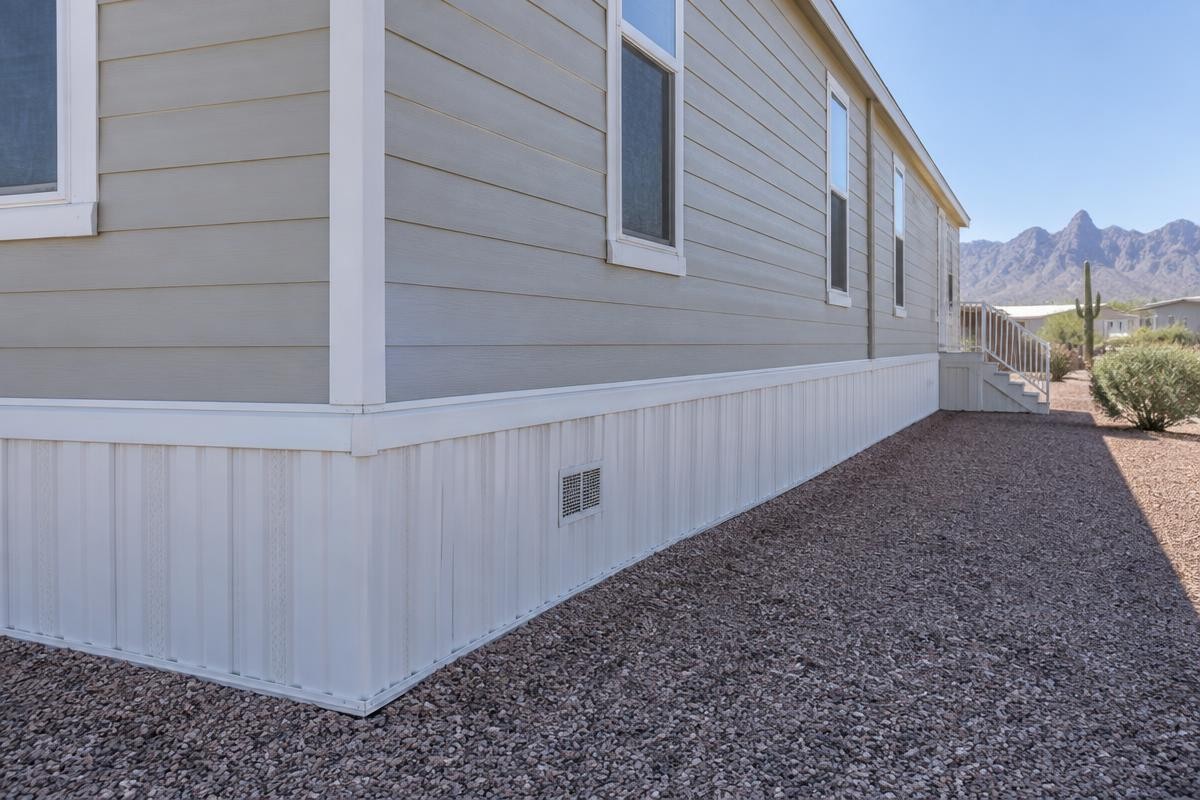
Almost every piece of pest control advice written for the Valley assumes a block house on a poured concrete slab. A great many homes in Apache Junction are nothing like that, and the difference is structural rather than cosmetic.
A manufactured home, a mobile home or a park model stands on piers with a void beneath the floor. That void is closed in by skirting panels — aluminium, vinyl or block — instead of by concrete. Beneath the joists there is usually a belly wrap, the membrane stretched under the floor to hold the insulation in place, and running up through it are the utility chases carrying water, waste and wiring into the kitchen and the bathrooms. Tie-down anchors and pier blocks stand in bare soil. None of that exists on a slab house.
It changes the shape of the whole job. On a slab house the argument happens at the perimeter: door sweeps, weep holes, the garage. On a skirted home the perimeter is a thin panel run with a seam at every joint, a cut-out at every service penetration and a gap wherever the ground has settled away from the bottom rail. Behind it is a dry, shaded, above-ground cavity nobody walks through for months at a time. It is the best address on the property, and most of our work here is about who has already taken it.
The belly wrap is the part owners never see. Once it tears — and it tears at the chases, at the ducting, and wherever somebody has cut it for a repair and taped it back badly — the insulation above becomes lined nesting material with a roof over it. An animal up in that layer is not inside your home yet, so it is easy to believe there is no problem. The chase is a short climb, and the first sign indoors is usually a noise above a bathroom ceiling.
A swamp cooler adds the last piece. Where there is one there is standing water, a wetted pad and a supply line, which is the difference between a void that struggles through July and one that can keep something alive all summer.
Rodents get under the home before they get into it
People search for rodent control in Apache Junction almost as often as they search for termites, which is unusual for a Valley suburb and, given what the houses are built like, entirely logical.
The order of work matters more than the product. A rodent problem in a skirted home nearly always has three parts, found in sequence. First the ground-level opening: a corner where two skirting panels no longer meet, a vent cut-out that has lost its mesh, a utility penetration sealed years ago with foam and since chewed back, or the low spot where a pier has settled and left daylight under the bottom rail. Second, the tear in the belly wrap above it. Third, the chase into a cabinet.
Take those out of order and you buy a short, expensive truce. Snap traps in the kitchen catch whatever came up last night while the population underneath replaces them. Bait pushed in under the panels without finding the opening is worse, because it leaves a carcass below your floor that you cannot reach or ventilate.
So the first visit is a ground-line inspection: the full skirting panel run, panel by panel, then as much of the belly wrap and the chases as can be seen from underneath. Sheds, add-on rooms and carports get the same attention, because on these lots the outbuilding is usually where the cardboard and the birdseed live. Only once the openings are closed does anything go inside, and by then there is normally little left to do inside.
Roof rats behave differently again on the older irrigated streets, where mature citrus and oleander give them a route at height. That is the same animal our rodent control work deals with across the Valley. What is different here is that a manufactured home offers them a way in at ankle height as well as at roof height.
Five months open, seven months shut

The other thing this city does that the rest of the Valley does not is empty out.
Apache Junction’s own winter visitor and demographic profile puts the season at December to April, with the large majority of park occupancy seasonal, visitors mostly in their sixties, and a repeat rate above three quarters — the same people, the same lot, year after year. The interviews behind that document are some years old, so it is fairer to read as the shape of the place than a current count. The shape is what matters: a lot of property here is lived in for five months and closed for seven.
A closed home is not a dormant one. Nothing runs through the plumbing, so the traps under the sinks, the shower and the laundry evaporate, and a dry trap is just an open pipe to the sewer line. Nobody notices the slow drip under a vanity, the panel a monsoon storm pulled loose in July, or the bees that found a wall void in April — Arizona’s first killer bee fatality was here, in 1995. Whatever begins in May has until December to settle in.
The answer is a closing routine rather than a treatment. Fill every trap and float a little cooking oil on top so it cannot evaporate. Clear out everything edible, including the shed and the pantry tins. Walk the skirting panel run and screw back anything loose. Shut the water off at the stop. And arrange for somebody to look at the lot after the monsoon, because that is the month the panels move.
Coming back in, before anything is unpacked: run every tap, flush every toilet, and walk the outside of the home at ground level while there is still light. Most of what we are called to in December was already visible in November.
Termites arrive where the building meets the ground
Desert subterranean termites do not care what a building is made of. They care about where it touches soil, and a home on piers touches soil in far more places than a slab house does.
On a slab the route is narrow and well documented: a crack in the pour, the gap around a plumbing penetration, an expansion joint. On a pier-supported home there is no single barrier to breach. The piers stand in soil. So do the steps, the porch posts, the carport uprights, the shed, the lattice used to screen the void and — more often than any of those — whatever was added later. An Arizona room on its own footing, a deck, a ramp, a raised planter banked against the skirting panels: each is a fresh place where timber and ground meet.
What they build to get there is a shelter tube, a pencil-width tunnel of soil and saliva running up a pier or a post to reach dry timber. On an exposed pier it is obvious to anyone who looks. Behind a skirting panel it is invisible, which is the strongest argument there is for opening the panels during an inspection.
Two other things are worth checking on these lots. Offcuts left under a home after a plumbing or levelling job are cellulose sitting directly on soil, and they will do as a starter colony. And a home that has been relevelled has had its piers disturbed, which makes it a sensible moment to look at them properly.
Termite treatment is applied differently here as well. A trench-and-treat line around a slab works against a continuous footing; under a skirted home the work is targeted at the piers and the contact points, and the scope has to name which were treated and which could not be reached. Our termite control page covers the chemistry and the warranty, and on a sale the termite inspection is the formal report.
Scorpions and the edge of the desert
Superstition Mountain stands immediately east of town, and on several sides the built edge simply stops where open ground begins. It is the same boundary that runs up the far side of east Mesa.
Bark scorpions climb, and they use the same ground-level openings the rodents use: panel seams, vent cut-outs, service penetrations. The void under a skirted home then gives them exactly what they want, which is shade, a steady temperature and a floor to get beneath. Lots backing onto undeveloped land see more of them, and the gap between a home on that boundary and one four streets in is wide enough to change what we recommend.
The survey is done after dark under ultraviolet light, because that is the only way to see where they are rather than where they might be. What follows is sealing at ground level and treating the harbourage, not spraying a yard and hoping for the best. Scorpion control sets out the method in full.
What a visit to an Apache Junction property involves
We run two noticeably different visits in this city, and it is worth knowing which one you are booking.
On a manufactured home, a mobile home or a park model, the inspection starts on your knees. We walk the full skirting panel run and open panels at the corners, at every service penetration and anywhere the ground has moved. We look at the belly wrap for tears and staining, at the piers and tie-down anchors for shelter tubes and contact with damp soil, and at the chases where they come up through the floor. Sheds, Arizona rooms, carports and any later addition are inspected separately. Then we treat, and the openings get closed with mesh and fixings rather than a bead of foam.
On a site-built house on a slab the visit is the familiar one: perimeter, weep holes, door sweeps, the garage, the irrigation line and the planting against the wall. Apache Junction has plenty of those too, particularly in the newer subdivisions, and there is nothing exotic about them.
Both end the same way. You get a written scope saying what was found, what was treated, what could not be reached and why, and a price, before any work is booked. If the honest answer is that you have a building fault rather than a pest problem, we will say so, and we would far rather say it before you pay for a treatment that was never going to hold.
What changes the price here
Two lots that look identical from the street can be very different jobs, and nearly all of the difference is access.
Getting under a skirted home is the main variable. Panels that lift off, or that are held by a handful of screws, cost nothing in time. Panels painted over, sealed, bricked in or landscaped against — gravel, pavers or a raised bed banked up to the bottom rail — mean either a longer visit or a frank conversation about what can be reached. A void used for storage is the same problem in another form: boxes and old furniture have to come out before anybody can inspect.
After that it is the number of separate structures on the lot, because a shed, a carport and an Arizona room are three inspections rather than one. Whether there is a swamp cooler. How close the boundary sits to open desert. And whether the home is occupied all year or seasonally, because a property standing empty for seven months is better served by one visit timed to the closing and another to the opening than by a schedule that runs while nobody is there.
What should not change the price is the county line running through the city, and nobody ought to be charging you differently because of which side you are on.
We do not quote without seeing a property. Anyone who gives you a firm figure for an exterminator visit in Apache Junction over the phone, sight unseen, is pricing an average home and will be revising it on the day.
Apache Junction pest control questions
Is Apache Junction in Pinal County or Maricopa County?
Both. The city straddles the line and most residents live on the Pinal side. It makes no difference to how a property is treated, but it changes who you call for the things a county handles. Pinal County Environmental Health runs the vector programme on 520-509-3555 or 888-431-1311. On the Maricopa side, Environmental Services takes mosquito, fly, feral bee and roof rat reports on 602-506-6616. Your property tax bill will tell you which side you are on. The same county split catches people out in San Tan Valley, which sits wholly in Pinal.
Do you treat park models and homes inside an RV resort?
Yes, and a park model is treated as the home it is. The one thing worth doing first is asking at the resort office, because many communities have their own arrangement for the common ground and their own rules about what a contractor may do on a lot. That normally covers the roads and the landscaping, not the inside of your home or the void beneath it, which is where most of the trouble sits.
We are only here in winter. Can anything be done while the home is empty?
The outside work can. Sealing at ground level, the skirting panel run, the piers, termite work and exterior treatment all get done with nobody inside, provided someone can give us access to the lot. Interior work needs a person present, either you or somebody you trust with a key. What we would not suggest is a treatment nobody inspects afterwards, because the value is in the report as much as the product.
Something is living under our home. Can you just put bait underneath?
We would rather not, for two reasons. Bait without a sealed building kills what is there and leaves the way in open for the next lot, and it puts a carcass below your floor that you cannot get to. The order that holds is: find the opening, work out what has been using it, close it properly, then deal with whatever is still inside. It costs one more visit and it lasts.
Are manufactured homes more likely to get termites than block houses?
Not by nature. Desert subterranean termites are in the soil across the whole Valley and will take whichever route is open. What differs is the number of routes and how easily anyone can see them. A home on piers has more points of ground contact and the skirting panels hide most of them, so it is an inspection problem rather than a construction one.
Our skirting panels are screwed shut and painted over. Do they have to come off?
Some of them. Not the whole run: the corners, the service penetrations and any stretch where the ground has moved are usually enough to show what is happening underneath. If panels genuinely cannot be opened, we do the work we can and the scope says which sections were not inspected, so you are not paying for a clean bill of health nobody verified.
Related services
Rodent Control in Phoenix
Mice, roof rats and pack rats, and closing the way in before anything is set.
Termite Control in Phoenix
Desert subterranean termites, the chemistry, and what a warranty is actually worth.
Termite Inspection
The written report a sale needs, and the limits it has to state.
Scorpion Control in Phoenix
A night survey under ultraviolet light, then sealing at ground level.
Cockroach Control in Phoenix
Sewer routes, dry plumbing traps and the kitchens they end up in.
All Service Areas
Where else we work across the Valley, and what is different about each one.
Tell us what kind of home it is
Manufactured, mobile, park model, RV lot or block on a slab — that one answer decides how the visit is planned and how long it takes. Cross streets and the name of the community are enough to get us started.