Weed control in Phoenix is about timing, not spraying harder
Desert yards get two germination windows a year. Treat before them and the yard stays clear for months. Treat after them and you are pulling weeds out of granite until the season ends.
Get a free quote
No obligation. We reply within 2 hours.
Pre-emergent is the part that actually works
Almost every frustrated weed conversation in Phoenix comes down to the same thing: the property is only ever treated once weeds are already visible. At that point you are killing what came up, and the seed bank in the soil is untouched.
Pre-emergent herbicide works differently. It creates a barrier in the top layer of soil that stops seeds from establishing as they germinate. It does nothing to weeds that are already growing, which is why it has to go down before the season rather than during it — and why the calendar matters more than the product.
A realistic Phoenix programme is pre-emergent twice a year, with post-emergent spot treatment in between for whatever gets through. Skip the pre-emergent and you are signing up for the spot treatment forever.
The two germination windows
Winter weeds
Germinate with cooler weather and the fall and winter rains, roughly October through December, then green up and go to seed in early spring. London rocket, stinknet and filaree are the ones people notice.
Summer weeds
Germinate with monsoon moisture and heat, roughly June through August. Spurge, purslane, goathead and Russian thistle belong to this group.
So the pre-emergent goes down
Before each window rather than during it — early autumn ahead of the winter germination, and late spring ahead of the monsoon. Miss the window by a few weeks and that application is largely wasted.
And it needs watering in
Pre-emergent has to be moved into the soil layer to form the barrier. Applied to bone-dry granite and left, it will not do the job.
The weeds we deal with most in the Valley
Stinknet (globe chamomile)
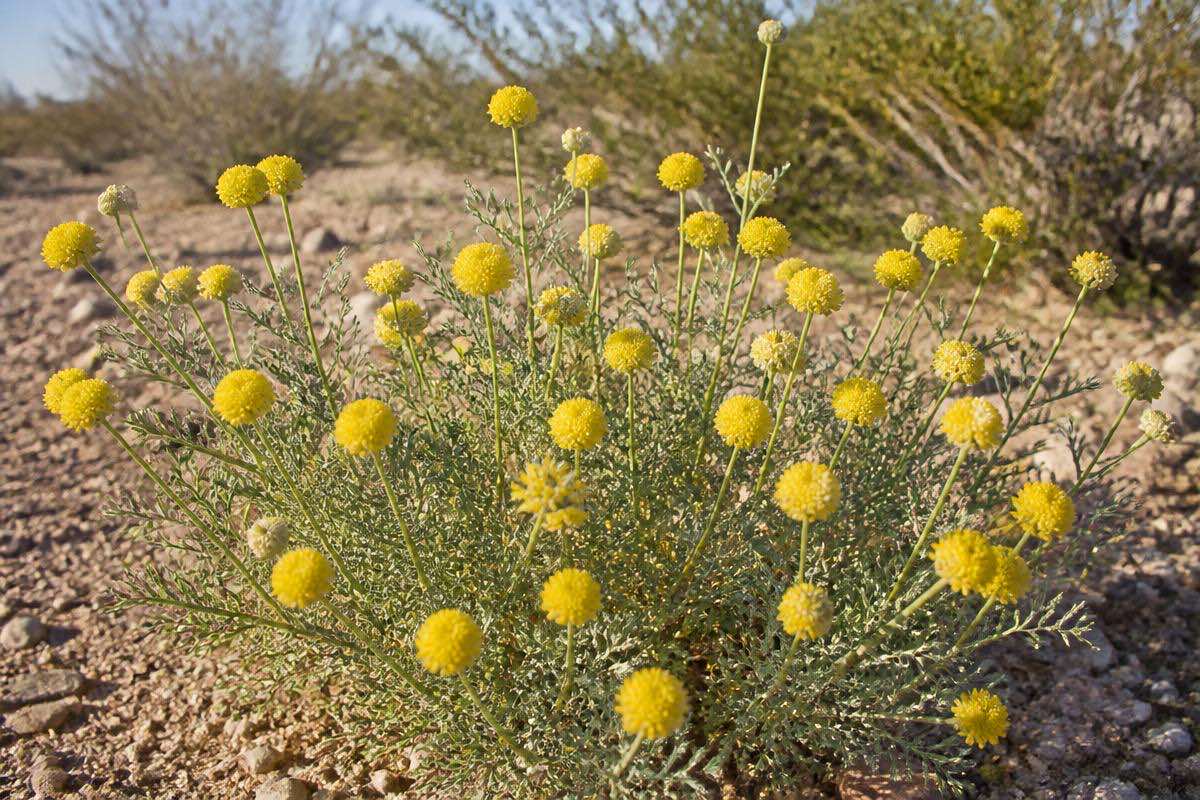
The one worth knowing about. An invasive from southern Africa that reached the Phoenix area in the 2000s and spread heavily through north Phoenix and Scottsdale and south along the I-10. It grows to around two feet, smells strongly, and dries into serious wildfire fuel. Critically, it is resistant to glyphosate — which is exactly why the bottle from the hardware store did not work on it.
London rocket
The tall yellow-flowered winter annual that appears everywhere after winter rain and sets seed fast. Easy to control early, tedious once it is flowering.
Goathead (puncturevine)
Low-growing summer weed with spiked seed pods that puncture bike tyres and hurt bare feet and dogs. The seeds stay viable in soil for years, so one bad season creates several.
Spurge and purslane
Flat mat-forming summer weeds that thrive in granite and along walkway edges. They spread fast in monsoon humidity.
Bermuda grass and nutsedge
Perennials that spread by runners and tubers rather than seed alone, so pulling them or a single spray rarely finishes them.
Russian thistle (tumbleweed)
Grows through summer, dies, breaks off and distributes its seed across the neighbourhood on the wind.
Why weeds still come up through your granite
People are often surprised that a decomposed granite yard grows anything. It grows plenty, for a straightforward reason.
Dust fills the rock
Over a few years, wind-blown soil, leaf litter and organic matter settle into the gaps between granite. That is a seed bed sitting on top of the weed barrier fabric, not underneath it.
Fabric does not help by then
Landscape fabric stops weeds coming up from below. It does nothing about seeds landing on top, which after a few seasons is where nearly all of them are.
Irrigation feeds it
Drip emitters and overspray keep the top layer damp in exactly the spots weeds establish. Bed edges and around emitters are always the worst areas.
Fire risk, not just looks
Dry weed growth against a block wall or a fence line is fuel. In stinknet-heavy areas of the Valley it is a genuine seasonal hazard rather than a cosmetic issue.
How we run a weed programme
Weed control in Phoenix is a calendar job more than a chemical one. Get the pre-emergent down ahead of a germination window and the season stays quiet; miss it by a few weeks and you spend the rest of the year treating what has already come up. The programme below is built around that timing rather than around a spray schedule.
Walk the property
What is growing, what stage it is at, and which areas the irrigation is feeding. Perennials like Bermuda and nutsedge get identified separately because they need a different approach.
Clear what is there
Post-emergent treatment of existing growth, and removal where it makes sense rather than leaving dead material as fuel against walls.
Pre-emergent barrier
Applied to granite, gravel, bed areas and along walls and fence lines, then watered in so it forms the barrier properly.
Twice-yearly timing
Repeat ahead of each germination window, with spot treatment in between. That is what keeps a yard clear rather than resetting it every season.
We are treating weeds, not caring for turf or landscaping. If you have live lawn, ornamental beds or anything sensitive, tell us where before we start and we will work around it. Acreage is a different programme from a garden, because the area is larger, the boundary is usually shared with open ground, and anything near grazing or a feed store has to be chosen with that in mind. That is covered on our Queen Creek page.
What weed control costs in Phoenix
Weed control is quoted per property. Because our technicians are already at the address on a pest route, adding it usually costs less than booking a separate landscaping visit.
Treatable area
Square footage of granite, gravel, bed area and wall and fence lines — not total lot size, since driveways and structures do not get treated.
Current condition
A yard already covered in mature weeds needs clearing before the barrier can go down, and that is extra work on the first visit.
What is growing
Annual weeds respond to a standard programme. Established Bermuda grass and nutsedge take longer and are priced accordingly.
One-off or programme
A single clear-out is priced differently to a twice-yearly pre-emergent programme, and the programme costs less per visit.
Ask us to quote it alongside your pest service and you will see both numbers before either starts.
How pre-emergent is applied, and the step most people skip
Pre-emergent does not kill seeds and it is not a tarp. It creates a thin treated layer in the top of the soil, and seedlings die as they push their first root and shoot through it. Everything about applying it well follows from that one fact.
It has to be watered in. Applied to dry granite and left, the product sits on the surface where it does nothing and slowly breaks down in the sun. It needs irrigation or rainfall within a few days to carry it down into the soil layer where the seeds are germinating. This is the single most common reason a homeowner application fails, and the reason we tell you to run the irrigation after we leave if rain is not forecast.
The layer is fragile. Raking, digging, pulling weeds by the root, a dog running the same route to the gate every day, or a landscaper blowing granite around all break the treated layer, and weeds come up in exactly those lines. If you are planting or moving rock, do it before the application rather than after.
Coverage has to be complete. Weeds appear first at edges — along walls, curbs, expansion joints and the drip line of the roof — because that is where a broadcast application thins out and where wind-blown soil collects new seed on top of the barrier. Those bands need deliberate treatment rather than whatever the spreader threw at them.
And it decays. A single application does not hold for twelve months in this climate. Timed applications ahead of each germination window, rather than one big one, is what keeps a yard clean year-round.
Stinknet needs careful handling
Globe chamomile — stinknet — deserves its own warning, because the usual homeowner response to it makes things worse in two different ways.
It is an irritant. The crushed foliage can cause skin reactions on contact, and the dust from cutting it dry can irritate airways, which matters if anyone in the house has asthma. Taking a string trimmer to a dry stand of it on a windy afternoon puts that dust straight into the air you are breathing, and does nothing about the seed. If you are removing it by hand, do it while the soil is damp so the roots lift whole, wear gloves and long sleeves, and keep it wet rather than letting it dry out as you work.
It should not be composted or burned. Composting a plant that has set seed simply redistributes it across the yard next season, and burning stinknet is both a fire risk and a way of aerosolising the irritant. Bagging it and putting it in household waste is the right answer, and worth the trip.
The fire point is not theoretical. Stinknet grows in dense continuous mats, then dries into fine standing fuel by early summer, which is exactly the material that carries fire fast through desert margins that never used to burn well. Along the corridors where it has established in the Valley, clearing it before it dries is a fire-season job as much as a tidiness one.
And it is the weed that most often prompts the “I sprayed it and nothing happened” call. Stinknet tolerates glyphosate, so the household weed killer that clears everything else leaves it standing. It has to be prevented at germination or treated with something it actually responds to. There is more on Valley weed timing in the seasonal pest calendar.
Weed control questions we get asked in Phoenix
When should pre-emergent go down in Phoenix?
Twice a year: in early autumn before winter weeds germinate with the cooler weather and rain, and in late spring before the monsoon brings up the summer batch. The exact weeks move with the weather, which is why we schedule it rather than putting it on a fixed date.
Why did my weed killer not work on that yellow weed?
If it is stinknet, that is expected — the species is resistant to glyphosate, the active ingredient in most consumer weed killers. It needs a different chemistry, and it needs treating before it dries out and becomes a fire hazard.
Will pre-emergent kill the weeds I already have?
No. Pre-emergent stops seeds establishing; it does nothing to a plant that is already growing. Existing growth needs a post-emergent treatment or removal, and then the barrier goes down to stop the next wave.
Is it safe around pets and children?
We use EPA-registered products applied to the ground surface, and your technician will tell you how long to keep pets and children off the treated areas. Usually that means staying off until it has dried or been watered in, and we will give you the specific timing on the day.
How long does the treatment last?
A properly applied and watered-in pre-emergent typically holds through a germination season, which is why the programme is built around two applications a year rather than monthly visits.
Do I still need to pull weeds?
Far fewer, and much smaller ones. A pre-emergent programme is not a promise of zero weeds — wind brings new seed in constantly, especially near open desert — but it changes it from a weekly chore to occasional spot pulling.
Can you treat if I have live grass or plants?
Yes, but tell us where everything is first. Pre-emergent will stop grass seed and wildflower seed germinating just as effectively as weed seed, so if you overseed in winter or scatter wildflowers we need to plan around that.
Do you handle weeds along the block wall and alley?
Yes, and those are usually the priority. Wall and fence lines are where wind-blown seed collects, where irrigation runs, and where dry growth becomes a fire risk against a structure.
Related services
Scorpion Control in Phoenix
Weeds and dense growth against a block wall are harbourage. Clearing them helps here too.
Mosquito Control in Phoenix
Overgrown, over-irrigated corners hold the moisture mosquitoes breed in.
Commercial Pest Control
Weed programmes for commercial lots, HOA common areas and rental properties.
Want the yard clear before the next season?
Tell us roughly how much granite and wall line you have and what is growing now. We will quote the clear-out and the pre-emergent programme separately so you can see both.