Scorpion control in Phoenix, done after dark because that is when they are out
Bark scorpions climb, hunt at night, and flatten through a gap about the width of a credit card. Spraying the ground in daylight finds none of that. We inspect under UV after dark, treat the harbourage, and seal the ways in.
Get a free quote
No obligation. We reply within 2 hours.
Why scorpion control in Phoenix is a sealing job
Almost everyone who calls us about scorpions has already sprayed something. It reduced the count for a few weeks and then the scorpions came back, because nothing about the building changed. The gaps were still open, the block wall was still hollow, and the crickets they eat were still there.
Bark scorpions are the only species in Arizona whose sting is considered medically significant, and they are also the one most likely to be found indoors, because unlike our other scorpions they climb. A treatment plan that only addresses ground level misses them entirely — they walk up stucco, along block walls, and across ceilings.
So scorpion pest control in Phoenix runs in three parts: find where they actually are, treat the harbourage, and close the entry points. Skip the third part and you are booking the same job again next spring.
What scorpion control costs in Phoenix
Hardly anyone publishes this, so it goes near the front. Across the Valley, ongoing residential cover generally sits between $40 and $100 a month, and a single general treatment between $110 and $300. Those are guide figures for the market rather than a tariff, and scorpion work is usually quoted against them rather than as a separate product.
Scorpions are also the service where that benchmark tells you least on its own, because the spray is the cheap half of the job. A perimeter treatment on a building still open at the screed line and the thresholds will need repeating indefinitely. Closing those gaps costs more up front and is the part that ends it, so we price it after the night inspection instead of folding a guess into a monthly figure.
How open the building is
A house with intact trim at the screed line, sound door sweeps and sealed utility penetrations is a different job from one where all three need attention. This is the single biggest swing in any scorpion quote.
How much block wall you have
Hollow block is a route through the property rather than a barrier, and capping it is real work. On many lots the length of wall moves the number more than the floor area of the house does.
Where the lot sits
Backing onto preserve, or onto ground cleared in the last year or two, means sustained pressure arriving from outside rather than one population already indoors. That changes the visit interval, not just the first treatment.
Whether you want the night survey
A blacklight inspection adds a visit. On a difficult lot it tends to save money rather than cost it, because it shows which gaps are actually being used instead of sealing everything on principle.
You get a flat figure after that inspection and before anything is sealed. If the house turns out tighter than it looked, the number comes down, and we will tell you so rather than keeping the original quote.
The blacklight inspection, and why it happens at night
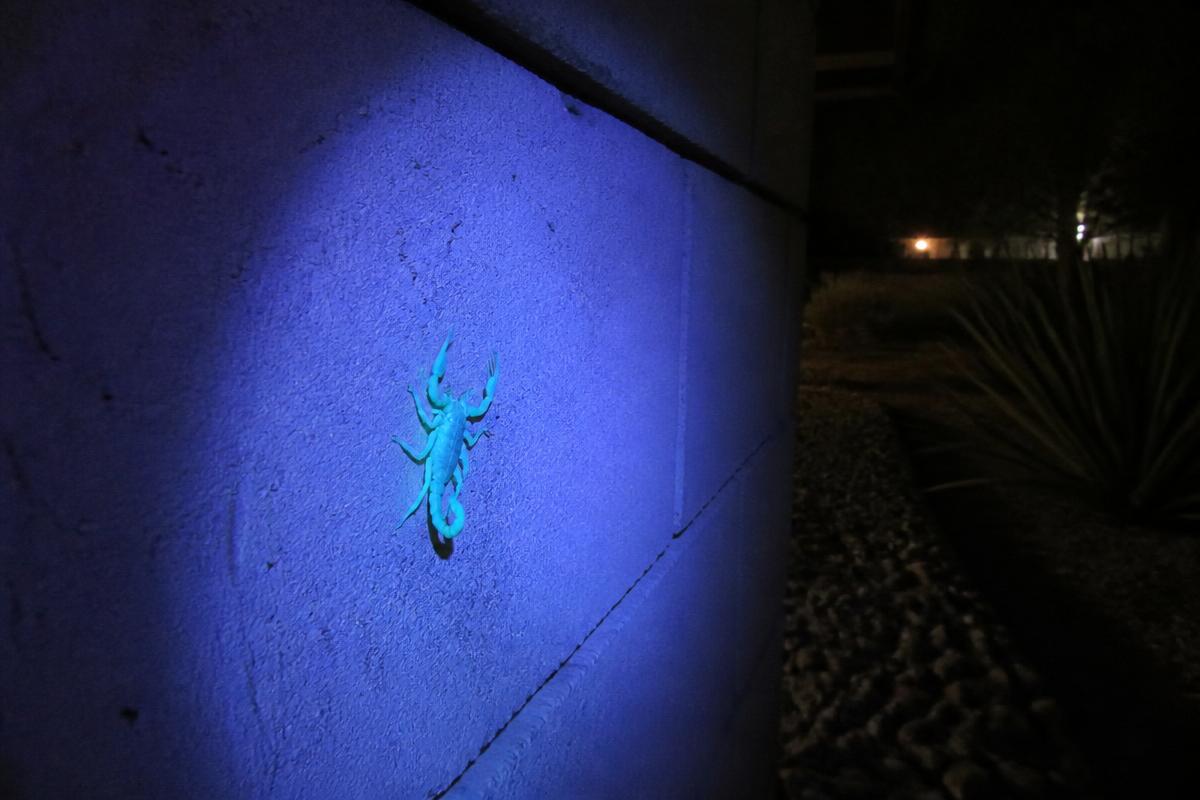
A scorpion quote given in daylight is largely guesswork, because the animal being quoted for is not out. A blacklight walk after dark turns an impression into something countable: how many, where along the wall they are moving, and how far in they are getting. That is the difference between treating where scorpions are and treating where you assume they are.
They fluoresce
Bark scorpions glow a bright blue-green under UV light because of compounds in their exoskeleton. Under a blacklight a wall or a block-wall cap that looked empty in daylight can show several at once.
They are nocturnal
Scorpions shelter through the day and hunt after dark. A daytime walk-around tells you very little about the population on a property.
It maps the harbourage
What matters is not the individual scorpion we find but where it came from — wall cavities, the underside of pavers, stored materials, irrigation boxes, tree bark, the cap of a block wall.
It sets the treatment
Where they are found determines where product goes and, more importantly, which gaps get sealed first.
How they get in
These are the entry points we find on Phoenix homes, roughly in the order we find them.
The weep screed / J-trim
The narrow gap where stucco stops above the slab. It is meant to drain, and it is the single most common scorpion entry point on Valley homes.
Door thresholds and sweeps
A worn or missing garage door seal, or a front door with daylight visible underneath. If light gets through, so does a scorpion.
Hollow block walls
Perimeter walls are cavities. They hold warmth, stay dark, and run the length of the property straight up to the house.
Roof and gable vents
Unscreened bird blocks and vents. Scorpions climb, so a second-storey opening is not out of reach.
Utility penetrations
Where plumbing, A/C lines, irrigation valves and electrical enter the wall, usually left unsealed by whoever installed them.
What comes in with you
Firewood, cardboard, pot plants and outdoor toys stored against the house, then carried inside.
Where scorpion pressure is worst in the Valley
Scorpion pressure is not spread evenly across Phoenix, which is why people search for a map of it. There is no official one, but the pattern is consistent enough to describe.
Backing onto desert preserve
Properties on the boundary of preserve or undeveloped desert have a continuous supply. North Phoenix, Cave Creek, Anthem, north Scottsdale and the Estrella and South Mountain edges all show it. Our Scottsdale page covers what that preserve boundary adds on top of everything else a property there is dealing with. Apache Junction has the same arrangement on the Superstition side, where the built edge simply stops.
Recently cleared land
New-build subdivisions on ground that was desert two years ago tend to have a bad first few seasons while the displaced population settles.
Heavy block-wall neighbourhoods
Dense block walling gives an unbroken sheltered route between properties. One untreated house feeds the street.
Irrigated and landscaped lots
Water and cover mean crickets, and crickets are what scorpions are hunting. Older irrigated neighbourhoods can have pressure well away from open desert.
If a neighbour is treating and you are not, you inherit their scorpions. It is one of the few pests where a co-ordinated street is genuinely more effective than a single property.
How we run a scorpion job
Scorpions are harder to shift than most Phoenix pests, and the reasons are biological. They live for years, they can go a long stretch between meals, and they pass through gaps most people would never think to seal. Spraying alone answers none of that, which is why the four steps below lean on sealing and on the insects scorpions came for in the first place.
Night inspection
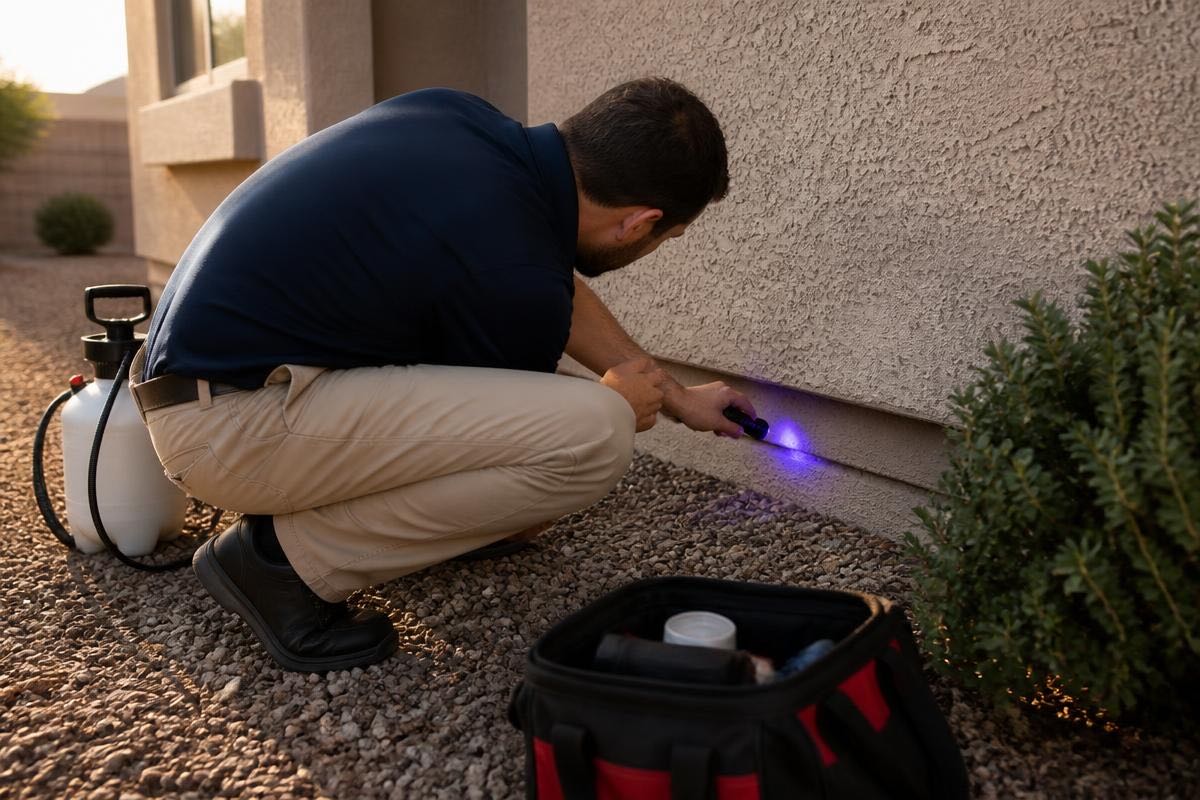
A UV walk of the property after dark — perimeter, block walls, patio, pool equipment, stored materials and the interior. We record where they are, not just how many.
Harbourage treatment
Dusting into wall voids, block wall cavities, weep screeds and utility penetrations, plus a perimeter application. Dust reaches the cavities a spray cannot.
Exclusion
Sealing weep screeds and J-trim, fitting or replacing door sweeps and garage seals, screening vents and bird blocks, and closing pipe penetrations.
Reduce the food
Cricket and roach control around the property, plus advice on the lighting, watering and storage habits that are feeding the population.
Scorpions are among the hardest pests to control, and any company promising a single visit and permanent silence is overselling — the questions worth asking anyone quoting you are set out separately. What is realistic is a large reduction after the first treatment, and a property that stops being easy to get into.
What you can do between visits
Move the woodpile
Firewood, pavers, bricks and timber stacked against the house is prime harbourage. Move it away from the wall and off the ground.
Change the outside lights
Bright white lights draw the insects scorpions eat. Warmer, lower-output fixtures near doors reduce the buffet.
Trim back to the wall
Shrubs, oleander and tree branches touching the house or the block wall give a covered route straight to the roofline.
Fix the water
Leaking drip lines, over-watered beds and a wet hose bib all support the crickets. Drying those out does more than most sprays.
Shake it out
Shoes, towels and folded washing left on the floor in the garage. It costs nothing and it is where most stings happen.
Why scorpions survive what kills other insects
People are often surprised that a product which clears ants and roaches barely touches scorpions. There are real reasons for that, and they shape how the job has to be done.
A scorpion is built to lose as little water as possible. The waxy layer over its cuticle is unusually effective, which is what lets it live in the desert — and it also slows the uptake of anything applied to a surface it walks across. Its metabolism is remarkably low; a bark scorpion can go for months between meals and survive far longer without water than most insects. So the two things that make an insecticide work quickly on other pests — rapid absorption and a fast metabolic rate — are both working against you.
On top of that, they are nocturnal and they spend the day pressed into a void: a block wall cavity, under a paver, inside a weep screed, in the gap behind a piece of trim. A residual sprayed across an open patio is a surface they may never cross. That is why the work concentrates on dusting into voids and harbourage where they actually rest, treating the specific bands they have to travel through, and sealing the routes in — rather than covering visible surfaces and hoping.
The other lever is food. Scorpions follow crickets, roaches and small insects, and a property with a heavy insect population at night is feeding its own scorpion problem. The spring scorpion guide walks through the DIY version of this. Reducing that population, and the lighting and watering habits that concentrate it, does more over a season than any additional spraying. In Fountain Hills, part of that is written into the town’s lighting ordinance, and our Fountain Hills page sets out which half of it actually matters.
If someone is stung
We are a pest control company, not a medical service, so treat this as orientation rather than advice — but it is the question people ask us most often, and having a plan before it happens is better than looking it up at 2am.
Arizona has a lot of scorpion species and only one of real medical concern: the Arizona bark scorpion. Most stings from it cause intense local pain, tingling and numbness that spreads from the site, and are managed at home. The reactions that need urgent care — difficulty swallowing, a thick tongue, roving eye movements, muscle jerking, trouble breathing — are far more likely in young children, and in small children a sting should always be taken seriously.
The Poison Control line on 1-800-222-1222 is free, staffed around the clock, and connects to a centre that handles Arizona scorpion stings routinely. They will tell you whether to stay home or go in. For a straightforward sting, the usual measures are washing the area with soap and water, applying a cool compress rather than ice directly on the skin, keeping the limb still and roughly at heart level, and taking the pain relief you would normally take. Do not cut the site, do not try to suck out venom, and do not apply a tourniquet — those cause harm without helping. Severe cases are treated in hospital, and an antivenom exists for the ones that need it.
If you are being stung indoors more than once, that is not bad luck. It means there is a route in, and finding it is the whole point of the inspection.
Scorpion questions we get asked in Phoenix
When do scorpions come out in Phoenix?
Activity climbs as nights warm from around March, peaks through the hottest months, and falls away in October and November as they move into sheltered voids to overwinter. They are nocturnal all year, so a quiet daytime property tells you very little.
Are bark scorpions dangerous?
The bark scorpion is the only scorpion in Arizona whose sting is generally considered medically significant, and reactions vary a lot between people, with young children and older adults more affected. We are a pest control company, not a medical service — for advice on a sting, call Poison Control on 1-800-222-1222, which is free and staffed around the clock, or seek emergency care if symptoms are severe.
Why do scorpions keep coming back after spraying?
Because spraying deals with the ones walking across the treated surface, and the population lives in cavities you cannot spray into — block walls, wall voids, under pavers. Combine that with entry points still being open and the count rebuilds within weeks. Dusting the harbourage and sealing the gaps is what changes it.
Can scorpions really get through a tiny gap?
A bark scorpion can flatten through a gap roughly the width of a credit card. That is why weep screeds, worn door sweeps and unsealed pipe penetrations matter more than they look like they should.
Do I need my neighbours to treat as well?
It helps more than with any other pest. Block walls connect properties, and a treated house next to an untreated one keeps receiving arrivals. If several houses on a street treat in the same season the difference is noticeable.
Will getting rid of crickets reduce scorpions?
Yes, indirectly. Crickets are a primary food source, so a property with a heavy cricket population is a property worth staying on. Cricket control and fixing the lighting and watering that attract them is part of the job rather than an add-on. If the crickets are the complaint in their own right — one chirping indoors at two in the morning — our cricket control page deals with that on its own terms.
Is the treatment safe around children and pets?
We use EPA-registered products applied into voids, cracks and the perimeter rather than across living space. Your technician will tell you which areas to keep clear and for how long. Dusts go where hands and paws do not reach, which is part of why we use them here.
How many visits does it take?
Most Phoenix properties need an initial treatment plus follow-up through the warm months rather than a one-off. The sealing work is done once and keeps paying; the treatment side is seasonal because the pressure is seasonal.
Related services
Rodent Control in Phoenix
The same weep screeds and roof vents let rodents in. Often sealed on the same visit.
Termite Control in Phoenix
Subterranean and drywood treatment, plus WDIIR reports for escrow.
Cockroach Control in Phoenix
Crickets and roaches are what scorpions are hunting. Reducing them reduces scorpions.
Seen one indoors?
Tell us where you found it and whether the property backs onto desert. Scorpion inspections run after dark, so we will book you a slot that actually shows what is there.