Pest control services in Phoenix, priced flat and quoted after we look
Twelve programmes, all built around Sonoran Desert pests rather than a national script. Every one starts with an inspection, and you get the number before any work begins.
Get a free quote
No obligation. We reply within 2 hours.
How our pest control service in Phoenix, AZ works
Three formats cover almost everything, and which one you need is usually decided by the pest rather than by the budget. Something that walked in from the yard and will not breed indoors is a one-off job: close the route, deal with what is already inside, and the matter ends. Anything with a population outside that keeps resupplying the building — scorpions on a desert boundary, roof rats in mature citrus, ants working a trail — needs intervals, because the arrivals do not stop just because the current ones are gone. A business is its own case, since the standard is not how the premises feel but what an inspector will record. If you cannot tell which of the three applies, describe what you have been finding and we will place it for you.
There are really only three shapes a job takes, and knowing which one you need saves a conversation.
One-off treatment
You have a specific problem — a wasp nest, a rodent in the ceiling, roaches after a house move. We inspect, treat, and where it needs a return visit we schedule it. No contract.
Recurring programme
Quarterly or bi-monthly protection covering the common household pests, with the exterior barrier and interior spot work kept up so problems do not start. Most Valley homes sit here.
Commercial contract
Scheduled service around your trading hours with a written report after each visit, for restaurants, warehouses, offices, rentals and multi-family. See commercial pest control.
What every visit includes
The point of a fixed list is that it stops a visit becoming whatever the technician felt like doing that morning. Every item below happens on every job, in this order, whether the call is a one-off ant trail or the fourth visit of a scorpion programme. It is also a list you can hold anyone to, including us: if a company cannot tell you before arriving what the visit consists of and what it will cost, that is worth knowing before they are standing in your kitchen rather than after. Nothing here is unusual in the trade. It is simply written down, which is the part that is less common than it should be.
An inspection first
Species, entry points and the conditions sustaining them. A quote written before anyone walks the property is a guess.
A flat price up front
You get the number before work starts. It does not move once the technician is on site unless the scope genuinely changes and you agree first.
Targeted application
EPA-registered products applied to the zones that matter — voids, cracks, perimeter, harbourage — not blanket-sprayed across living space. If there are animals in the house, pest control with pets explains what that placement changes and what the word “pet-safe” is actually worth.
Sealing where it counts
Weep screeds, thresholds, utility penetrations, vents. Product handles what is there now; exclusion is what stops the next lot.
Clear timings
Which areas to keep clear, and for how long. Your technician tells you before they start, not after.
Follow-up when needed
Rodent, bed bug and German cockroach work needs return visits. Those are scheduled in rather than sold to you later.
Our pest control services in Phoenix
Most of these are the same underlying job wearing different clothes. Find where the thing actually rests, close the route it travels, treat the narrow band it has to cross, and remove whatever is feeding it. What changes between them is the detail, and the detail is where jobs are won or lost — a bark scorpion needs dust pushed into a hollow block wall, a German cockroach needs bait that is not competing with crumbs, a subterranean termite needs a continuous treated zone in soil rather than anything applied to a surface. Each page below sets out the specific version for that pest, including the parts that commonly get done wrong.
Each programme below links to its own page. Eight are written up in full; the rest are covered inside the general programme.
General Pest in Phoenix
A quarterly barrier programme covering the common pests found in Phoenix homes, with interior spot treatment and a full exterior perimeter service.
Termite Control in Phoenix
Subterranean and drywood termite inspections, trenching, bait stations, and escrow-ready reports for Valley homeowners.
Termite Inspection & WDIIR
What an inspection costs in Phoenix, what the inspector actually checks, and the wood-destroying insect report that escrow asks for.
Rodent Control in Phoenix
Roof rat and mouse exclusion: we seal entry points, set monitored traps, and return until activity reads zero.
Scorpion Control in Phoenix
Bark scorpion treatment built around blacklight inspection, block-wall dusting, and weep-screen and threshold sealing.
Cockroach Control in Phoenix
Targeted gel baiting and crack-and-crevice work for German, American, and Turkestan roaches in kitchens, garages, and alley walls.
Ant Control in Phoenix
Bait-led treatment matched to the species, whether that is trailing house ants, southern fire ants in a lawn edge, a harvester nest or carpenter ants in damp timber.
Bed Bug Control in Phoenix
Discreet bed bug elimination using heat treatment and residual applications, with follow-up verification visits.
Bee & Wasp Removal in Phoenix
Swarms, colonies in meter boxes and bees established inside a wall or roof, plus comb removal and closing the cavity. Paper wasp nests on eaves too.
Mosquito Control in Phoenix
Monsoon-season yard barrier treatments, breeding-source reduction, and larvicide for standing water.
Spider Control in Phoenix
Web and egg sac removal, a full survey of the low voids where widows sit, and work on the insects the spiders are feeding on.
Cricket Control in Phoenix
Finding the one that is chirping indoors, and dealing with the yard population that keeps sending more of them in.
Commercial Pest Control in Phoenix
Restaurants, warehouses, offices, rentals and multi-family. Scheduled around your trading hours and documented for the health inspector. Non-food sites have their own set of problems, and offices, warehouses and industrial units are covered separately.
Restaurant & Food Service
Kitchen programmes built around the Maricopa County inspection, the drains and the equipment voids where pests actually live.
Weed Control in Phoenix
Twice-yearly pre-emergent timed to both germination windows, plus stinknet and goathead that consumer weed killers miss.
Which service do you actually need?
The useful question is rarely which pest you have. It is whether the thing you are seeing is produced inside the building or delivered to it from somewhere else, because those two situations have almost nothing in common beyond the insect. A property generating its own population needs the harbourage found and the cycle broken. A property receiving arrivals needs the perimeter and the entry points, and will keep receiving them for as long as the source next door or over the wall is there. The four groupings below are the ones that actually behave differently on a Phoenix property; everything else is a variation inside one of them.
The most common mistake is booking a general treatment for a structural problem. Here is the short version.
Ants, crickets, spiders, the occasional roach
A general quarterly programme handles these. They are surface-level problems and a maintained barrier keeps them down.
Scorpions, rodents, termites
Structural. The visible pest is a symptom, and the fix involves sealing or soil work rather than spraying. These need their own service, not a general visit.
Bed bugs
Always its own job. Method, preparation and follow-up all differ from anything else we do, and it is quoted separately after inspection.
Something in a business
Commercial, because the documentation matters as much as the treatment when an inspector asks to see your pest control log.
What we do not do
A company that claims it handles everything is telling you nothing, and the four below are the requests we turn down most often. Saying so in advance is cheaper for everybody than discovering it on the day, and in two of these cases the right trade will do the work better and for less than we would charge to do it badly. None of this is a reluctance to take on difficult jobs. It is the difference between the work that genuinely belongs to a licensed pest control business in Arizona and the work that has simply been sold alongside it because the customer was already on the phone.
Worth saying plainly so you are not disappointed on the day.
Repairs and construction
We seal gaps as part of exclusion. We do not re-stucco a wall, replace a roof vent assembly or repair termite-damaged timber — that is a builder, and we will tell you when you need one.
Landscaping
Weed control is a treatment programme, not garden maintenance. We are not trimming, planting or caring for turf.
Wildlife trapping
Rodents, yes. Snakes, javelina, coyotes and larger wildlife are a different licence and a different service.
Guaranteeing zero pests forever
Phoenix sits in the desert. New scorpions, ants and roaches arrive from outside constantly. What a programme does is keep the population down and the building closed — anyone promising permanent silence is overselling.
What it costs
Recurring residential cover across the Valley sits at roughly $40 to $100 a month, and a one-time general treatment usually falls between $110 and $300. Where a property lands depends on its size and construction, which pest is involved, how far the problem has progressed, and whether you want a one-off or an ongoing programme.
Termite, bed bug and commercial work is quoted separately after inspection, because the range on those is far too wide to publish an honest single figure. Whatever the job, you have the price before we start.
What actually happens on a first visit
Knowing the shape of the appointment makes it easier to plan your day around, and it tells you whether what you are being sold elsewhere is a real inspection or a quick spray.
We start outside
The perimeter is where nearly everything is decided. We walk the full boundary looking at the weep screed line, thresholds, utility penetrations, the irrigation, the block walls, any citrus or dense planting touching the structure, and where water sits after the irrigation runs.
Then only where we need to be inside
Interior inspection is targeted, not a tour of the house. Kitchens and bathrooms for roaches and drains, the garage and laundry for entry points, the attic access if the evidence points upward, and the specific rooms where you have seen something.
We ask you what you have seen
Where, when, how often, and what time of day. It is the fastest route to the right identification, and it frequently changes the plan — daytime biting outside means a different mosquito than evening biting, and that changes where we look.
You get the findings before any work
What we found, what we think it is, what we recommend and what it costs. If we think you do not need a recurring plan, we say so at this point rather than after you have signed one — the way we work is set out in full separately.
A first visit on a typical Phoenix property runs somewhere between forty-five minutes and an hour and a half, depending on lot size and how much of the perimeter is accessible. It takes longer than a treatment-only visit because most of it is looking rather than applying. If someone quotes you a first visit measured in ten minutes, they are not inspecting.
How we decide what to use, and what that means for your household
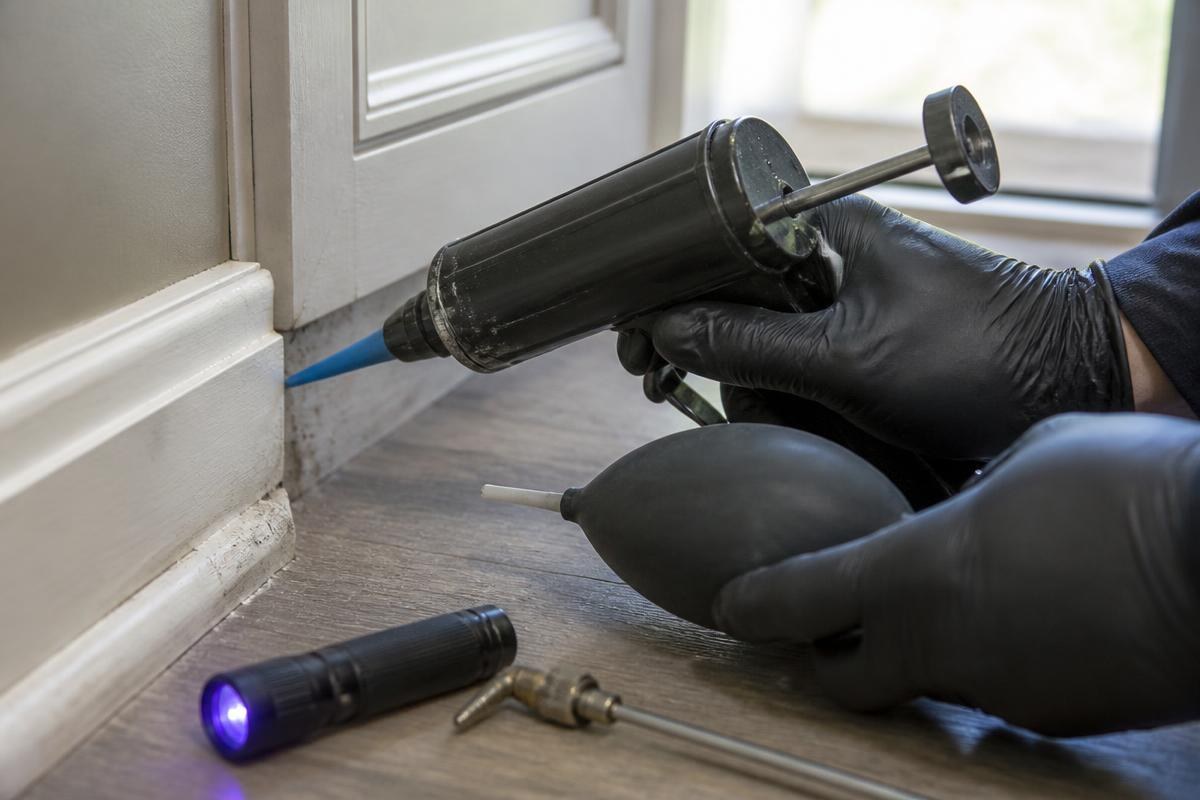
There is no single product that handles everything, and treating as though there is one is how properties end up on an endless spray cycle. The decision runs in a fixed order.
Identify first. The treatment for an American cockroach coming up a drain and a German cockroach breeding in a kitchen are almost opposites, and getting that wrong wastes the visit. The same goes for a roof rat versus a house mouse, or a subterranean versus a drywood termite.
Then remove what is supporting it. Exclusion, water and food. Sealing a gap or getting a dripping valve fixed is permanent in a way that a residual never is, so it comes before product wherever it is possible.
Then choose the narrowest tool that reaches the pest. In practice that means one of a small number of things:
Baits
Taken back to the nest or colony, so they reach insects you never see. The main tool for German cockroaches and most ants, and placed in cracks and voids rather than on open surfaces.
Dusts
Applied into wall voids, weep holes, and the harbourage behind trim. Stays put and stays effective in dry voids far longer than a spray, and it goes where the pest actually rests.
Targeted residuals
Applied in bands to the specific surfaces a pest has to cross — not broadcast across a yard or sprayed around a room.
Growth regulators
Interrupt the moult so an immature insect never reaches breeding age. Slow, but they break the cycle rather than the current generation, which is why they are used alongside baits.
Your household changes those choices, and it is worth telling us up front. Children and pets shift work into voids and enclosed stations rather than accessible surfaces. A fish tank or a pond means avoiding pyrethroids upwind and covering the water. Bee hives or a flowering garden mean not treating blooms and not applying during foraging hours. Chickens, tortoises and reptiles all have their own constraints. Everything we apply has a label with a re-entry interval on it — usually until the product has dried — and we will tell you what yours is and put it on the report rather than leaving you to guess.
Service questions we get asked
Do I have to sign a contract?
No. Plenty of customers book a single treatment and nothing else. A recurring programme costs less per visit and stops problems starting, but it is your call, and we will not make a one-off job conditional on signing up.
How quickly can you come out?
Across the core metro we can usually offer something the same day or the next, and further out it depends on the run we already have scheduled. We take calls from 6am to 9pm, seven days a week, including weekends.
Do I need to be home?
For an interior treatment or an inspection, yes. Exterior-only service on a recurring programme usually does not need you there, as long as we can reach the gates and the yard.
Are the treatments safe for children and pets?
We use EPA-registered products applied to targeted zones rather than across living space, and your technician tells you which areas to keep clear and for how long. Tell us about pets, fish tanks, beehives or anyone with respiratory sensitivity before the visit and we will plan around it.
What if the pests come back between visits?
Tell us. On a recurring programme a return visit between scheduled services is part of what you are paying for, not an extra charge.
Do you treat businesses as well as homes?
Yes — restaurants, warehouses, offices, rentals and multi-family buildings, on scheduled programmes with written reports. That is commercial pest control.
Can you handle more than one problem in the same visit?
Usually yes, and it is cheaper than booking separately. Scorpion sealing and rodent exclusion in particular overlap almost completely, since the same gaps let both in.
Which areas do you cover?
Phoenix and the surrounding Maricopa County communities. Every city and community we cover is listed on our service areas page.
Not sure which service you need?
Describe what you are seeing and where. We will tell you which programme fits, or tell you that you do not need us — both happen.