Bed bug treatment in Phoenix, explained honestly before you book it
Heat or chemical, what each actually does, what it costs you in preparation, and how long it really takes. Discreet vehicles, and a verification visit before we call it finished.
Get a free quote
No obligation. We reply within 2 hours.
First, the thing everyone wants to hear
Bed bugs are not a hygiene problem. They travel — in luggage, on second-hand furniture, in a delivery box, on a bag set down in the wrong place. Spotless homes get them, and so do hotels that cost several hundred dollars a night. Nobody who works in this industry thinks less of a customer for calling about bed bugs, and if a company makes you feel otherwise, use a different company.
The second thing worth knowing early: what you do in the first week matters. The two most common reactions — setting off bug bombs and throwing out the mattress — both tend to make the job harder and more expensive, for reasons below. If you want the reasoning rather than the recommendation, our guide to the bed bug life cycle explains why the eggs are what decide whether any treatment worked.
How to tell it is actually bed bugs
Bites in a line or cluster
Often on arms, shoulders and legs — skin left exposed while asleep. Bites alone are not proof, though: people react very differently and some do not react at all.
Small dark spots on the sheets
Digested blood. They look like a felt-tip dot that has bled slightly into the fabric, usually near the mattress seam or the head of the bed.
Shed skins
Pale, empty casings in the mattress seam, behind the headboard or in the bed frame joints. A strong sign of an established population rather than a single hitchhiker.
Live insects
Apple-seed sized, flat, reddish-brown. They hide within a few feet of where you sleep, so check seams, the frame, the headboard and the first few inches of carpet edge.
A sweet musty smell
Reported with heavier infestations. On its own it means little, but with any of the above it is worth an inspection.
Not fleas or carpet beetles
Fleas bite ankles and jump; carpet beetle larvae cause a rash that is often mistaken for bites. Getting the identification right changes the entire treatment.
What a bed bug inspection involves, and whether a dog is worth it
A bed bug job should never start on a guess. The species in Arizona homes is the common bed bug, Cimex lectularius, and confirming it takes a proper look rather than a glance: mattress and box spring seams, the piping and label edges, headboard joints and the wall behind them, bed frame screw holes, the underside of a bedside drawer, and the carpet edge nearest the bed.
What confirms it is usually the evidence rather than the insect. Dark spotting where they have fed, translucent shed skins caught in a seam, and eggs cemented into a joint. Live bugs hide during the day; the marks they leave do not.
Canine detection is the other route, and it is worth understanding rather than dismissing. A trained dog and handler screen a room far faster than a person can, which is why the method earns its place in apartment blocks, hotels and student housing around Tempe and across Maricopa County, where twenty units have to be cleared to find the two that matter. Accuracy depends on the handler and the conditions on the day as much as on the dog, so an alert is a reason to look hard at that spot rather than a diagnosis on its own.
For a single home in Phoenix, Scottsdale or Mesa with a known bite pattern and one bed to examine, a careful visual inspection answers the question at lower cost. Ask a company which method it uses and why before you book. The answer tells you how they think.
If you would rather look before you call anyone, there is a published protocol for doing it properly. Purdue University’s Extension entomologists set one out for residents, and the order matters more than the effort: you start where people sleep and work outward, because that is where the evidence concentrates.
The tools are ordinary. Purdue’s list is a magnifying glass, tweezers, a small jar with a lid or a piece of tape and card to hold a sample, labels to record where each one came from, something to write with, and a camera. The sample matters more than it sounds — a positive identification ends the guessing, and a photograph of a spotted seam is the quickest way to tell us what you are dealing with before anyone arrives.
The sequence runs bed first, then outward. Pull back the bedspread and check the top sheet, then the bottom sheet and the mattress pad. Strip the bedding, and if you have already seen signs, bag and seal it rather than carrying it through the house. Then the mattress — top, bottom and every seam — and the box spring with it. Then the bed frame, into the cracks. Then the headboard and footboard, pulled away from the wall so you can see the legs, the upholstery creases, the back panel and the gap between the board and the mattress.
Only then does the search widen: the night stand, wall hangings, rugs and anything stored under the bed, then dressers, armoires, chairs and storage units, then the closet — particularly clothing nobody has worn in a while — and last the other rooms, where upholstered furniture and undisturbed clutter are the places that repay a look.
How far out is worth the effort is a question the EPA answers with a number: bed bugs will readily travel five to twenty feet from their harbourage to reach someone sleeping. That is the radius a thorough check has to cover. And the assumption that searching in daylight is pointless is wrong — the EPA notes that although they are mostly active at night, a hungry bed bug will look for a host in full daylight.
One thing worth saying plainly, because it is where a home inspection most often goes wrong: finding nothing is not the same as there being nothing. A light, early infestation can be genuinely hard to see, and that is an argument for a second pair of eyes rather than for treating on suspicion.
Where we look first
Mattress seams and piping, the headboard joint, bed frame screw holes, and the carpet edge within a metre of where someone sleeps.
What confirms it
Dark faecal spotting, translucent shed skins and cemented eggs. The evidence outlasts the insect and is easier to find.
When a dog earns its keep
Multi-unit buildings, hotels and student housing, where the task is clearing many rooms quickly rather than examining one.
What we will not do
Treat on suspicion. If an inspection cannot confirm bed bugs, you get told that rather than sold a treatment.
Heat or chemical? The honest comparison
Both work when they are done properly. They cost different amounts, take different lengths of time, and ask different things of you. Any company that only ever recommends one of them is describing its own equipment, not your situation.
Heat — what it does
The structure is raised to a lethal temperature and held there. It reaches into wall voids and furniture, and it kills every life stage including eggs, usually in a single day.
Heat — the cost to you
It is the more expensive option, and it is the more demanding preparation: heat-sensitive items have to come out first — aerosols, cosmetics, candles, medication, vinyl records, houseplants, some electronics. Clutter has to be opened up so hot air circulates.
Chemical — what it does
Targeted residual application to harbourage, repeated. Cheaper per treatment and far less disruptive on the day, but it does not kill eggs, so it needs follow-up visits timed to when those eggs hatch.
Chemical — the cost to you
Time. Expect the process to run over several weeks rather than one day, with bagging and laundering of bedding and clothing between visits, and the discipline to not move things around mid-treatment.
In practice a lot of Phoenix jobs end up combined: heat where the population is concentrated, residual treatment around it to catch anything that moved. We will tell you which we think fits after the inspection, and why.
What we need you to do before we arrive
Most of the damage in a bed bug job is done in the week before anyone is called, and it is done with the best intentions. Moving out of the bedroom, setting off a fogger, or throwing the mattress on the drive all feel like taking action, and all of them make the treatment harder and longer. Four things to do, and not do, before we arrive.
Stop moving things
Do not shift mattresses, furniture or bags into other rooms. It is the single most common way a one-room problem becomes a whole-house problem.
No bug bombs
Foggers do not reach into harbourage and they scatter the population deeper into voids and adjacent rooms. A treatment after a fogger is harder and usually costs more.
Launder and bag
Bedding, curtains and worn clothing washed hot and dried hot, then sealed in bags until we are done. Dry heat is the part that kills; washing alone is not enough.
Keep the mattress
Unless it is falling apart, keep it. Throwing it out does not remove the population, it costs you a mattress, and dragging it through the house spreads them. An encasement afterwards is cheaper and works better.
You will get a written preparation list specific to the method and the property. Following it properly is genuinely the difference between one treatment cycle and three.
Rentals, apartments and short-term lets
Bed bugs in a shared building are a different problem from bed bugs in a house.
They move between units
Along shared plumbing, wall voids and conduit. Treating a single unit while the neighbours go untreated usually just relocates the population and buys a few weeks.
Inspect the neighbours
We inspect the units either side, above and below as standard. It looks like extra work and it is what keeps the job from repeating.
Short-term rentals
A turnaround that fits between guests, and a verification visit before the listing goes back up. Scottsdale licenses its short-term rentals and requires a named contact who must attend within the hour, which is set out on our Scottsdale page. One review mentioning bed bugs costs more than the treatment did.
Documentation
Property managers get a written report of what was found, what was treated and what needs doing, which is what you want on file if a tenant disputes the timeline.
Is it worth calling an exterminator, or can you do this yourself?
This is the question most people arrive with, and the honest answer depends entirely on how early it was caught. A single bug found on a suitcase the night you got home is a laundry problem. An established population in a bedroom is not, and the reason is biology rather than effort.
Bed bugs shelter in cracks narrower than a credit card, and a supermarket spray only kills what it lands on. Eggs are cemented in place and survive most contact products, so a treatment that ignores the hatch cycle simply resets the clock two weeks later. Heat works because it takes the whole room past the lethal threshold and holds it there, which is not something a domestic heater reproduces safely.
The expensive part of a failed attempt is not the products. It is that the survivors move outward, from the bed into the sofa, then the next room, and in a shared building the next unit. A job that was one room in March becomes a whole-home bed bug removal in June, and the second version costs several times the first. If you want to try, give it one honest attempt with encasements, hot laundry and a vacuum, then call a bed bug exterminator if you see anything at all after two weeks.
Worth doing yourself
The first day or two after travel. Hot laundry, a thorough vacuum and mattress encasements, before anything has spread beyond the bed.
Not worth doing yourself
Anything already established. Sprays miss the eggs, and the follow-up you skip is the one that mattered.
What getting it wrong costs
A one-room job becoming a whole-home removal. The ranges above show what that difference looks like in money.
The two-week test
Treat once, wait two weeks, then look again at the seams. Anything at all means eggs hatched and it needs doing properly.
What bed bug treatment costs in Phoenix
Bed bug work is quoted after an inspection rather than from the general pest price list, because the job scales with the number of rooms the population has reached. These are the ranges a household in Phoenix, or anywhere else in Arizona, should expect.
$70 – $180
Inspection. A visual check of the bed, frame and the harbourage around it, with a written finding and a quote before anything is treated.
$250 – $400
One room, caught early. The usual case when someone finds it in the first bedroom and calls straight away.
$500 – $800
Two rooms. Typically a bedroom plus the living room sofa, which is where a population moves next.
$1,000 – $2,200
Whole home. An established infestation that has reached several rooms and needs the whole structure treated.
$750 – $2,000+
Heat treatment. Priced by treatable area rather than by room, and the more expensive route per visit.
Where a particular job lands inside those ranges comes down to four things.
Method
Heat is priced by the treatable area and is the more expensive of the two. Chemical is cheaper per visit but involves more visits.
How many rooms
A single bedroom caught early is a very different job to a whole home where the population has reached the living room furniture.
How long it has run
Bed bugs spread outward from where people sleep. Months of unnoticed activity means more harbourage and more follow-up.
Clutter and access
Heat needs air to circulate and technicians need to reach harbourage. A packed room adds time to every stage.
Whatever the method, you get a flat price after the inspection and before work starts, and the number of included follow-up visits is written into it rather than added later.
How we confirm it is actually gone
This is the part of a bed bug job people skip, and it is the reason so many “finished” treatments turn back into infestations six weeks later. Stopping being bitten is not evidence. Bites fade, some people never react visibly at all, and a small surviving population takes weeks to build back to the point where you notice it again.
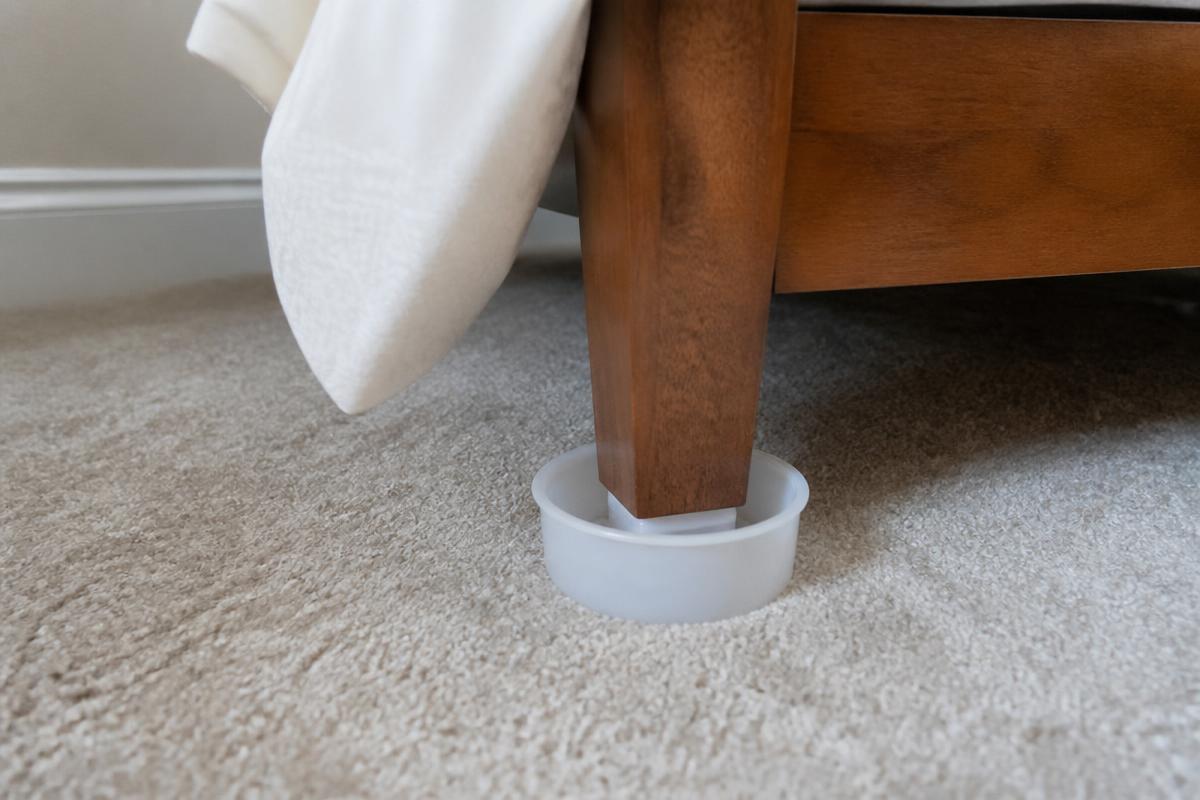
So the job closes on monitoring, not on feeling. Interceptors — shallow pitfall cups — go under the legs of beds and upholstered furniture. A bed bug travelling to or from the bed has to pass through one, and cannot climb back out of the inner well. They cost very little, they are passive, and they turn “I think we are clear” into a countable number you can look at each week.
The timing follows the insect rather than the calendar. Eggs are the stage that survives most treatments, and at normal indoor temperatures they hatch roughly a week to ten days after they are laid, with the nymph then needing several more weeks and several blood meals to reach adulthood. That is why the follow-up visit is scheduled around the hatch rather than “in a fortnight”, and why a single treatment with no return visit is rarely enough on anything but the earliest catch.
We treat a job as clear when the interceptors have read zero for a sustained monitoring period after the last live find, and there is no fresh evidence at the seams and headboard. If something turns up in that window, we come back — that is what the monitoring is for.
Not bringing them home again
Bed bugs do not appear in a clean house from nowhere. They arrive on something. In Phoenix that is usually travel or second-hand furniture, and both have a routine that makes reintroduction unlikely.
Check before you unpack
In a hotel or rental, put the case in the bath or on a hard surface, not on the bed or the carpet. Pull back the sheet at the head of the mattress and look along the piping and the seams, then behind the headboard if it lifts. You are looking for small dark spotting and shed skins, not for live insects.
Keep luggage off soft surfaces
Use the metal rack, away from the wall, for the whole stay. Most travel-related introductions come from a case left open on a bed.
Deal with the bag on arrival
Unpack straight into the dryer rather than into a wardrobe. A hot cycle of around half an hour kills every stage including eggs, and it works for clothes that were never worn as well as those that were. Then store the case away from the bedroom.
Be careful with second-hand furniture
Upholstered items and bed frames from a kerb or a marketplace listing are the other common route. Inspect seams, staples, screw holes and the underside of the frame in daylight before it comes through the door.
None of this is about being houseproud. Bed bugs are not a hygiene problem — see the identification guide for what the evidence looks like — they are a transport problem, and they are equally at home in a spotless house. The routine above takes a few minutes and removes the two ways they usually get in.
Bed bug questions we get asked in Phoenix
Can bed bugs survive a Phoenix summer?
Easily, because they live indoors where you do. Air conditioning keeps Valley homes in a range bed bugs are very comfortable with all year, so there is no seasonal die-off to wait for. Outdoor heat only helps if it is applied inside the structure deliberately, which is what heat treatment does.
Does one treatment finish it?
Heat can, when the whole structure is treated and preparation was done properly. Chemical treatment does not — it cannot kill eggs, so follow-up visits timed to hatching are part of the method rather than a sign something went wrong. We book those in from the start.
Should I throw out my mattress?
Usually no. It does not remove the population, it spreads them as you carry it out, and you have then bought a new mattress into an untreated room. A zipped encasement after treatment is cheaper and lets us monitor.
Will a bug bomb help while I wait?
It will make things worse. Foggers do not penetrate the seams and voids bed bugs live in, and they push the survivors deeper into the structure and into neighbouring rooms. Treatment after a fogger takes longer.
Do I have to leave the house?
For heat treatment, yes for the day, and pets and plants go too — our pet-safe pest control page sets out how we work around animals. For chemical treatment you are usually back in the same day once treated areas have dried. Your technician will give you exact timings before the visit.
How did I get them?
Almost always travel or second-hand items — a suitcase, a hotel stay, a rideshare, a used headboard or sofa. It is not about cleanliness, and there is no useful answer to who is to blame, so we do not spend time on it.
Can I just treat one room?
Only if the inspection says the population really is confined to it, which is worth checking rather than assuming. Bed bugs spread outward from where people sleep, so a second sofa or a spare room is often already involved by the time bites are noticed.
How do I stop it happening again?
Check hotel mattress seams and headboards before unpacking, keep luggage off the bed and floor, and run travel clothing through a hot dryer when you get home. For second-hand furniture, inspect the joints and seams before it comes through the door.
Is it worth getting an exterminator for bed bugs?
If the population is established, yes, and the reason is the eggs rather than the adults. Over-the-counter products do not reach eggs cemented into a seam, so the hatch two weeks later restarts a problem you thought was finished. Caught in the first day or two after travel it is genuinely a laundry and encasement job. Past that point, a second attempt almost always costs more than doing it once properly.
How do I check for bed bugs myself?
Start where people sleep and work outward. Pull back the bedding and check the sheets, then the mattress top, bottom and seams, the box spring, the cracks in the bed frame, and the headboard with it moved off the wall. Then the night stand and anything stored under the bed, then other furniture, then the closet. A magnifying glass and a camera are the only tools most people need. That order is Purdue Extension’s published protocol for residents, and it is the same order we work in.
How far from the bed should I look?
About five to twenty feet. That is the distance the EPA says bed bugs will readily travel from a harbourage to feed on someone, so it is the radius a proper check covers. Searching the whole house before the bed itself has been examined carefully is the common mistake — the evidence is nearly always concentrated close in.
Think you have bed bugs?
Send us what you have seen and where. If it turns out to be fleas or carpet beetles we will tell you that too, and you will not have paid for a bed bug treatment you did not need.