Spider control in Phoenix is mostly about what the spiders are eating
A house with spiders in it is a house with insects in it. Remove the spiders and leave the supply alone, and the webs are back within the month, which is why this job is web work, egg sac work and prey work rather than a spraying round.
Get a free quote
No obligation. We reply within 2 hours.
A spider is a second-order problem
Spiders do not scavenge, they do not come in for crumbs, and there is no such thing as a spider bait, because nothing on this list eats anything it did not catch alive. Every spider in your house is there for the same reason: something it can eat is there too.
That is the whole difference between this job and every other one on the site. A roach problem is about food and moisture, a rodent problem is about gaps, a termite problem is about timber and soil. A spider problem is a report on your insect population, delivered by something with eight legs sitting in the corner of the garage.
It also explains the pattern everybody describes on the phone. The spiders get knocked down, the webs come off, the house is clear for two or three weeks, and then it looks exactly as it did before. Nothing failed. The vacancy was refilled, because the thing that made the spot worth occupying was never touched.
University of Kentucky entomologists make the same point from the other side: spiders are beneficial animals that prey on flies and other pests. The ones outdoors on a desert lot are doing work you would otherwise pay for. What matters is where they are, not how many there are in total.
What a spray does, and what it does not do
This is worth being straight about, because the honest answer sells less work and produces better results.
Products applied around the outside of a building have a real place in this job and there are pyrethroid actives made for exactly that, applied periodically through the warmer months. What they are not is a solution on their own. The published extension guidance is consistent on the point: pesticide alone, with no work done on the habitat that suits the spiders, does not hold, and control by spraying is temporary unless it comes with the physical side of the job.
Part of the reason is the animal itself. A spider stands on the tips of long legs, so it touches very little of any treated surface, and it does not groom the way an ant or a roach does after crossing one. Put that next to the fact that it will not take a bait and you have a pest that is genuinely awkward to reach with chemistry, and unusually easy to reach with a brush.
Which is why the guidance from the University of Kentucky is as blunt as it is: a vacuum cleaner or broom effectively removes spiders, webs and egg sacs, and doing that is the best way to be rid of them and to discourage them from coming back. On a service visit the same principle drives the order of work. Physical removal first, targeted treatment into the harbourage that cannot be reached with a brush second, and the insect supply dealt with as its own piece of work.
The web tells you which job you have
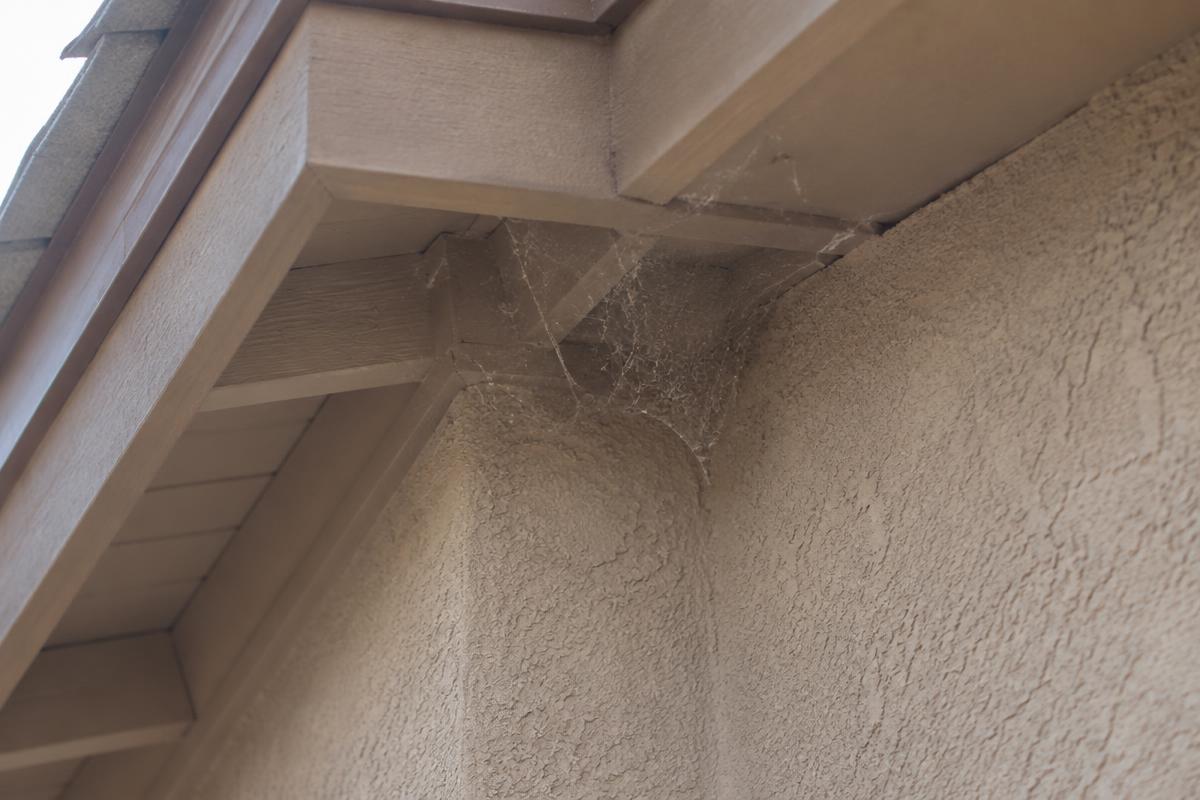
Before anybody worries about the species, look at the silk. It says more about what to do next than the spider does, and you can read it from a few feet away. If you do want the name, our guide to identifying Arizona spiders does that properly.
A messy tangle, low down and out of the weather
Irregular silk in a sheltered corner near ground level is the one to take seriously, because that is how widows build. Meter boxes, irrigation valve boxes, the underside of patio furniture, the gap behind a pool pump, the cavity at the top of a block wall, the lip under a garden bench. These are all dark, undisturbed and close to the insects that move along the ground at night, and they are places people put their hands without looking.
What it changes: the work is a systematic pass through every box, cavity and underside on the property rather than a spray along the wall, and it is the one situation where we care about what is in the silk as much as the spider on it.
A neat wheel across a light, a gate or a window
An orb web strung where you walk into it is a lighting problem wearing a costume. The spider has built across the flight path of whatever the porch light pulled in last night, and it will rebuild there as long as the queue keeps arriving. Knocking it down is a two-second job with a three-day result.
What it changes: the fix is the bulb and its position rather than the spider, which is dealt with further down this page.
No web at all, moving across a wall or floor
Hunting spiders do not build catching webs, so a large one crossing the wall at night is not living where you saw it. It is patrolling, and in a Phoenix house it is usually patrolling for cockroaches and crickets. Giant crab spiders in particular eat the insects most people would pay to be rid of.
What it changes: the spider is the least interesting thing in the room. If they are indoors often enough for you to notice a pattern, the real finding is the roach or cricket population that is supporting them, and cockroach control is the page that deals with it.
Egg sacs are the part people miss
If a treated area is busy again a few weeks later, this is usually why, and it is the single most common reason a competent job looks like a failed one.
A widow egg sac is a pale, papery ball roughly the size of a pea, suspended in the tangle rather than stuck to the wall, and one female produces several of them. Remove the spider, leave the sacs, and you have removed one animal from a site that is about to produce a great many more. The extension advice to lift spiders, webs and egg sacs out together is not tidiness; it is the part of the work that decides whether the site stays clear.
It is also why we ask you not to knock a widow web down with a stick before we arrive, tempting as that is. Scattering sacs across the patio spreads the problem into places nobody will check, and it removes the evidence we would have used to work out how long that corner has been occupied.
Widows get a different level of care, and the rest usually do not need it
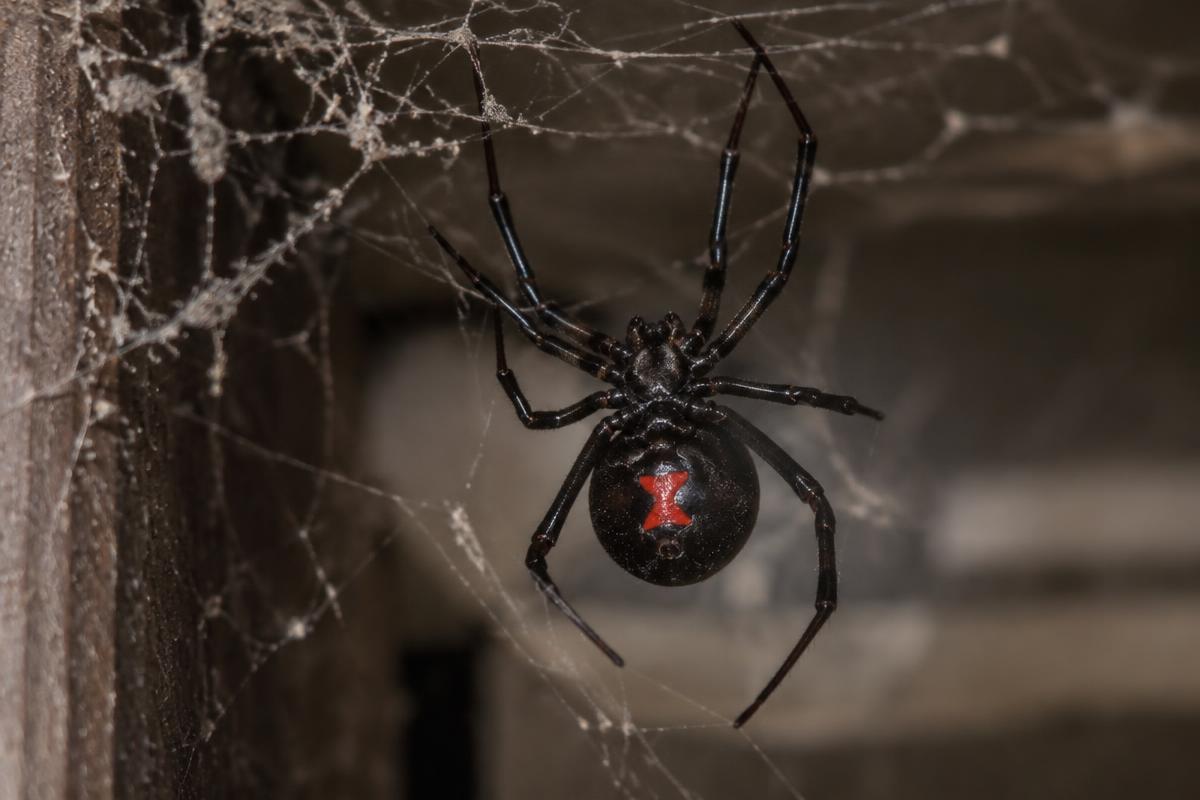
The western black widow is the one spider on a Phoenix property that is medically significant, and it is also one of the easier ones to manage, because it does not wander far and it chooses predictable places.
On a property where a widow has been found, the survey covers every low, sheltered void we can open: meter and valve boxes, the block wall cavity, stored pots, the underside of garden furniture and play equipment, the space behind the pool equipment, the gap under a shed. Those get physical removal and, where the void cannot be brushed out, a treatment into the harbourage itself rather than across an open surface where nothing lives.
Everything else on the property is judged on where it is rather than on what it is. A crab spider on the garage wall is eating roaches. A funnel web in the far corner of a gravel bed is catching crickets on the desert side of the yard. Clearing those out changes nothing you care about and costs you a working predator, so we will say so rather than treat them to make a visit look thorough. If a bite has happened, that is a medical question rather than a pest control one: keep the spider if you safely can, and speak to a doctor or the Arizona Poison and Drug Information Center.
The cheapest thing that works is a light bulb
If the webs on your property are around doors, the porch, the garage entry and the patio, this paragraph is worth more to you than a treatment is.
Night-flying insects gather at lights, and spiders build where the insects gather. The University of Kentucky recommendation is to run yellow or sodium vapour bulbs at outside entrances, because they pull in far fewer night-flying insects than a conventional bulb does, and fewer insects means fewer spiders setting up in the doorway you walk through.
Position matters as much as the bulb. A light mounted on the wall beside the door puts the insect cloud at the threshold. The same light on a pole a few metres out, aimed back at the house, keeps the arrivals away from the doorway while lighting the same path. On a Phoenix property, where outside lights run for most of the evening for most of the year, that one change does more to thin the webs around the entrances than anything we apply.
What a spider visit involves
Roughly two thirds of it is physical work, and that is deliberate.
We start with a survey that maps silk rather than sightings: where the webs are, which kind they are, how old they look, and which of them contain sacs. That map is what tells us whether this is a widow job on the perimeter, a lighting problem at the entrances, or a hunting-spider pattern that points indoors at something else entirely.
Then removal. Webs and sacs come off eaves, corners, boxes, furniture undersides and wall cavities, because that is the step that actually clears a site. Where a void cannot be reached with a brush, it is treated into the void rather than across the face of the wall. Sticky traps have a place too, not as a control but as a detector: set flat along the base of a wall, they tell us within a week where wandering spiders are actually travelling, which is more reliable than anybody trying to remember which room they saw one in.
The last part is the supply, and it is the part that decides whether you need us again. If the survey found a cricket population in the gravel, an ant problem feeding a wall void or standing water breeding midges, that is written into the findings with a price against it, and you can take it or leave it. Where the pressure is coming from open desert or land nobody on your street maintains, our service areas page explains why some boundaries keep resupplying a property no matter how well it is treated.
What changes the price
Spider work is quoted on how much there is to physically clear and how much of it can be reached, which is why two houses on the same street can be quoted differently.
On figures, since almost nobody publishes them: a standing programme around the Valley is broadly $40 to $100 each month, with a one-off visit in the $110 to $300 band. Spider work ordinarily sits within that, and those numbers are a market guide rather than a fixed rate.
Height does most of it. Eaves, gable ends, a two-storey elevation and a covered patio roof all hold silk, and all of them take longer than a single-storey run of wall. After that it is how much low, dark, openable structure the property has: the number of boxes, cavities, stored items and pieces of garden furniture is a better predictor of the time than the size of the house is.
Then the reason for the call. A single widow found in a meter box is a contained job. Webs across an entire elevation are a clearing job plus whatever is drawing the insects, and that second half is quoted separately so you can see what you are paying for. A property that has stood empty, or one that stores a great deal in the garage, sits at the longer end of both.
Spider questions we get asked in Phoenix
Can you just spray the house for spiders?
We can treat the perimeter, and on some properties that is part of the work, but it is the smallest part. Extension guidance is clear that spraying alone does not hold without the physical work, and a spider standing on the tips of long legs picks up very little from a treated surface anyway. The webs and sacs coming off is what changes the site.
Why are the webs back a few weeks later?
Two usual reasons. Either egg sacs were left in place, or the insects that made the spot worth using are still arriving. If the webs come back in the same three or four places rather than everywhere, that is a supply pattern and it is worth looking at the lighting and the ground cover near those spots.
Should I kill every spider I see?
No, and it is not a close call outdoors. Spiders prey on flies and other pests, so clearing the ones out in the yard costs you free pest control. The ones worth removing are widows near where people reach and sit, and anything set up at a doorway you walk through in the dark.
How do I know if it is a widow?
Glossy black, about half an inch of body, a red marking underneath, and an untidy tangle of silk low down rather than a neat wheel. Our Arizona spider guide covers this in detail, including the brown recluse question, which comes up far more often than the spider itself does here.
Do sticky traps work on spiders?
They catch wandering spiders and they are very good at telling you where the traffic is, which is how we use them. Placed flat along the bottom of a wall and in room corners they reveal the hotspots within days. As a stand-alone control on their own they do not clear a property.
Are spiders worse at a particular time of year here?
Calls rise when their food does, so the warm months and the weeks after monsoon rain are the busy ones, and autumn brings the large hunting spiders indoors as the nights cool. The widow population under patio furniture tends to be a steady, year-round matter rather than a seasonal one.
Related services
Identifying Arizona Spiders
Which ones live here, why the brown recluse story is wrong, and how to photograph one so it can be named.
Cockroach Control in Phoenix
The food supply behind most indoor hunting spiders. Deal with this and the patrols thin out.
Ant Control in Phoenix
An ant trail in a wall void feeds more than ants. Species-led baiting rather than spraying the line.
Scorpion Control in Phoenix
The other after-dark arrival, and the one where sealing the building is the main event.
Pest Identification Guide
Photographs of every species on this page, plus the insects they are hunting.
All Service Areas
Where we work across the Valley, and why a desert boundary changes what arrives.
Send a photograph of the web, not just the spider
Where it is, how high, and whether the silk is a tangle or a wheel. From that we can usually tell you which of these jobs it is before anybody drives out, and what the visit would involve.