Pest control in Gilbert, AZ
Gilbert dug its water on purpose — ornamental lakes in the middle of the subdivision, a few dozen metres from the back door. Most of what swarms over them at dusk is not a mosquito, and that changes what the answer is.
Get a free quote
No obligation. We reply within 2 hours.
Five thousand people to two hundred thousand, and the water came with them
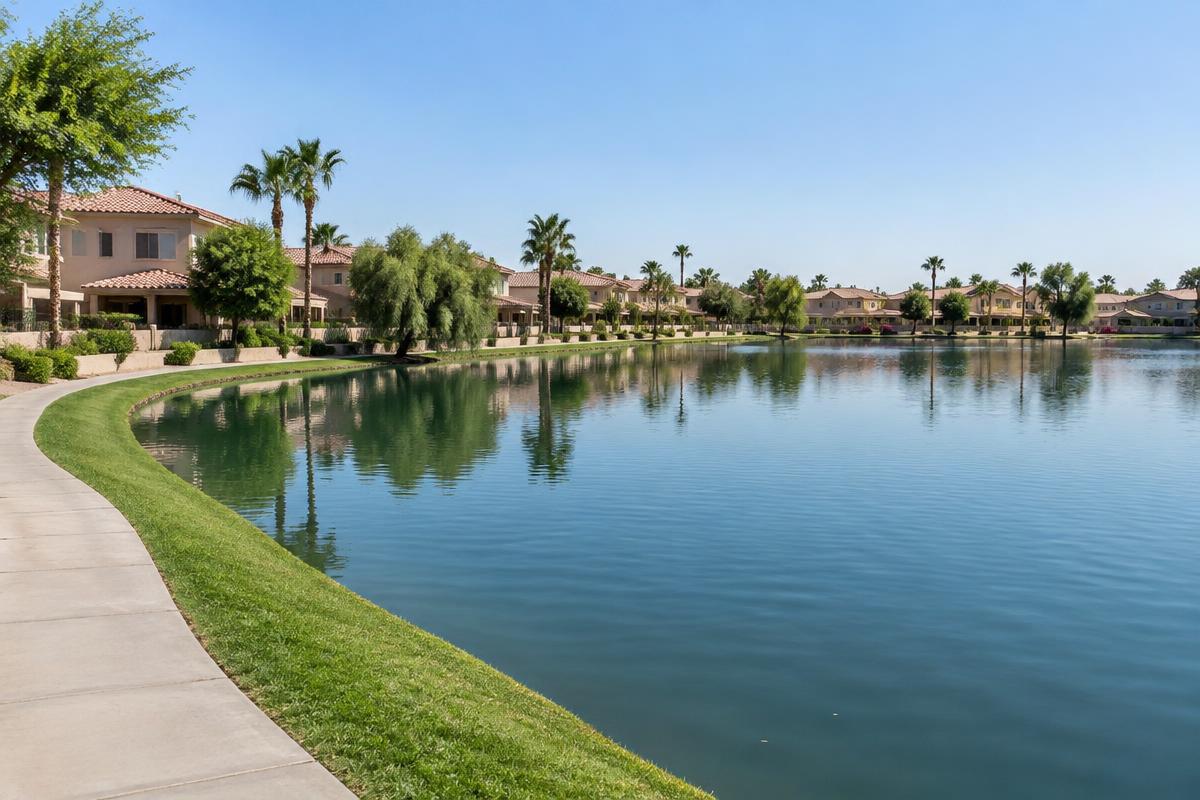
In 1980 Gilbert had 5,717 residents. By 2010 it had 208,453, and between 2000 and 2010 it was the fastest-growing incorporated place in the United States among populations over a hundred thousand — up ninety per cent in a decade. Almost everything you can see here was built inside one generation, by developers working at speed on land that had been farmed since the town called itself the Hay Capital of the World.
That matters for pest control because of what those developers chose to build. In most of the Valley, water is either a natural feature somebody built around or a piece of agricultural plumbing that predates the houses. In Gilbert a great deal of it was dug on purpose, as an amenity, in the middle of the subdivision. The Islands is built around three interconnected man-made lakes covering roughly eighty acres. Val Vista Lakes runs to about nine hundred acres around four more. The Riparian Preserve at Water Ranch, created by the town in 1999, is a hundred and ten acres of which seventy are seven water recharge basins, and it is designated an Important Bird Area.
So a very large number of Gilbert houses have permanent, open, nutrient-rich water within a few dozen metres of the back door — water nobody living there owns, controls or can treat. That single fact drives most of what we get called about on this side of the East Valley, and it produces one problem that is almost universally misdiagnosed.
It is worth saying what Gilbert is not, because the comparisons people reach for do not hold. This is not Mesa, where the water arrives on a schedule and the pests run on the irrigation calendar with it. It is not Goodyear, where a river was there first and the town grew around it. It is not Peoria, where the water people notice is municipal plumbing. In Gilbert the water is decorative, it is private, and it was dug after the decision to build houses around it had already been made. A town of sixty-eight square miles lists two-tenths of a square mile as surface water, and almost all of that sits inside residential neighbourhoods rather than at the edge of them.
What is actually swarming over the lake
When somebody in a Gilbert lake community rings us in spring about the cloud of insects hanging over the water at dusk, they call it a mosquito problem. Nine times out of ten it is not. It is a swarm of non-biting midges — the family Chironomidae — and the distinction is not academic, because it changes the diagnosis, the treatment and what you should expect to happen next.
This is a well-documented consequence of the way these communities are built. Research summarised by the University of California found that housing developments built around man-made recreational lakes have been met with swarms of chironomid midges, some of them large enough to be mistaken for mosquitoes. The University of Kentucky’s entomology department sets out why: midges breed in aquatic environments including lakes, canals and ponds, and they prefer shallow, stagnant, nutrient-rich water. An ornamental lake with fertilised turf running down to the edge is close to a purpose-built midge factory.
The good news is substantial, and it is the first thing we tell people. These midges do not bite, and they cannot carry pathogens that cause disease. What you are looking at is a nuisance, not a health problem. The bad news is that it is a nuisance nobody can spray away, for reasons set out further down this page.
Telling a midge from a mosquito in two seconds
You do not need a hand lens, and you do not need to catch one. Three things separate them at arm’s length, and any one of them is usually enough.
The swarm itself
Midges form dense columns that hover and shift over a fixed point — often above a tree, a post or the edge of the water. Mosquitoes do not do this. A visible pillar of insects at dusk is a midge swarm.
Nobody is being bitten
Stand in it. Midges will land on you and walk about and that is the whole of it. Chironomids have no functioning biting mouthparts. If an evening outside produces no bites, you did not have mosquitoes.
Where they end up
Midges pile up on light-coloured walls, around doors and under porch lights in numbers mosquitoes never reach, and the dead ones accumulate below. Mosquitoes disperse to find a host; midges aggregate.
One more distinction worth knowing, because the names collide. The midges people mean when they say “biting midges” or “no-see-ums” are a different family altogether, Ceratopogonidae. Those do bite. The ones coming off a Gilbert lake in a column at sunset are not those.
Why nobody can spray the lake
This is the part that disappoints people, and we would rather say it plainly than take money for a treatment that will not hold.
The larvae are in the sediment at the bottom of the lake. That lake is not yours, it is usually the community association’s, and a body of open water cannot and should not be treated with insecticide — the University of California’s own summary of the problem says exactly that. So the source is simultaneously out of your control, out of ours, and off-limits to the obvious product.
Spraying the adults instead buys very little. The University of Kentucky is blunt about it: insecticide against adult midges gives only temporary relief, because they repopulate quickly and fresh ones simply fly in from outside whatever you treated. Fogging an entire neighbourhood is no better — the products available for it are short-lived and indiscriminate, and they take out a great many harmless insects on the way through. Anyone quoting you a barrier spray that will “solve the lake” is either guessing or selling.
There is a genuine consolation in the biology, though. A midge swarm is temporary and often breaks up within a day or two. If you are three days into one and furious, the situation is already resolving itself without anybody doing anything.
The light on your patio is doing more than you think

Here is the lever that actually works at a single house, and it costs almost nothing. At night, adult midges are drawn to outdoor lighting — strongly, and particularly to mercury vapour lamps. Your porch light, your landscape uplighters and the lamp over the back door are the reason the swarm that formed over the water ends up on your wall rather than somebody else’s.
So the practical sequence for a lakefront or near-lake Gilbert property, in the weeks when they are emerging, is a lighting problem rather than a pest-control problem. Turn off what you do not need after dark. Move what you do need away from the doors you actually use, so the insects gather somewhere that does not matter. Switch the fixtures nearest the water to warmer, lower-intensity lamps. Close blinds so interior light does not spill onto the glass. Fit or repair door sweeps and screens, because midges that pile up at a threshold will find a three-millimetre gap.
None of that is glamorous and none of it involves us turning up with a sprayer. It is also, for this specific problem in this specific kind of neighbourhood, the only thing that reliably changes your evening.
Where the mosquitoes actually are
None of the above means Gilbert has no mosquitoes. It means the lake is rarely the thing producing the ones that bite you, and that people spend a season staring at the wrong body of water.
The mosquitoes biting you in a Gilbert back garden are overwhelmingly coming from something small, still and close — a saucer under a pot, a sagging section of pool cover, a blocked scupper, an unused fountain, the tray beneath an air-conditioning unit, a wheelbarrow nobody tipped out. On a lakefront lot the irony is that the manicured side of the property is usually the problem and the hundred acres of open water is not.
The mosquito control page sets out how we find those sources and what treatment reaches them, and the guide to mosquito repellents that work deals with what goes on your skin in the meantime — including why the zapper on the patio does nothing for either insect described here.
The water’s edge, and what lives in the margin
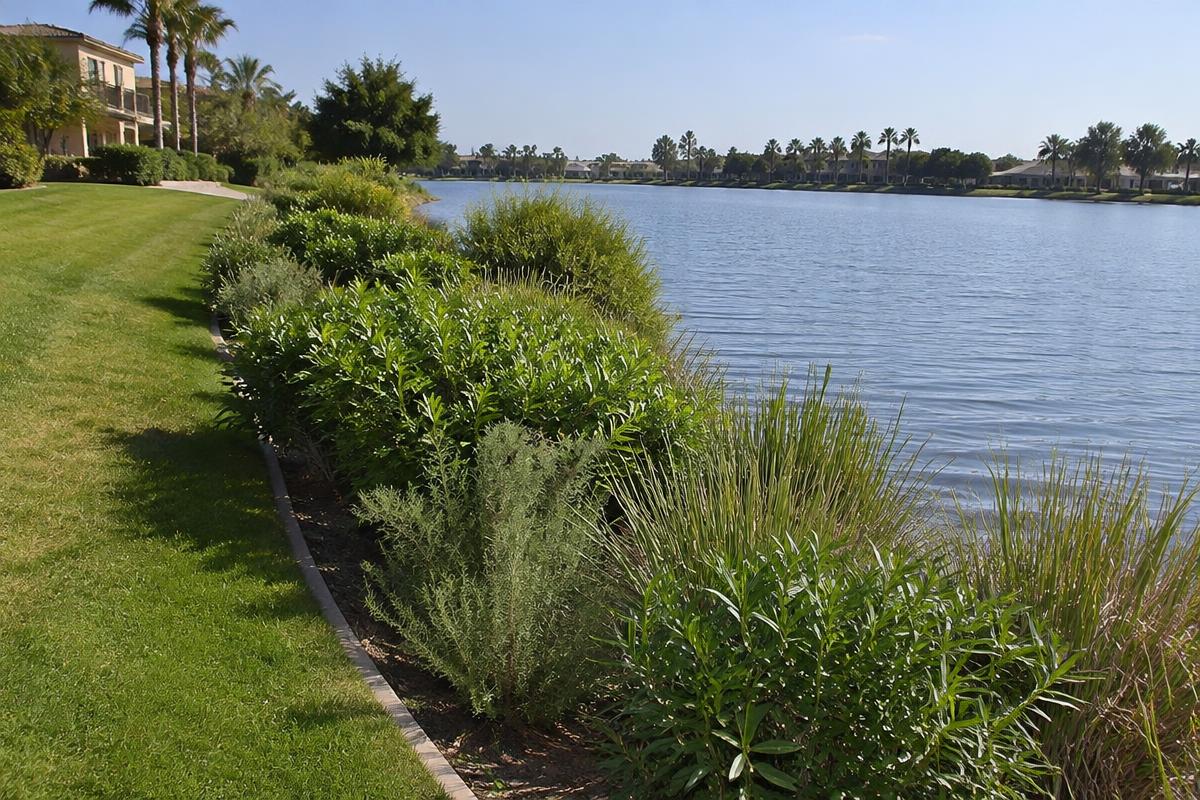
The lake is not only an insect question. The margin between water and lawn is the richest strip of habitat in the whole subdivision, and it behaves accordingly.
Dense ornamental planting at the shoreline gives rodents cover, a water source and a travel corridor that runs the length of the community without ever crossing open ground. Waterfowl bring their own set of problems and a great deal of droppings onto paths and lawns. Mature landscaping and permanent moisture together are exactly the combination that keeps roof rat pressure up in a neighbourhood far newer than the ones where people expect it. And the preserve on the other side of town is a designated Important Bird Area for good reason — there is a great deal of wildlife moving through a town that looks, from the air, like unbroken housing.
On a lake-adjacent property the survey we run looks different from a standard one. We work the shoreline planting and the fence line that meets it, the irrigation boxes and valve pits along that strip, and the roofline on the water side, because that is the approach a roof rat will take. Our rodent control page explains what the sealing work involves once we find the route.
A farm inside a subdivision
Gilbert has one more feature that does not exist anywhere else we work. Agritopia is a hundred and sixty-six acre planned community built around a working, USDA-certified organic farm, with more than eleven acres of gardens and farm plots that residents actually use. It is a genuinely good idea and it is also, from our side of the fence, an agricultural operation with houses pressed against it.
Produce, compost, irrigation and stored feed are a food supply with a roof over it, and the houses nearest the plots get the pressure first. The answer is not to treat the farm — you cannot and should not spray an organic holding, and nobody sensible would ask. It is to treat the boundary: tight exclusion on the houses facing the growing ground, attention to where compost and green waste sit, and a survey that starts at the fence rather than at the back door. The same logic applies on a smaller scale to the community garden plots scattered through other Gilbert neighbourhoods.
What we actually do on a Gilbert property
The first visit is mostly looking, and on a Gilbert lot the order is dictated by how close the water is.
We establish which problem you have
Before anything else: midges or mosquitoes. If it is midges we will tell you that the spray you were expecting is the wrong answer, and what to do instead.
The water side first
Shoreline planting, the fence line where it meets the margin, irrigation boxes and valve pits along that strip, and the roofline facing the water.
Then the ordinary sources
Pot saucers, pool covers, scuppers, condensate trays, blocked drainage. The small still water that actually produces the mosquitoes biting you.
Lighting, on lake-adjacent lots
Which fixtures are pulling insects to which doors, and what to switch off or move. Free, and more effective than product for this one.
Termites, on a young housing stock
Most of Gilbert went up between 1990 and 2010, which puts a great deal of it past the point where an original treatment can be assumed to still be working.
A written route list
Where things are getting in and what closes each one, so the sealing work is a specification rather than a conversation.
Where the problem is genuinely on common ground rather than on your lot, we will say so and tell you who to take it to, because a report from a resident who can describe exactly what was found and where carries a great deal more weight with an association than a complaint about insects.
What changes the price in Gilbert
Four things move a Gilbert quote, and only one of them is the size of the house. We would rather set them out here than have the number arrive as a surprise, because on this side of the East Valley two properties on the same street can need genuinely different work depending on which way the garden faces.
Distance to water. A lakefront lot takes longer because the shoreline strip is a second perimeter and gets surveyed as one. A lot four streets back from the same lake does not.
Which insect it turns out to be. A midge diagnosis frequently ends with us charging nothing, because the honest recommendation is a lighting change you can make yourself. That is not generosity; it is that we would rather not sell you a treatment we know will not hold.
The age of the house. Gilbert’s build-out was compressed, so an enormous number of properties here are at a similar point in their lives. A house that went up in the 2000s is now old enough that its original termite treatment cannot simply be assumed to be intact, and the termite control page explains what we check before anybody quotes for a re-treatment.
Whether the source is on your property at all. If it is, we fix it. If it is on common ground, the work on your side is smaller and cheaper, and we will tell you plainly that the rest is a conversation with your association rather than an invoice from us.
Gilbert pest control questions
There is a huge cloud of insects over the lake at dusk. Is that mosquitoes?
Almost certainly not. A dense column hovering over a fixed point is a midge swarm, and non-biting midges are the usual consequence of a housing development built around a man-made lake. Stand in it for a minute: if nothing bites you, that settles it.
Do midges bite, or carry anything?
No on both counts. Non-biting midges cannot bite and cannot transmit pathogens that cause disease. They are a nuisance and nothing more, which is genuinely the best news on this page. The biting ones people call no-see-ums are an entirely different family.
Can you treat the lake so this stops?
No, and neither can anyone else. The larvae sit in the lake sediment, the lake belongs to the community association rather than to you, and open water should not be treated with insecticide. Spraying the adults gives short-lived relief at best because fresh ones fly straight back in from beyond whatever was treated.
Then why is it so much worse at my house than next door?
Usually lighting. Midge adults are strongly drawn to outdoor lights after dark, so the fixtures nearest your doors decide whose wall the swarm settles on. Turning off what you do not need, moving what you do, and keeping interior light off the glass changes this more than any product will.
How long does a swarm last?
Often only a day or two. Emergences are episodic rather than constant, which is worth knowing before anyone signs you up to a programme to deal with something that was going to stop on its own by the weekend.
I am several streets from the water. Does any of this apply to me?
Less of it. Midge pressure drops away quickly with distance, and if you are getting bitten rather than swarmed the source is almost certainly something small and still on your own lot. That is a different job and usually a straightforward one.
My house was built in 2004. Is it too new to worry about termites?
No. A great deal of Gilbert went up between 1990 and 2010, which means a very large number of houses here reached the same stage at the same time. A house from the 2000s is well past the point where its original treatment can simply be assumed to be doing its job, and that is worth checking rather than hoping.
Related services
Mosquito Control
Once we have established it really is mosquitoes, this is where the water on your own lot gets dealt with. Mosquito control.
Rodent Control
Shoreline planting is a travel corridor with cover and water along its whole length. Rodent control.
Termite Control
A compressed build-out means a lot of Gilbert houses hit the same stage together. Termite control.
Tell us how far you are from the water
That one detail changes the whole survey. Describe what you are seeing and roughly where you are, and we will tell you whether this is a treatment, a lighting change, or a conversation with your association.