Bee removal in Phoenix, AZ
A cluster hanging in a tree and a colony built inside your wall are two different jobs with two different answers. Tell us which one you are looking at and we will tell you what it takes, including when the cheapest answer is not us.
Get a free quote
No obligation. We reply within 2 hours.
A swarm and a colony are two different phone calls
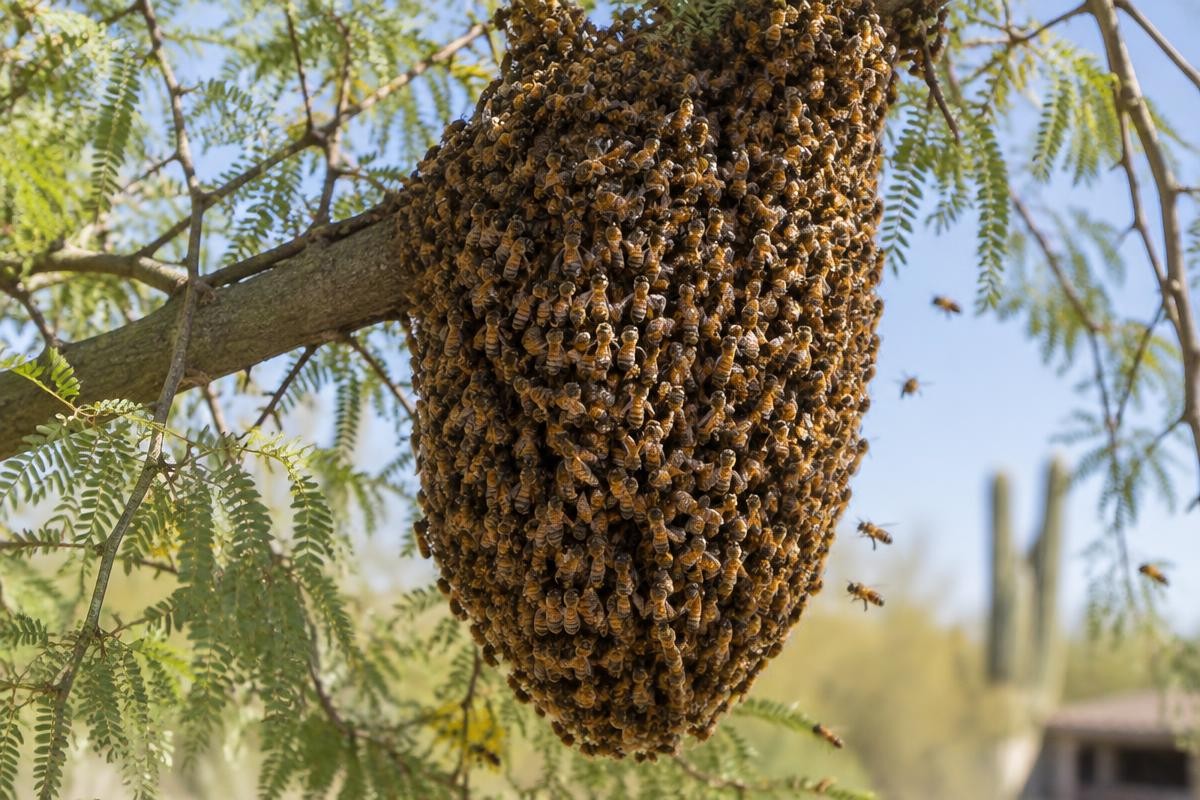
Almost every mistake made with bees in this city starts here, so it is worth two minutes before anything else. Look at what the bees are attached to.
A swarm is a cluster of bees hanging on something: a branch, a gate post, a wall, a car wing mirror. There is no comb, no honey and nothing built. They are in transit, carrying the food they left with, and scouts are out looking for a permanent cavity. The USDA research centre in Tucson makes the distinction that matters here plainly: stinging incidents happen when the nest itself is disturbed rather than when a swarm is. A resting swarm looks alarming and is usually the least dangerous form bees take.
A colony is what happens once the scouts choose somewhere. Comb gets built inside a cavity, brood is raised, honey is stored, and from that point the bees have something to defend and will. That is the job that needs opening up, and it is the one people describe as bees going into the wall by the meter, or under the tiles, or through a gap in the stucco.
The reason this matters commercially is that the two are priced nowhere near each other, and on a free-hanging swarm you have an option that does not involve paying anybody. Local beekeeping groups and individual beekeepers in the Valley will often collect an accessible swarm at no charge, because a swarm is a useful thing to them. We will say so when that is the situation you have, and we would rather tell you that than turn a twenty-minute collection into an invoice.
In Arizona you treat every wild colony as Africanized
Not as a scare line. As a working rule, because you cannot tell by looking and the consequences of guessing wrong are not symmetrical.
Africanized honey bees are not a different insect in any way you could see from your patio. Where they came from, when they reached Arizona and what the research says about the real risk is set out in killer bees in Arizona. They look like honey bees because they are honey bees, hybridised with an African subspecies, and identification is a laboratory matter rather than a doorstep one. What differs is behaviour, and the USDA describes it in terms worth repeating: a colony becomes defensive far more readily, the response comes much faster, and their guidance is to stay at least a hundred feet from a hive, which they put as the width of a four-lane highway.
The second difference is why they are everywhere here. A European colony swarms about once a year. An Africanized colony may swarm as often as every six weeks during the season and can throw several swarms each time. That reproductive rate is what has made feral colonies so common across the Phoenix area, and it is why a wall cavity that was empty in March can hold an established colony by May.
In practice that changes the approach distance and the hour of the day rather than the drama. The work is done in protective equipment, with a plan for where people and pets will be, and rarely in the middle of a hot afternoon when the whole flying population is home. It also makes the advice to leave a colony alone until somebody arrives serious rather than routine.
Where colonies actually set up on a Phoenix property
Africanized bees are far less fussy about a cavity than European bees are, and they will use a much smaller one. The USDA list reads like an inventory of an ordinary desert yard.
Water meter boxes. Utility poles and cement blocks. Junk piles and old tyres. House eaves. Hollow tree limbs. Overturned flower pots. Mobile home skirting and abandoned structures. Around here you can add irrigation valve boxes, the hollow cores of a block wall, the gap where stucco meets a soffit, chimneys and disused vents, a pool equipment enclosure, and the crown of an untrimmed palm.
Two things follow. Most colonies on a residential property are inside something rather than hanging off it, which is why few of them can be handled from a ladder. And the entrance you can see is rarely where the comb is: bees use a gap at the meter box and build sideways into the block wall, or enter at a soffit corner and build along the ceiling joists. Working out the shape and extent of what is in there comes before anything is treated.
If you want the identification side of this rather than the removal side, our pest identification guide covers bees alongside the paper wasps and the stinging ants people confuse them with. On acreage the list is longer again, because a water trough, a tack room, a hay store and an unused outbuilding are all cavities with a reason to be visited. Our Queen Creek page works through what a property with animals on it changes.
The comb is the part that decides whether they come back
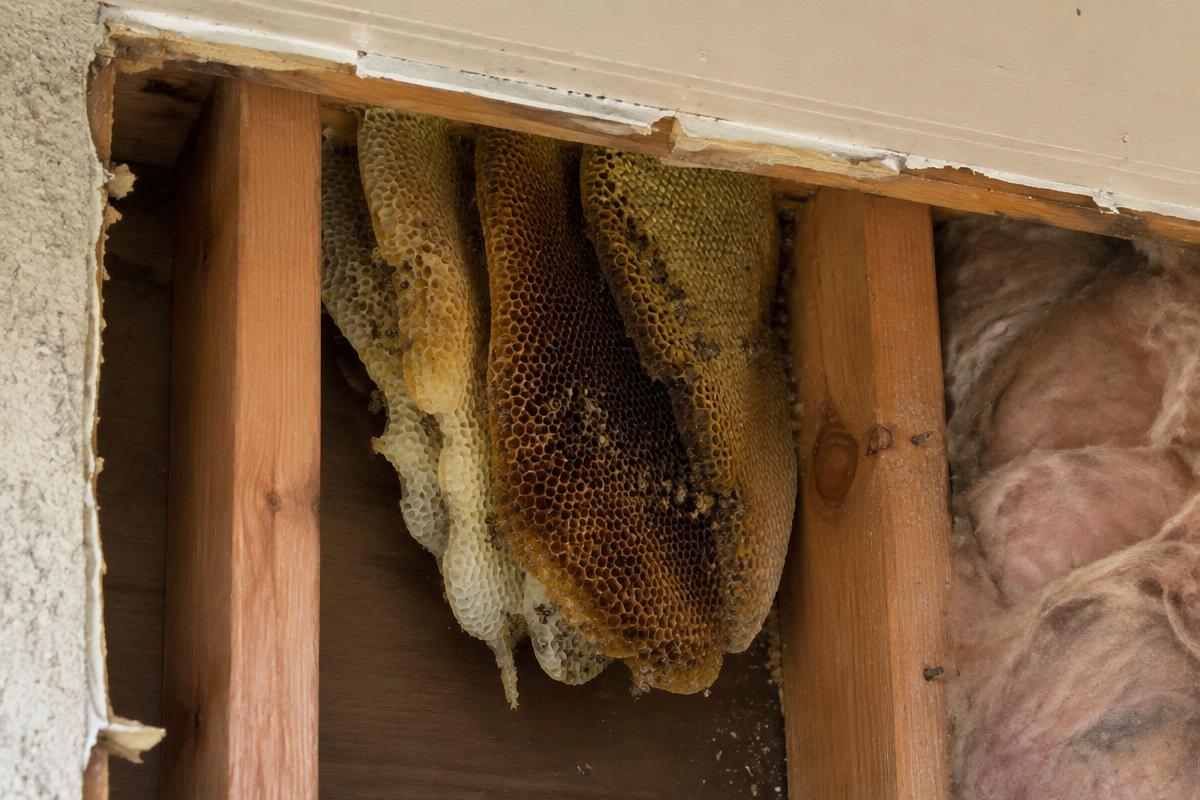
This is the single thing that separates a job done properly from one that looks finished on the day and goes wrong in July, and it is the question to ask anybody quoting you for bees in a structure.
Deal with the bees and leave the comb inside the cavity and you have left three problems in the wall. Wax and honey that is no longer being kept cool by a living colony softens in a Phoenix summer, and honey from an established colony is measured in pounds rather than spoonfuls; it runs, it stains through plasterboard and stucco, and it does not stop. Second, that sugar is now an unguarded food source, so ants, roaches and beetles work their way to it, which is how a bee job turns into an ant job a month later. Third, wax and the scent that goes with it read as a finished, furnished cavity to the next swarm that passes, which is why a wall that has had bees once so often has bees again.
So a colony inside a structure is three pieces of work, not one. The bees, the comb, and the closing of the cavity. Opening up means taking off a section of stucco, drywall, soffit or roof tile to reach the nest, and that has to be put back afterwards. When you compare two quotes for the same wall and one is half the price, the difference is almost always that the cheaper one stops after the first piece.
It is also why the first question is how long bees have been using that entrance. Two weeks means a small comb and a small opening. Since last spring means more honey, a bigger hole in the wall and a repair worth planning.
What the fire department will and will not do
People search for this constantly, usually in the wrong order, so here is the position in writing.
The Phoenix Regional Standard Operating Procedure for Africanized honey bees states it in its first line: the fire department does not exterminate bees. What it does do is deploy units to rescue and treat the victims of a bee attack, and the procedure sets out how crews approach one, including staging at roughly a hundred and fifty feet from the colony and using a hose line on a fog pattern to get people out.
So the line is clean. Somebody is being stung, or a person or animal cannot get away: that is a 911 call, immediately. Bees are living in your wall and nobody is in danger: that is a removal job on a property owner, and the Arizona Department of Agriculture, which licenses pest control businesses in this state, does not run a bee removal service either. The two searches people mix up are an emergency and a quote, and they go to different numbers.
If bees are coming at you right now
This section is the USDA guidance rather than ours, because in an attack the right instructions are the ones that have been tested.
Run, and keep running until you are inside an enclosed shelter such as a building or a vehicle. Pull your shirt up over your head or use your arms to protect your face as you go, because the eyes, nose and ears are what they go for. Do not swat and do not flail; crushed bees and fast movement bring more of them. Do not jump into a pool or a canal, because the bees will simply wait for you to come up. If a stinging attack is serious, or if anybody cannot get clear, call 911.
Once you are somewhere safe, take the stingers out by scraping sideways with a fingernail, a credit card edge or a dull blade. Do not pull them with tweezers or fingers, which squeezes more venom in. Anything beyond that is a medical question rather than a pest control one, and an allergic reaction or a large number of stings means a doctor or the emergency room, not a phone call to us.
And while you are waiting for somebody to come out: leave the colony alone. Do not spray it, do not block the entrance, do not throw water at it and do not try smoke. Every one of those turns a colony that was ignoring you into a colony that is not, and a blocked entrance simply pushes bees through the next gap, which on a wall cavity is often an interior one.
Wasps are the other half of this call, and a smaller job
Roughly half the stinging-insect calls we take are not bees at all, and the difference is visible from six feet away.
Paper wasps hang a small grey comb in the open, with the cells pointing at the ground and the wasps sitting on the face of it. Nothing is enclosed, there is no wax and no honey, so this is a treat-and-remove visit rather than a building job. Timing is what varies: the nest you ignored in April is a handful of cells, and by late summer the same nest can carry a hundred wasps at head height over a doorway.
Mud daubers get treated as wasps too and mostly should not be. The hard mud tubes on a wall are the work of a solitary insect that is not defending anything, and scraping them off is all that is ever needed. If something is flying in and out of a hole in the ground or a wall void in numbers, that is not a paper wasp, and it gets handled the way a colony gets handled.
What happens when we come out
The first decision is which of the three situations you have, because it changes everything after it.
We look at what the bees are attached to, where the traffic is going, and how long it has been going there. A free-hanging swarm is one conversation, and it may end with us pointing you at a beekeeper. A colony in an accessible box, pot or enclosure is a contained job. A colony inside a wall, roof or chimney is the full piece of work, and the survey covers where we will open up, what has to come off, what goes back, and what access we need on the day.
On the day the order is set by the structure: secure the approach and keep people and pets clear, deal with the colony, open the cavity, take out comb and honey, clean back the residue, then close the entrance and the other gaps on that elevation that would serve the same purpose next spring. The findings and the figure reach you before any of it starts.
What we will not do is quote a wall cavity over the phone from a photograph of bees going into a hole. Until somebody has seen the elevation, the height and the construction, any number is a guess, and the guesses in this trade are what produce the arguments afterwards.
What changes the price
Bee work has the widest price range of anything on this site, and it is not arbitrary. Five things move it.
What it is comes first: swarm, accessible colony, or colony inside a structure. Then where it is, because a meter box at ground level and a soffit on a two-storey elevation are different pieces of work before anybody has touched a bee. Then how long it has been there, which decides how much comb and honey has to come out.
Fourth is the repair, because opening a cavity is destructive by definition and closing it properly is part of the job, so stucco, tile, drywall and paint belong in the quote rather than turning up later. Fifth is urgency and access: a weekend, a tenant who cannot use the garden, a gate that needs somebody home.
On actual figures, the most useful local reference is not a price list but a consumer investigation. ABC15 in Phoenix looked into bee removal billing and found two Valley homeowners — one in Surprise, one in Mesa — charged $695 and $995 for spray jobs, neither of whom was given a verbal or written estimate before the work started, and both of whom were then offered a separate dust treatment on top. Other local firms the station contacted said they would not charge more than $300 for comparable work: bees outside a structure, no comb removal, no wall opened. A Valley operator quoted in the same piece put a typical figure at around $175 to $250 and said that above $500 it is worth carrying on ringing round.
Read those numbers carefully, because the gap between them is not really about bees. The $695 and the $995 were for the simplest version of the job. What produced them was the absence of a written figure before anybody arrived. That is why the quote on this page is written down first, and why the three job types above are separated out rather than averaged into one headline rate — a swarm on a branch and a colony behind stucco are not variations of the same price.
Bee and wasp questions we are asked most
How much does bee removal cost in Phoenix?
It depends which of the three jobs you have, and the range between them is wide. A free-hanging swarm is the cheapest thing on this page and may cost you nothing at all if a beekeeper collects it. A colony in a meter box or a pot is contained work. A colony inside a wall or roof includes opening up, comb and honey removal and putting the structure back, and that is priced from the elevation rather than from a photo. You get the figure in writing before anything starts.
Can I remove a beehive myself?
Not an established colony in Arizona, no. Feral colonies here are treated as Africanized, and USDA guidance is to stay a hundred feet from a hive, which is the width of a four-lane highway. Spraying a hole in a wall, blocking an entrance or using smoke on a colony are the three things that most reliably turn a situation into an emergency, and a blocked entrance often sends the bees through an interior gap instead.
Do bees come back after removal?
To the same cavity, often, and that is usually a sign the comb was left in. Wax and honey residue makes a cavity attractive to the next swarm, so removal without clean-out and sealing leaves the property advertising the same address. Done properly, the comb comes out, the residue is cleaned back and the entry is closed along with the other obvious gaps on the same elevation.
How long does bee removal take?
A swarm collection is usually under an hour. A contained colony in a box or pot is a short visit. A structural job runs from a few hours to most of a day, because the time is in the opening up, the comb and honey, the clean-out and the repair rather than in the bees themselves. A large, long-established colony in a two-storey soffit is the longest version.
Does the city of Phoenix remove bees?
No. The Phoenix Regional Standard Operating Procedure says plainly that the fire department does not exterminate bees; crews are dispatched to rescue and treat people being attacked. Bees on private property are the owner’s responsibility, and the Arizona Department of Agriculture, which licenses pest control businesses, does not remove them either. Call 911 for an attack, and a removal company or a beekeeper for a colony.
How can I get bees removed without killing them?
For a swarm, that is usually straightforward: beekeepers want swarms and will often collect an accessible one free. For an established colony inside a structure it depends on where the comb is, how accessible it is and whether the bees can be taken out intact, so it is a question to settle on the survey rather than on the phone. We will tell you when live collection is realistic and when it is not.
Related services
Pest Identification Guide
Bees, paper wasps, mud daubers and the stinging ants people mistake for them, with photographs.
Ant Control in Phoenix
Honey left in a cavity becomes an ant problem. This is the page for what happens next.
Commercial Pest Control
Colonies in plant rooms, signage, roof voids and shared walls, where access has to be arranged around trading hours.
Rodent Control in Phoenix
The same soffit gaps and roof penetrations let something else in. Worth closing both at once.
Scorpion Control in Phoenix
Sealing the elevation properly is the overlap between the two jobs.
All Service Areas
The suburbs we cover, and what changes from one part of the Valley to the next.
Tell us what they are attached to
A branch, a meter box, or a hole in the wall. That one answer decides whether this is a collection, a contained job or a structural one, and we will tell you which before anybody drives out. If somebody is being stung, call 911 first.