Commercial pest control in Phoenix, built around your inspection
Restaurants, warehouses, offices, rentals and multi-family buildings. Scheduled around your trading hours, documented for the health inspector, and scoped for the pests your particular site actually gets.
Get a free quote
No obligation. We reply within 2 hours.
Business pest control is a documentation job as much as a treatment job
The difference between commercial pest control and residential work is not the products. It is that a business has to be able to prove the programme exists. When an environmental health inspector walks into a Phoenix food establishment, one of the things they can ask to see is the pest control record — who serviced the site, when, what was found, and what was done about it.
That distinction is worth holding on to when you compare quotes. Most commercial pest control companies in Phoenix will happily sell you a visit. What a business actually needs is a programme, with a written scope, a fixed schedule and a record somebody is accountable for, and that is the line that separates commercial pest control services from a residential call-out repeated twelve times a year.
So every commercial visit we run produces a service report: what was inspected, what was found, what was treated, what needs your action, and what we recommend before the next visit. Kept together, that is the log that answers the question when it gets asked.
The second difference is timing. A restaurant cannot have a technician working through the kitchen at seven in the evening, and a warehouse cannot have dock doors open during treatment. Service gets scheduled around how the site runs, not around our route.
Industries we run commercial programmes for
Food service has its own page, covering the Maricopa County grade card and where pests hide in a commercial kitchen: restaurant pest control in Phoenix.
Restaurants and food service
Drain and grease-line work for small flies, gel baiting for German roaches, rodent pressure at the dumpster corral and delivery door. Serviced before opening or after close.
Warehouses and industrial
Rodent and bird pressure at dock doors, pallet and inbound-goods inspection, perimeter rodent stations, and treatment planned around stock movement. Offices, warehouses and industrial sites are covered in their own depth separately.
Offices and retail
Low-disruption quarterly programmes. Break rooms, kitchenettes, planters and entrances are where almost every office issue starts.
Multi-family and apartments
German roach and bed bug work spreads unit to unit if it is treated unit by unit. We treat neighbouring units together and schedule access with the property manager.
Short-term rentals
Bed bug response with a turnaround that fits between guests, plus a standing programme so a single complaint does not become a review. In Scottsdale these properties are licensed and must name a contact who attends within the hour, which the Scottsdale page goes through in detail.
Hotels, resorts and hospitality
Guest rooms, back of house, laundry and pool areas. Bed bug response has to be discreet and fast, and the room has to be back in service.
Property management and HOA
Multiple sites on one schedule, one point of contact, and reporting that rolls up per property rather than per visit.
What a commercial programme includes
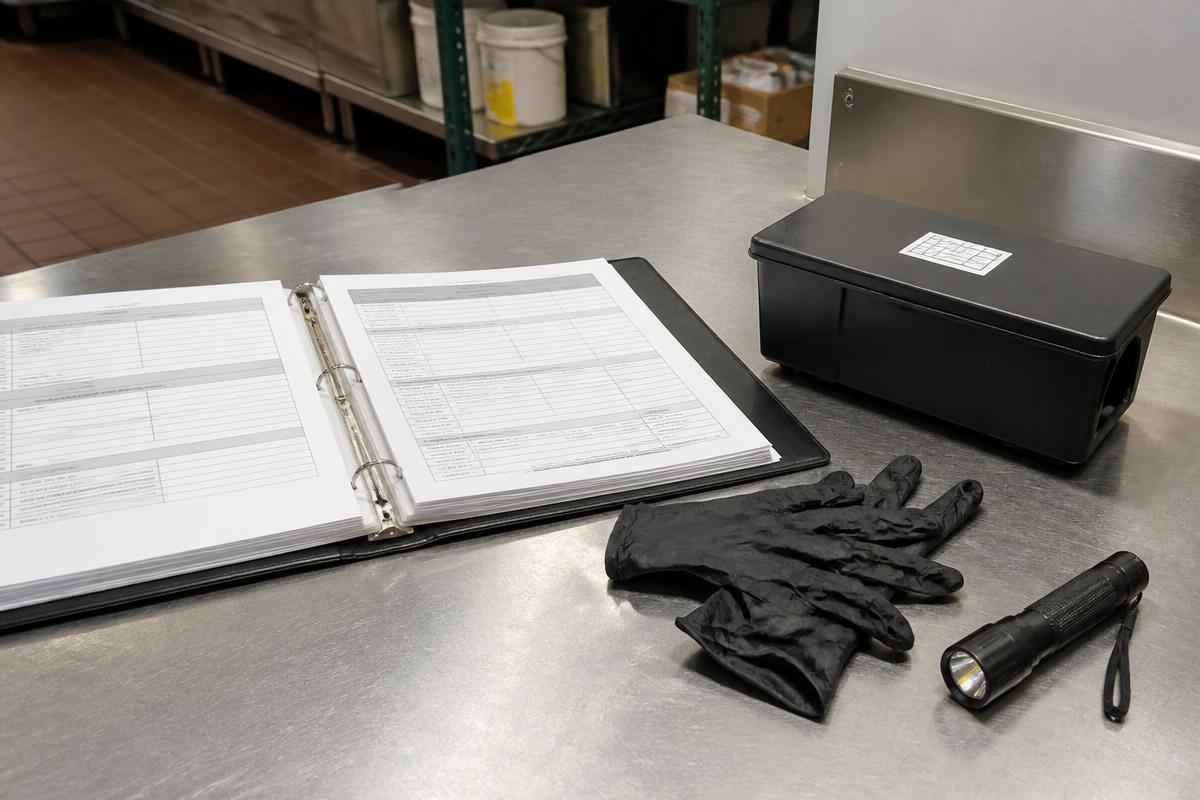
A callout and a programme are different products, and the paperwork is what separates them. A callout ends when the pest does. A programme is a standing arrangement with a written scope, a fixed frequency and a record of every visit — which is what an environmental health inspector, a landlord or a franchise auditor actually asks to see. Four things make one up.
Site survey
A full walk of the property with whoever runs it. We map pest pressure, entry points, sanitation issues and the areas your own inspections focus on.
Written scope
Which pests, which areas, what frequency, and what falls to you versus to us. Priced flat per visit so it can go in a budget.
Scheduled service
Visits at times that suit the operation — before opening, after close, or during a shift change. Technicians sign in and out however your site requires.
Reporting
A service report after every visit: findings, actions, recommendations. That is the record you hand an inspector or an auditor.
The pests Phoenix businesses call us about most
German cockroaches
The defining restaurant and multi-family pest. They spread along shared plumbing and in delivered goods. Baiting works; spraying alone scatters them into neighbouring units and makes the problem harder.
Small flies
Drain flies and fruit flies almost always trace back to a biofilm in a floor drain, under a bar mat or in a rarely-moved piece of equipment. Killing the adults without treating the breeding site achieves nothing.
Rodents
Roof rats and mice at dock doors, dumpster corrals and roof penetrations. Exterior stations plus exclusion, because a bait-only programme inside a food premises is a poor idea for obvious reasons.
Birds
Pigeons on warehouse ledges, signage and solar arrays. Droppings are a slip hazard and a contamination issue before they are a cosmetic one.
Ants
Trails along expansion joints and planter edges, usually running from irrigated landscaping straight into a break room.
Bed bugs
Short-term rentals, multi-family and hotels. Confirmed inspection, treatment, then a verification visit before the unit goes back into use.
Getting a Phoenix food business inspection-ready
Most of what fails a pest-related inspection is not the pests themselves. It is the conditions and the paperwork.
Keep the log accessible
A folder of service reports on site beats a promise that the records exist somewhere. Ask for them if your provider is not leaving them.
Fix the conducive conditions
Gaps under exterior doors, unsealed pipe penetrations, standing water at the mop sink, cardboard stored on the floor. These are what our reports flag, and they are what an inspector looks for.
Deal with the dumpster corral
Distance from the building, lid condition, drainage and cleaning frequency drive more rodent and fly pressure than anything happening inside the kitchen.
Treat drains, not just floors
If small flies keep coming back, the breeding site is almost certainly organic film inside a drain. Surface spraying will never reach it.
What commercial pest control costs in Phoenix
Commercial work is quoted per site after a survey. Published residential rates do not transfer, because two restaurants of the same size can need very different programmes.
People ask what commercial pest control costs as though one number exists for it, and the range is genuinely wide: a small office on quarterly service and a busy kitchen on fortnightly service with drain work and inspector-ready paperwork are not the same product. The survey exists to place you on that range rather than to pad the quote.
These are starting prices by property type. Where a site lands above the starting figure comes down to the four things below, and an ongoing programme is quoted per visit after the survey rather than from this list.
$250 – $500
Office or small business
$300 – $600
Restaurant or retail store
$250 – $400
Apartment, single unit
$250 – $400
Hotel, single room
$500 – $1,500+
Multiple rooms or units
Custom quote
Large hotel or apartment building
When you compare commercial pest control companies, compare four things rather than the total: the starting frequency and when it steps down, whether drains and the exterior are in scope or extra, what documentation you receive after each visit, and who is called if something appears between visits. A cheaper quote that omits two of the four is not cheaper.
Size and layout
Square footage matters less than the number of separate areas needing attention — kitchen, store, bar, dock, roof, exterior.
Frequency
Monthly is common for food premises; quarterly suits most offices and retail. Higher frequency lowers the per-visit cost.
Pest pressure
An established German roach or bird problem needs an intensive phase before it settles into a maintenance programme. We price those as two stages, not one.
Reporting requirements
Sites that need documentation for a third-party audit rather than just a health inspection take more time per visit, and we say so up front.
You get a flat per-visit figure and a written scope before anything starts, so it can be signed off and budgeted rather than approved invoice by invoice.
What an inspector opens the folder to find
When an environmental health inspector asks to see your pest control documentation, they are not reading it for pleasure. They are checking a small number of specific things, and a programme that produces them without anyone scrambling is worth more than one that treats more often.
A report for every visit
Dated, signed, saying what was inspected, what was found and what was applied. Gaps in the sequence are the first thing anyone notices.
A pest sighting log
Kept by your staff, not by us. Somewhere your team records what they saw, where and when, so it gets acted on rather than mentioned in passing.
A device map
A numbered plan of where every station and monitor sits, so a device can be checked against the plan instead of hunted for.
Corrective actions
What was recommended, who was responsible, and whether it was done. An open recommendation repeated month after month reads badly.
Product records
Labels and safety data sheets for anything used on site, kept current and reachable.
The licence
Proof the business and the person applying product are licensed in Arizona. Ask us for it and keep a copy in the folder.
Over time the reports become the most useful part. Six months of records show whether activity is trending down, holding steady or creeping up in one corner of the building — which tells you far more than any single visit, and gives you something concrete to point at when you are asking a landlord to fix a door seal.
Fitting the programme around how you actually trade
The treatment is rarely the hard part of a commercial job. The scheduling is.
Restaurants and bars mostly get serviced after close or before prep, because the areas that matter — under the line, behind the dish pit, the dry store — are unreachable during service and nobody wants product applied near open food. Warehouses and distribution work better between shifts or on the changeover, when racking aisles are clear enough to reach the wall-floor junction where monitors live. Offices are usually an out-of-hours job with a key or an escort arranged in advance. Multi-family buildings need the most notice, because tenants have to be told before anyone enters a unit, and one inaccessible apartment in a block can keep a problem alive for the whole building.
We would rather agree an awkward time that works than a convenient one that means half the site never gets inspected.
One more thing worth saying plainly: some of what keeps pests out of a commercial building is not pest control. Door sweeps that no longer touch the threshold, a loading bay left open, a grease interceptor that needs pumping, standing water under a compressor, cardboard stored against a wall — those are maintenance, housekeeping or landlord items. We will identify them and put them in the report, because they are usually the reason the problem persists, but treating around them is not a substitute for fixing them.
Running more than one site
If you operate several locations, the value of a commercial programme changes. The treatment at each site is much the same; what you are really buying is one reporting standard across all of them.
That means the same report format, the same numbering convention on device maps, and the same corrective-action language everywhere — so a regional manager can read the file for any location without learning a new system, and so an inspector at one site sees the same standard as an inspector at another. It also means the records become comparable. When one location is generating three times the activity of the others on an identical programme, that is not a pest problem in isolation; it is usually a building or a process problem at that site, and the reporting is what makes it visible.
We handle multi-site accounts on a single agreement with per-site scheduling, because trading hours and access rarely match across locations. Tell us how many sites and what each one does, and we will quote them individually rather than averaging them.
Commercial pest control questions
Can you service outside our opening hours?
Yes, and for most food premises that is the default. Before opening, after close or during a shift change — whatever suits the operation. Tell us your trading hours when you call and we will build the schedule around them.
What documentation do we get?
A service report after every visit covering what was inspected, what was found, what was treated and what needs your action. Kept together those form the pest control log, which is what you produce when an inspector asks.
How often does a restaurant need service?
Monthly is the usual baseline for food premises in Phoenix, because roach and small-fly pressure rebuilds quickly in a warm kitchen. Sites with a live problem start on a shorter interval and step down once it is under control.
Do you treat individual units in an apartment building?
We treat the affected unit and its immediate neighbours together. German roaches and bed bugs move along shared plumbing and wall voids, so treating one unit in isolation usually just relocates the problem next door.
Is treatment safe around food preparation areas?
We use EPA-registered products chosen for food-handling environments, applied to targeted points such as cracks, voids and drains rather than to surfaces. Your technician will tell you what needs covering or moving before the visit and when each area is clear.
Can you handle several sites on one account?
Yes. Multiple properties on one schedule with one point of contact, and reporting broken out per site so each manager sees their own and you see the whole picture.
We keep getting small flies even after spraying. Why?
Because the adults you are killing are not the problem — the breeding site is. Drain flies and fruit flies develop in organic film inside floor drains, under bar mats and inside rarely-moved equipment. Until that is cleaned and treated, new adults keep emerging.
Do you deal with pigeons on the roof and signage?
Yes — exclusion and deterrent work rather than trapping, plus advice on the roof penetrations and ledges causing it. Droppings on a walkway are a slip and contamination issue, so it is worth handling before an inspection rather than after.
Does the HOA pay for pest control, or does the homeowner?
It depends on the CC and Rs and on where the pest actually is. The common pattern in Arizona communities is that the association covers shared structures and common areas, and the owner covers the inside of their own unit. Termites and roof rats in an attached roofline are what get argued about, because the damage crosses that boundary. Read the CC and Rs before assuming, and if the association already holds a programme, ask what it covers rather than what it is called.
We manage an HOA. What should a community programme actually cover?
Common areas first, because that is where the pressure originates: landscaping and irrigation, block wall runs, ramadas, pool equipment enclosures, mail kiosks and any shared roof or attic space. Scorpion and rodent pressure across a Phoenix community is usually driven by the landscaping rather than by any individual home. Then agree in writing what happens when an owner reports something inside a unit, because that is where most disputes start.
Related services
Get a commercial quote
Tell us the type of site, roughly how big it is, and what you are seeing. We will survey it and come back with a written scope and a flat per-visit price.