Mosquito control in Phoenix is source removal first, spraying second
A barrier treatment kills the mosquitoes resting in your yard today. If something on the property is still holding water, a new batch is flying within a week. We find the water first.
Get a free quote
No obligation. We reply within 2 hours.
Two very different mosquitoes, two different problems
Phoenix has two mosquito groups that matter, and they behave so differently that people often think their treatment failed when it simply addressed the other one.
Aedes aegypti — the daytime ankle biter
Bites during the day, low to the ground, usually around ankles and legs. It is a container breeder: a bottle cap of water is enough. It rarely travels far, which means if you are being bitten in your own yard, it almost certainly hatched in your own yard.
Culex — the dusk-to-dawn mosquito
Active from dusk through the night. These are the West Nile virus vectors in Maricopa County, and they breed in larger, stagnant water — green pools, blocked drains, standing irrigation, retention basins.
The practical difference: Aedes problems are usually solved on your own property. Culex problems often come from something nearby — a neglected pool two doors down, a blocked storm drain — and need reporting as well as treating.
Why Phoenix takes this seriously
Maricopa County has historically been one of the most affected counties in the United States for West Nile virus, averaging roughly 70 neuroinvasive cases a year over the last decade, with a record year in 2021. The county runs its own mosquito surveillance programme, trapping across urban and suburban areas and testing pooled mosquitoes for West Nile and Saint Louis encephalitis.
That is context, not a scare. Most bites are a nuisance and nothing more. But it is why source reduction on residential properties genuinely matters here in a way it does not in a lot of the country, and why an unattended green pool is worth reporting to Maricopa County Vector Control rather than ignoring.
Where the water actually is
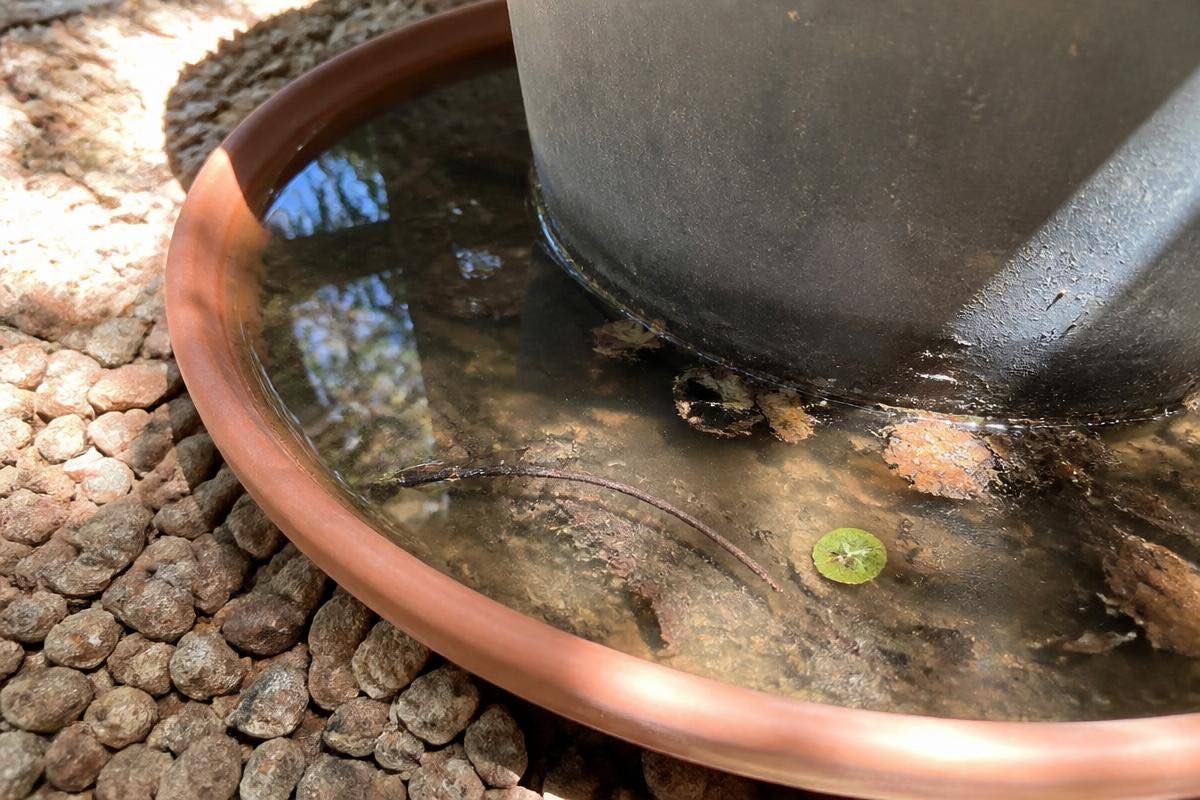
When we inspect a property for mosquitoes, this is the list we work through. Most homeowners are surprised by at least two of them. One city is a case of its own. Goodyear has the Gila River passing through it and lakes inside its largest community, so the biting season there opens earlier and closes later than the rest of the metro.
Pot saucers and planters
The single most common Aedes breeding site on Phoenix properties. A saucer under a patio pot holds enough water for a generation, and it refills every time you water.
Bromeliads and plant axils
Water collects where the leaves meet the stem. Nothing looks like standing water and yet it is.
Unused and green pools
Foreclosed, rented or simply neglected. A single untreated pool can produce mosquitoes for an entire street.
Blocked scuppers and drains
Roof scuppers, patio drains and low spots that hold water for days after a monsoon storm.
Tyres, tarps and toys
Anything stored outside that curves upward. Wheelbarrows left the wrong way up are a classic.
Irrigation and A/C condensate
A leaking valve box, a low spot that never dries, or a condensate line dripping into the same patch of soil all day.
How we treat it
Inspection
A walk of the property looking for water, not for mosquitoes. We will point out every source we find, including the ones you can empty yourself for free.
Source reduction
Removing or draining what can be removed. This is the part that determines whether the treatment lasts, and we would rather you tip out the saucers than pay us to spray around them.
Larvicide
For water that cannot be removed — a pond, a retention area, a drain that always holds. Larvicide stops larvae becoming adults rather than chasing adults later.
Barrier treatment
Residual applied to the shaded resting places adults use during the heat — dense shrubs, the underside of foliage, shaded walls, patio undersides. Repeated through monsoon season.
Monsoon months usually need a shorter treatment interval than the rest of the year, because numbers rebuild within days of a storm rather than over weeks.
What you can do that costs nothing
Walk the yard after rain
Two days after a storm, look for anything still holding water. That is exactly the window mosquitoes are using.
Tip and store
Empty saucers, buckets and toys weekly and store them upside down. Weekly matters — the cycle from egg to adult is short in Valley heat.
Refresh standing water
Pet bowls, bird baths and fountains — change the water rather than topping it up, at least twice a week.
Fix the drips
A leaking hose bib or irrigation valve keeps one patch permanently damp, which is all Culex needs. Flood-irrigated neighbourhoods are a category of their own here, and the Mesa page covers how that watering calendar works.
Report a green pool
If a neighbouring property has an abandoned pool, Maricopa County Vector Control takes reports. It is a faster route than trying to treat around it.
What mosquito control costs in Phoenix
Mosquito work is normally a seasonal programme rather than a one-off, because the pressure is seasonal. Recurring residential pest control across Phoenix generally runs $40 to $100 a month; mosquito treatment is quoted on top of or within that depending on the property.
Yard size and planting
Dense, shaded, well-watered landscaping gives adults far more resting area to treat than an open desert-landscaped lot.
How many sources
A property with a pond, a pool and heavy irrigation is a different job to one with a couple of pot saucers.
Season
Monsoon months need shorter intervals. Winter often needs nothing at all, and we will say so rather than billing for visits that do nothing.
Neighbouring sources
If the breeding site is off your property we will tell you plainly. Treating your yard repeatedly for someone else’s pool is not a fix and we will not sell it as one.
What a barrier treatment does, and what it does not
The part of the service people can see is the barrier application, and it is worth being precise about what it is, because the marketing around it is often not.
Adult mosquitoes do not fly all day. They spend most of daylight resting somewhere cool, humid and shaded — the undersides of dense foliage, the shaded face of a block wall, under the eaves, inside a hedge, beneath a deck. A barrier treatment is a residual product applied to those resting sites specifically. A mosquito that lands there picks it up and dies. It is not a cloud sprayed over the yard, and it is not applied to open lawn or to flowering plants where pollinators forage.
In season it needs renewing roughly every three to four weeks, because sun and heat break the residual down and new growth is untreated. Irrigation and monsoon rain shorten that further where the spray lands on foliage that gets wet. That is why mosquito work is a programme rather than a single visit.
The honest limit: a barrier treats your property, not the block. If the source is next door — a green pool, a neglected fountain, a permanently damp alley — the treatment reduces what survives in your yard but does not stop new arrivals flying in. In that situation the treatment is worth doing and the source still has to be dealt with, which sometimes means a conversation with a neighbour and sometimes means reporting it. The month-by-month guide covers when Valley mosquito pressure peaks. The companion to this is our guide to what actually works against mosquitoes, which covers the repellents worth buying and the patio gadgets the research has already ruled out.
Larvicide, and how it actually works
Where water cannot be removed, the sensible place to break the cycle is before the mosquito can fly. That is what larvicide does, and the product used most often is worth understanding because it is far more specific than people assume.
Bti is a naturally occurring soil bacterium. It produces crystal proteins that only become toxic in the very alkaline gut of a small group of larvae — mosquitoes, black flies and fungus gnats. A larva has to eat it for anything to happen. It does not work through contact, and it does not affect fish, birds, pets, bees or people, which is why it is the standard choice for water that has other things living in it or that animals drink from. What treatment means more generally with animals around is covered on our pet-safe pest control page.
It comes as slow-release briquettes for standing water and as dunks or granules for smaller or intermittent collections. In practice that means ponds and water features, a pool that has gone green and cannot be drained yet — a problem the older irrigated parts of the Valley see most, retention basins that hold after a storm, irrigation valve boxes that never fully dry, and low ground that stays wet under a drip line. Briquettes typically need replacing every month or so in the heat, and any collection that dries out and refills needs re-treating, because the material goes with the water.
Larvicide is not a substitute for tipping out what can be tipped out. A saucer under a pot can produce mosquitoes in about a week, and emptying it is free. Larvicide is for the water that has to stay.
Starting at the right point in the year
Mosquito programmes work far better started early than started in response to being bitten, and the reason is arithmetic rather than sales pressure.
A mosquito goes from egg to biting adult in about a week to ten days in summer heat, and each female lays in batches of a hundred or more. How long those adults themselves live is a separate question, and the answer changes once they are indoors. A population that is small in March is very large by July, because you are compounding generations. Breaking the cycle while the numbers are still low means the source reduction and the larvicide do most of the work, and the barrier applications have far less to suppress.
In practice that means beginning as the nights stop being cold and before the monsoon arrives — dealing with the water that held over winter, getting larvicide into anything that cannot be drained, and having the first barrier application down before the population expands rather than after. Starting mid-season still helps, it simply takes longer and costs more to reach the same result.
Mosquito questions we get asked in Phoenix
Why am I being bitten during the day?
That is Aedes aegypti, the daytime species people call ankle biters. They breed in very small containers and do not travel far, so daytime biting in your own yard almost always means the water source is on your property. It is usually a pot saucer.
When is mosquito season in Phoenix?
Numbers climb with the monsoon, roughly June through September, and can stay high into autumn. Standing water after a storm produces adults within days, which is why treatment intervals shorten during those months.
Will one spray fix it?
Only if there is nothing breeding on the property. A barrier treatment kills the adults resting in your yard now; if a saucer, a drain or a pool is still producing, you will have new mosquitoes within about a week. That is why we inspect for water before we quote spraying.
Do those ultrasonic repellers or bug zappers work?
Ultrasonic repellers have no credible evidence behind them. Zappers do kill insects, mostly harmless ones, and are not effective at reducing mosquito bites. Neither addresses breeding sites, which is the part that matters.
What about the neighbour’s green pool?
It is a genuine problem — a single neglected pool can supply an entire street. Maricopa County Vector Control accepts reports on standing water and green pools, and that is usually a faster route than treating around it indefinitely.
Is West Nile something I should worry about?
Maricopa County has historically been among the most affected counties in the country, so it is worth taking seriously without panicking. Most infections cause no symptoms. Reducing standing water and using repellent at dusk and dawn are the practical steps; for medical questions, speak to your doctor or the county health department.
Are the treatments safe for pets and pollinators?
We use EPA-registered products applied to resting sites rather than blanket-spraying open flowers, and we avoid treating blooming plants where bees are active. Your technician will tell you when treated areas are dry and clear for pets.
Do I need treatment in winter?
Usually not. Mosquito pressure in the Valley drops sharply in the cooler months, and we would rather pause the treatment than charge for visits that are not doing anything. Source reduction is worth keeping up year-round.
Related services
Weed Control in Phoenix
Overgrown, over-irrigated corners are where adult mosquitoes rest through the day.
Scorpion Control in Phoenix
Standing water and dense growth support the insects scorpions hunt.
Commercial Pest Control
Mosquito programmes for apartment complexes, HOA common areas and restaurant patios.
Being bitten in your own yard?
Tell us whether it is during the day or at dusk — that alone narrows it down. We will find the water before we quote any spraying.