Pest control in Anthem, AZ
Anthem stands the better part of a thousand feet above the Valley floor. That is enough to move the year at both ends, and almost every piece of timing advice written for Phoenix is wrong here by a few weeks.
Get a free quote
No obligation. We reply within 2 hours.
Most of a thousand feet above the Valley floor

Anthem averages one thousand eight hundred and sixty-four feet, and the ground inside the community runs from about one thousand seven hundred and sixty up to two thousand four hundred and twenty-eight.
Set that against the rest of the metro. The airport sits near one thousand and eighty feet. Goodyear, the lowest place on our list, is at nine hundred and sixty-eight. A house here can be standing the better part of a thousand feet higher than one we treated the same morning, and what follows from that is not a matter of opinion: the standard references say that because of its height in the northern Sonoran Desert, Anthem is cooler than the parts of Phoenix to the south and receives more rain.
Neither of those is decorative. Cooler and wetter is a different operating calendar. Warm-season activity opens later in the year here than it does down on the floor of the Valley, and it shuts down earlier. Rain that falls as one brief violent cell forty miles south arrives here more often and sits in the ground longer afterwards.
The consequence is a mistimed year, and it is extremely common. Nearly everything published about when to treat in this state is written for the Valley floor, because that is where nearly everybody lives. Follow it in Anthem and you are early in spring, ahead of anything worth finding, and late in autumn, after whatever was going to come indoors has already done it. The two visits that would actually earn their money are the two nobody books.
When to book, and why it is not when Phoenix books
This section is worth more to you than anything we could sell, so it goes near the top rather than buried at the bottom.
The Valley rhythm is familiar enough. Things wake up in March. The monsoon arrives in July. Scorpion calls run through the hot months. Rodents start looking for a way in somewhere around October. In Anthem every one of those shifts, and they do not all shift in the same direction.
Spring runs late. A barrier put down the same week as one in Chandler goes onto ground that is still cool, ahead of the activity it was bought to meet, and a good part of its useful life is spent before anything arrives to meet it. Two or three weeks later is usually worth more than the same money spent early.
Autumn runs the other way. Cool nights reach this height sooner, so the move indoors that a householder in town notices in late October is often already under way here while the Valley is still in shorts. Wait for the weather down there to turn before you ring anybody and the animals are in the roof before the appointment.
Rain leaves a longer tail as well. Wetter ground at this height holds moisture after a storm for longer than it does three hundred metres lower, which keeps anything that depends on damp going for longer afterwards. A visit booked for the week after a big cell is doing a measurably different job here than the same visit in the Valley.
None of that is exotic. It is simply the difference between a schedule built for the ground you are standing on and one copied from somewhere else.
The desert is not behind the last house. It runs through the middle
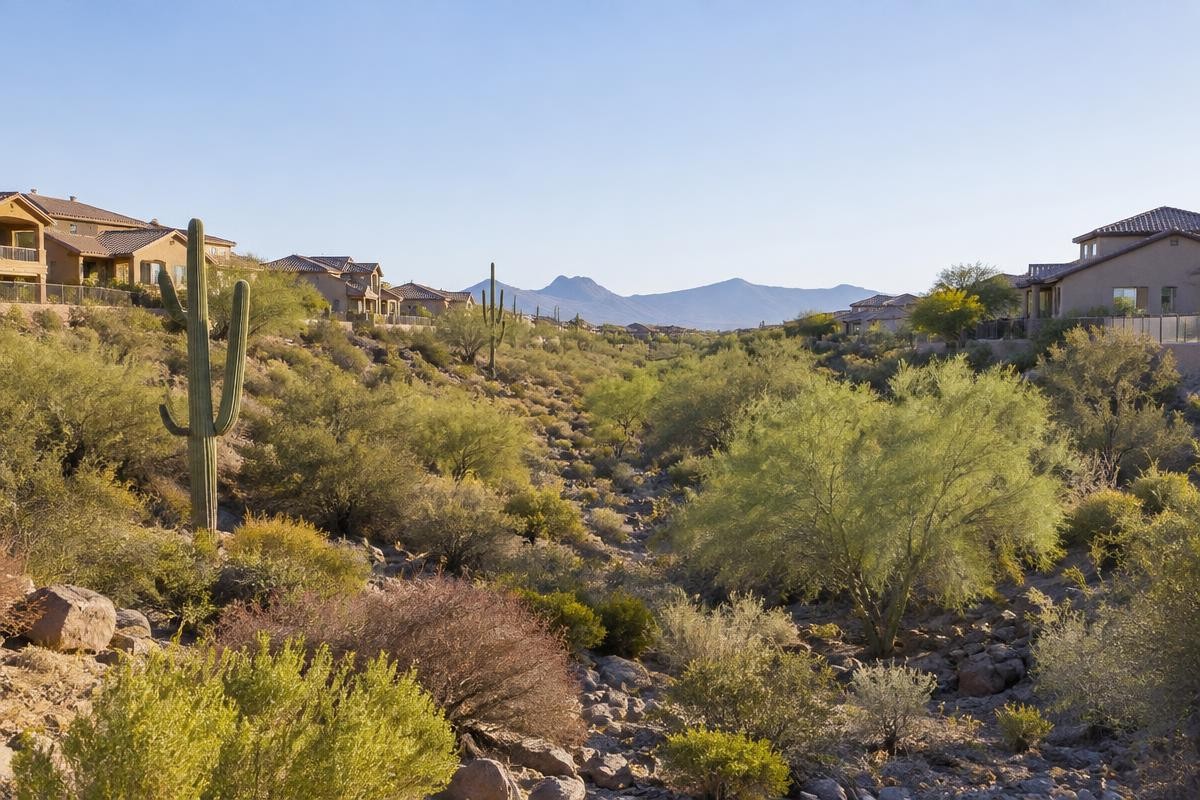
Roughly thirty-six per cent of Anthem is preserved open space, including close to three hundred acres of open hillside, and the whole community was built at the foot of Daisy Mountain and Gavilan Peak.
That proportion changes the shape of the work. In most planned communities the undeveloped ground is an edge: the outermost row of houses backs onto it and everything inside that ring is insulated by other people’s gardens. Here it is threaded through instead — washes, preserved slope, hillside, the ground on either side of the trails — so a house four streets in from the boundary can still have open desert a short walk from its back wall.
Our scorpion control page already places this part of the north Valley among the heaviest scorpion pressure anywhere in the metro, and the open space is the reason. A supply does not need to arrive from one direction when it is distributed through the community itself.
On a particular lot that means direction matters less than it does elsewhere and the building matters more. Where pressure can arrive from any side, sealing is worth more than spraying: the gap under a gate, the weep screed line at the base of the render, the expansion joint where the garage meets the drive, the void behind a piece of trim that has worked loose. If your garden does back directly onto preserved ground, our Scottsdale page works through what that particular arrangement adds on top.
Rodents arrive earlier here than they do in town
The most useful single thing to know about rodents in Anthem is that the calendar is ahead of the Valley’s.
What triggers the move indoors is temperature rather than the date on the calendar. Cool nights reach this height sooner, the search for a warm cavity starts sooner, and by the time the conversation about rodents gets going in Phoenix the work up here should already have been done and paid for.
The route itself is the ordinary one, and it is worth saying plainly rather than dressing up: the roofline, anywhere a service line passes through a wall, the gap along a garage door seal, a vent that has lost its mesh, and the roof space above all of it. Trapping indoors is the last step and not the first, because an animal taken out of a building that is still open is replaced inside a week. Our rodent control page covers how a job is actually run.
Where a property sits near open ground the outbuildings deserve as much attention as the house. A shed, a casita, a pool equipment enclosure and a garage being used for storage are four separate opportunities, and between them they are the things nobody thinks to inspect.
Termites, and a community built in one go
Anthem was developed from 1998 onwards, which means the housing here is essentially one generation of construction.
That has two consequences worth knowing about. The first is that whatever soil treatment went in when these houses were built stopped doing anything a long time ago, so the protection a buyer tends to assume is still there very probably is not. The second is that the construction details repeat, which cuts both ways: what turns up at one address is worth looking for at the next, and the same handful of contact points come round again and again.
Desert subterranean termites want soil contact and they want damp. On this housing stock that usually means a patio poured later up against the slab, a planter built against the render, or an irrigation line that has been running along a foundation for twenty years without anybody moving it. Termite control covers how treatment is applied, and the termite inspection page explains the formal report when a property is changing hands.
What a visit up here involves
Two things are different about working in Anthem, and one of them is simply the drive.
The community sits about thirty miles north of downtown Phoenix with open country in between, which makes this a scheduled visit rather than a same-morning call-out. We would rather say that plainly than have you find out on the day. If what you need is somebody within the hour, tell us when you ring and we will be straight about whether it can be done.
We begin outdoors at the boundary rather than at the front door, because where open space sits nearby the direction things are arriving from is usually readable within a minute or two of standing in the garden. Then the building at ground level — the weep screed line, thresholds, gate gaps, utility penetrations, the garage door seal. Then the roofline. Then any outbuildings, one at a time. Indoors comes last, and only where something has actually been seen.
The timing conversation happens during that visit as well, because it is the part most likely to save you money. If the right answer is to come back in three weeks rather than treat today, that is what the written findings will say, and you will get them with the price before anything is booked.
What changes the price
Three things, and the one that moves the figure most is what your boundary touches rather than which part of Anthem you live in.
Parkside, Country Club and the Village are three subdivisions with their own associations, and they are not laid out identically, but the deciding question is simpler than the address. A lot with preserved open space, hillside or a wash close to it is a boundary job with an interval behind it, because the supply does not stop. An interior lot ringed by other houses is usually a shorter visit and often a single one.
Second, how many separate structures stand on the property. A shed, a casita and a pool equipment enclosure are three inspections, not three minutes.
Third, the distance. A visit here carries a drive that a job inside the metro does not, and where a property needs a maintained interval that shows up honestly in the quote rather than being buried in the first figure and recovered later.
Nothing gets priced from a description over the telephone. You get a figure once somebody has walked the property, and a line beside it saying which parts of the property were reached and which were not.
Anthem pest control questions
Why would the timing be different here from the rest of the Valley?
Height. Anthem averages a little over eighteen hundred feet and parts of it are well above two thousand, against roughly a thousand at the airport. That makes it cooler and wetter than the Valley floor, which pushes the warm season later at the start and earlier at the finish. The advice you read about when to treat in Arizona is written for the floor, because that is where most people live, so following it here puts you a few weeks out at both ends of the year.
Am I in Phoenix or not? I get different answers.
Both answers are right for different parts of Anthem. The western portion sits inside Phoenix city limits; the rest is unincorporated Maricopa County, bordered north, east and south by New River. For anything a county deals with rather than a contractor — standing water, a swarm that has settled somewhere public, rats on ground nobody occupies — the number is 602-506-6616, which reaches Environmental Services at the county. It makes no difference at all to how we treat your property.
Which association am I under, and does it affect what you can do?
Anthem is divided into Parkside, Country Club and the Village, each with its own homeowners association and elected board, and those boards in turn elect the Anthem Community Council. For work on your own lot none of it changes anything. Where it matters is common ground: if the problem is coming off preserved open space, a wash or a shared landscaped strip, that is not yours to have treated, and what we can do instead is deal with the ground that is yours and give you a written note of where the pressure originates, which is the document a board will actually act on.
Is it true that scorpions are worse in Anthem?
This stretch of the north Valley does carry heavier scorpion pressure than most of the metro, and we say so on our scorpion page rather than only here. The reason is the open space: roughly a third of the community is preserved ground, so the supply is not sitting politely at the edge, it is distributed through the middle. What that changes is the remedy rather than the severity — on a lot where things can arrive from any direction, closing the building is worth more than treating the yard.
We are four streets in from any open space. Are we fine?
Better placed than a boundary lot, certainly, but not outside it. Because the preserved ground runs through the community rather than around it, a great many interior addresses still have open desert within a short walk, and the trails and washes carry things further in than people expect. The practical difference is that an interior lot is usually a single visit and a check rather than a maintained interval.
Do you actually come out this far?
Yes, and it is a booked appointment rather than a same-day one. Anthem is about thirty miles north of the centre with open country in between, so we schedule it properly instead of squeezing it in and arriving late. If your problem genuinely cannot wait, say so on the phone and we will tell you honestly whether we are the right people for that particular day.
Related services
Scorpion Control in Phoenix
Where pressure can arrive from any side, closing the building beats treating the yard.
Rodent Control in Phoenix
The roofline, the outbuildings, and a calendar that runs ahead of the Valley’s.
Termite Control in Phoenix
One generation of houses, and a soil treatment that expired years ago.
Termite Inspection
What gets checked, and what the report is obliged to leave out.
Pest Identification Guide
What you found, whether it matters, and what it usually means.
All Service Areas
Every other town we cover, each running to a calendar of its own.
Tell us what the garden backs onto
Whether there is open space, hillside or a wash near your boundary, and which of the three villages you are in. That, plus the time of year, decides what the visit ought to be.