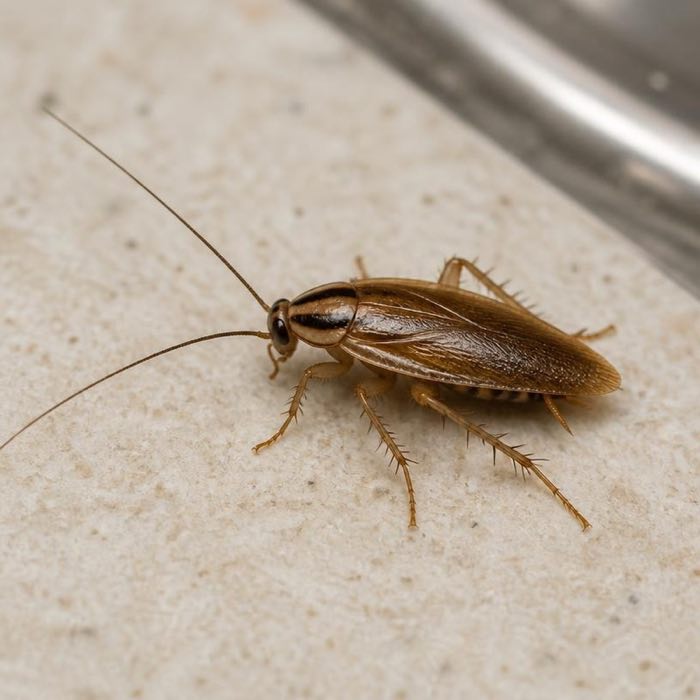
Two questions come up more than any others once somebody has seen a cockroach in the house. Are they actually dirty, and how quickly do a few turn into a problem? They get asked separately, and they are really the same question — but not for the reason most people expect.
The short version: there is a genuine, well-documented health issue with cockroaches indoors, and it is not the one the word “dirty” points at. The disease story is weaker than it sounds. The allergy story is stronger, far better evidenced, and depends almost entirely on how many of them there are — which is where breeding rates come in.
This page is about risk and biology. For working out which roach you are looking at, the species descriptions are on our pest identification guide, and what to do about them is on cockroach control in Phoenix.
The disease claim is softer than almost anyone admits
Search this question and you will be told cockroaches spread salmonella, dysentery, typhoid and a list of other things, usually in a confident sentence with no source attached. It is worth looking at how the people who actually study this phrase it.
The University of California Statewide IPM Program’s pest note on cockroaches says German cockroaches are believed capable of transmitting numerous disease-causing organisms, listing Staphylococcus and Streptococcus species, hepatitis virus and coliform bacteria, and that they have been implicated in the spread of typhoid and dysentery. American cockroaches, because they move through sewers and pet waste, are described as capable of transmitting the bacteria behind food poisoning, Salmonella and Shigella.
Read those words carefully. Believed capable. Implicated. Capable. Not one of them says transmission to a person has been demonstrated. For the other common species — oriental, Turkestan, brownbanded — the same publication makes no disease-transmission claim at all.
That is not an argument for living with them. Cockroaches do walk through drains and waste and then across worktops, and contamination of food and utensils is listed plainly as a problem rather than a maybe. Where food is being prepared commercially that contamination risk is handled as its own job, which is what restaurant pest control covers. But if you came here asking whether a roach in the kitchen has made your family ill, the honest answer is that the evidence for that specific chain is thinner than the internet suggests, and the real case against them sits somewhere else entirely.
The health effect that is actually established
It is allergens, and it gets a fraction of the attention.
The same UC IPM publication states that indoor infestations are important sources of allergens and have been identified as risk factors for the development of asthma in children, particularly in multi-unit housing. The material responsible is not anything the insect is carrying on its feet. It is the insects themselves — shed skins and droppings, which break down into dust, become airborne and are then inhaled.
One line in that publication matters more than the rest, and it is the hinge of this whole page: allergen levels have been directly correlated to cockroach density and to the conditions that allow a heavy infestation in the first place.
In other words the health risk is not a yes or no property of the animal. It scales with how many there are and how long they have been there. A single American cockroach that came up a dry drain trap last night has not changed the air in your house. A German cockroach population breeding behind a kitchen cabinet for six months is a different proposition, and the difference between those two situations is entirely a question of reproduction.
Two things are worth saying plainly here. A risk factor is an association, not a cause — the research links exposure to asthma development and severity, it does not say cockroaches give a child asthma. And this is a pest control page, not a medical one. If a breathing problem at home has anyone worried, that is a conversation for a doctor rather than for us.
What happened when researchers sent in an exterminator
This next study is an awkward one for a pest control company to put on its own website, and leaving it out would make this page worse.
The National Cooperative Inner-City Asthma Study ran an environmental intervention and published the results in the Journal of Allergy and Clinical Immunology in 1999 (Gergen and colleagues). Of 331 eligible families whose asthmatic children had tested positive to cockroach allergen, 265 agreed to professional extermination — two applications of abamectin — plus education on removing allergen from the home. Settled dust from 48 of those homes was measured for Bla g 1, the main German cockroach allergen.
It worked, and then it stopped working. Kitchen allergen fell from a geometric mean of 68.7 units per gram at baseline to 33.6 at two months, a statistically significant drop. The proportion of kitchens above 8 units per gram fell from 86.8 per cent to 64.3 per cent by six months. But by the twelve-month visit the allergen burden had returned to, or exceeded, where it started. Levels stayed well above the thresholds considered clinically significant throughout, and after a year the families who had been treated did not report fewer cockroach problems than the families who had not.
One more detail deserves attention. About half the families followed the cleaning instructions they were given, and those households saw no greater benefit than the ones who did not. Scrubbing was not the variable that mattered.
The lesson is not that treatment is pointless. It is that a visit is an event and an allergen load is a state. If the population comes back, so does everything it sheds, and a year is long enough for it to come back completely. What reduces allergen is holding the numbers down over time, which means the useful question is not what kills a cockroach but how fast the survivors replace themselves.
So how fast do they actually multiply?
Fast enough that the species matters more than almost anything else you could know about the situation.
A female cockroach does not lay loose eggs. She produces an egg case, called an ootheca, holding a fixed number of eggs. What varies between species is how many eggs are in it, how long it takes to hatch, whether she carries it or glues it somewhere, and how often she makes another.
For the German cockroach, UC IPM puts the case at about 30 eggs with a 30-day incubation, carried by the female for most of that time and dropped only as hatching approaches — which is why you so rarely find abandoned German egg cases, and why a vacuum cleaner takes the next generation with the adult. She can produce a new one every few weeks. Followed through for a single year, one female and her descendants come to over 30,000 individuals.
Then compare that with the roaches most Phoenix households actually meet outdoors. An American cockroach case holds about 12 young, is carried for roughly six days and then cemented to a surface, and takes about two months or longer to hatch. One female and her descendants over a year: a little over 800. Brownbanded, over 600. Oriental, close to 200.
German
About 30 eggs per case, 30-day incubation, carried almost to hatching, a new case every few weeks. One female and her descendants in a year: over 30,000.
American
About 12 young per case, carried roughly six days then glued down, and slow to hatch. One year, one female and descendants: over 800.
Brownbanded
Case glued to furniture and ceilings rather than carried, several weeks to hatch. One year: over 600.
Oriental
Case deposited almost immediately after forming. The slowest of the four. One year: close to 200.
That is roughly a fortyfold gap between the top of the list and the bottom, from the same starting point, in the same twelve months. It is the single best reason to find out which species you have before deciding how worried to be — and it is why one roach in a bathroom and one roach in a kitchen are genuinely different news.
The roach taking over Phoenix is winning on breeding, not toughness
There is a local twist here that national articles miss completely.
Across the desert southwest, the Turkestan cockroach, Blatta lateralis, has been steadily replacing the oriental cockroach outdoors. It is not a new arrival either — a study of its life history in the Journal of Economic Entomology records substantial numbers already present in Mesa, Scottsdale and Tucson in 1984. The first reported infestation in the United States was at an army depot in California in 1978, and the researchers suspect it arrived on military transport returning from Central Asia. Its spread since has been helped along by online sales to reptile keepers, who breed it as feed.
What makes it worth knowing about is why it wins, because it is not strength and it is not chemical resistance. The same study puts it down to two things, and both are reproduction. A Turkestan female produces up to 25 egg cases in her lifetime, against five to ten for an oriental female. And her nymphs reach adulthood after five moults, where an oriental nymph needs somewhere between seven and ten.
Each case holds around 17 eggs, which is not remarkable in itself, and the hatch rate is about 83 per cent. The telling detail is that the egg count does not tail off after her fourth case the way a German cockroach’s does. She keeps producing at the same rate.
Where they live is the other half of the local story. The study lists in-ground containers — water meter boxes, irrigation boxes, cable and electrical boxes — along with hollow block walls, broken pavement and expansion joints. That is a description of a standard Phoenix front yard. One more quirk explains a lot of the sightings: they cannot climb smooth surfaces, which is why they turn up stranded in utility boxes, pool skimmers and sinks they could not get back out of.
What all of this actually changes
Three things follow, and none of them is about scrubbing harder.
Identify before you worry. The gap between the species is enormous, both in breeding rate and in whether the population is indoors shedding allergen or outdoors in a meter box. The identification guide separates the four Phoenix species, and a photograph settles it faster than a description will.
Treat density as the target, not the sighting. That is what the 1999 trial result argues for, and it is also simply what the allergen correlation means. A single visit against a German population that is replacing itself every few weeks buys months, not years.
And deal with what is feeding and watering them, because that is what sets the ceiling on how many there can be. The conditions side is covered in detail on roach-proofing a desert kitchen, and the treatment side on cockroach control in Phoenix. Where there are children or animals in the house, how a treatment is carried out matters as much as what is used, and pet-safe pest control goes through that.
Questions we get about cockroaches and health
Are cockroaches dirty?
They contaminate food and surfaces, and that part is not disputed. The disease-transmission claims are softer than they are usually presented — UC IPM frames them as believed capable and implicated rather than demonstrated. The firmly evidenced problem is allergens from shed skins and droppings, which is a question of how many there are rather than of the insect being inherently filthy.
How fast can cockroaches multiply?
It depends almost entirely on species. UC IPM puts a single German cockroach female and her descendants at over 30,000 individuals in one year, on egg cases of about 30 eggs produced every few weeks. An American cockroach reaches a little over 800 on the same basis, brownbanded over 600 and oriental closer to 200.
How many eggs are in a cockroach egg case?
About 30 for a German cockroach and about 12 for an American, per UC IPM. A Turkestan case averages close to 17, with roughly 83 per cent hatching. The number per case matters less than how often she makes a new one, which is where the species separate sharply.
Does one treatment fix the allergen problem?
The published evidence says no. In the 1999 inner-city asthma trial, professional extermination cut kitchen allergen roughly in half at two months, but by twelve months it had returned to or passed its starting level and stayed above clinically significant thresholds throughout. Allergen tracks population density over time, so holding numbers down is what changes it.
Why do I keep finding roaches in my water meter and irrigation boxes?
That is characteristic Turkestan cockroach habitat — the research lists in-ground water meter, irrigation, cable and electrical boxes, hollow block walls and expansion joints as where they live. They also cannot climb smooth surfaces, so once one drops into a box or a skimmer it tends to stay there, which makes them look more numerous in exactly those spots.
Should I be worried about asthma in the house?
Cockroach allergen is recognised as a risk factor for asthma developing in children, especially in multi-unit housing, and exposure correlates with how heavy the infestation is. That is an association rather than a diagnosis, and we are not medically qualified — if anyone in the house has asthma or symptoms you think are linked to the home, raise it with a doctor. What we can affect is the population producing the allergen.