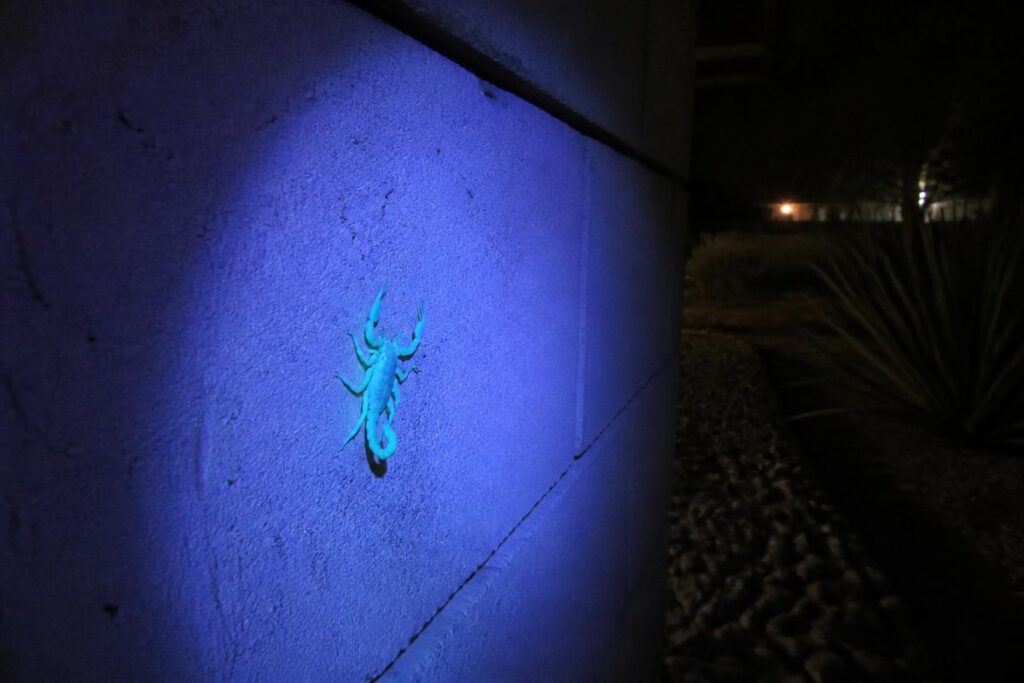
Someone finds a scorpion the size of a grain of rice on a bathroom wall, or a pale one no bigger than a fingernail in the tub, and the question is always the same. Is it a baby, and does that make it worse?
Length is the least useful thing about it. A scorpion that small in the Valley is more often a fully grown adult of a species that barely matters medically than an infant of the one that does — and when it genuinely is a newborn, that stage lasts a fortnight rather than a season. What the find tells you has little to do with size and a great deal to do with where it came from.
So this page is about life stage: what a newborn bark scorpion is, how briefly it stays one, and what a small one indoors says about the property it appeared on. For working out which species is in the jar, the body-shape test that separates the Valley’s scorpions sits on our pest identification guide.
What a newborn bark scorpion is, and how long it stays one
Scorpions do not lay eggs. Arizona’s bark scorpion, Centruroides sculpturatus, gives birth to live young, and the University of Arizona Cooperative Extension publication on scorpions of the desert southwest — Gouge, Li, Bibbs and Nair, 2018 — describes the sequence in enough detail to be useful to a householder.
The young are called scorplings. The mother folds her legs into what the authors call a birth basket, cradling them and helping them onto her back, where they settle as a cluster. Extension puts the average litter at about 25 to 35 young. A 2025 review of medically relevant bark scorpions in the Journal of Integrated Pest Management gives a narrower species-specific range for C. sculpturatus of roughly 12 to 38, citing Stahnke’s 1966 work. Whichever end is closer to the truth on a given night, the point stands that a female does not produce one or two.
Newborn scorplings are pale, and the reason is structural rather than cosmetic — the cuticle has not hardened yet. Extension describes them as very delicate and unable to defend themselves, which is why riding on the mother is the entire strategy at that stage. They also do not eat. The JIPM review notes that first instars live on stored yolk reserves instead of hunting.
Then it is over quickly. Extension records the pale young climbing down off their mother’s back, moulting, and returning to her for several days before leaving for good, usually within one to three weeks of birth. From there they are independent, and they moult periodically as they grow.
So a baby scorpion in the strict sense is an animal a couple of weeks old at most, very probably still on its mother’s back where nobody will see it. That is the first reason the search term and the thing in the tub are rarely the same animal.
First instar
Pale and soft-shelled, the cuticle not yet hardened. Does not feed at all, living on yolk reserves. Rides the mother’s back and cannot survive off it.
After the first moult
Climbs down, moults, returns to the mother for several days, then leaves for good — usually one to three weeks after birth. From here it hunts for itself.
Juvenile
A smaller bark scorpion with adult proportions, moulting as it grows. Extension says years are required to reach maturity, so this is where most small ones people find actually sit.
Adult
Two to three inches, living five to seven years. Slender-pincered and thin-tailed — the shape separates the species, not the size.
Why the small one you found is probably not a baby
Two separate things make a one-inch scorpion read as an infant when it is not. The first is how long the juvenile stretch runs. Extension states that years are required for a scorpion to reach maturity, and that bark scorpions live for five to seven years. Between leaving its mother at two or three weeks old and arriving at adult size, a bark scorpion spends a long time simply being a smaller bark scorpion — the same silhouette, the same slender pincers and narrow tail, just shorter. There is no visual cliff between baby and adult, which is why trying to age one by eye leads nowhere.
The second is that some scorpions sharing a Phoenix yard are small when fully grown. Extension describes the Arizona stripe-tailed scorpion, Paravaejovis spinigerus, and the yellow ground scorpion, Vaejovis confusus, as burrowing species full-grown at under three inches, photographs the pair at roughly an inch each, and says plainly that they are often mistaken for bark scorpions. Their venom is relatively mild and, in the same publication’s words, does not usually require medical intervention.
That is the real trap in the question. A one-inch scorpion on a patio slab is more likely to be a mature adult of a low-consequence species than an infant of the one that counts. Length will not sort them out; proportion will, and that test belongs with every scorpion on the property rather than only the small ones.
The blacklight blind spot
This next part genuinely changes what you should do, and it is almost never mentioned in anything written about baby scorpions.
Scorpion cuticle fluoresces under ultraviolet light. The JIPM review puts excitation near 395 nanometres and emission peaking around 500, which is why an ultraviolet torch is the standard way to survey a property after dark, and why Extension recommends walking the inside of a house with one before bed. Our spring scorpion post goes through how to do that walk properly.
But the glow comes from hardened cuticle. The same review records, citing Lourenço in 2012, that newly hatched and recently moulted scorpions do not fluoresce at all.
The individuals that stay dark are precisely the ones this question is about: newborns, and any juvenile in the days right after a moult. A blacklight sweep is still the best tool available for finding adults, and nothing here argues against doing one. It does mean a quiet walk is not evidence that there are no young on the property — only that there were no hardened scorpions where the beam happened to point.
Are baby scorpions more dangerous? What the evidence supports, and what it does not
One claim turns up everywhere on this topic: that juveniles cannot regulate how much venom they release, so a small one stings worse than a grown one. It is stated with real confidence across a lot of pest control websites.
We could not source it. The 2025 JIPM review is the current synthesis of the literature on this species and offers no comparison of venom potency between juveniles and adults, and we found no study making that comparison within C. sculpturatus. There is published work showing that across species smaller scorpions tend toward more potent venom, but that sets one species against another rather than a youngster against its own parent. Repeating the claim as settled fact would be guesswork dressed up as information.
What is established is more useful anyway, because it points at the person rather than at the scorpion. Extension is unambiguous that the Arizona bark scorpion is the only scorpion of medical concern in the United States, citing Curry and colleagues, 1983. Every native scorpion here can sting; only this one’s sting is hazardous to human health. Severity then tracks who was stung rather than what stung them: Klotz and colleagues reported in 2021 that patients under five have the most severe symptoms and are likeliest to be given antivenom, while O’Connor and colleagues found in 2018 that most patients admitted with severe envenomation are adults.
Extension’s household threshold is specific. If a child of nine or under, or anyone under 70 pounds, is stung, it says to call 911 or the Poison Help hotline on 1-800-222-1222, or go straight to the nearest hospital. Most healthy adults manage a sting without a doctor, though it still advises calling the hotline, since responses vary.
None of that is medical advice and this is not the page to look for any — the hotline is free, staffed around the clock, and the correct first call. But the honest answer to the original question is that the scorpion’s size is not what decides how serious a sting turns out to be. The age and size of the person is, and so is the species.
Where there are small children or animals in the house, the practical consequence is about how a treatment is carried out rather than about alarm, and pet-safe pest control covers what changes on a job like that.
One small scorpion indoors means something a single adult does not
An adult bark scorpion found inside can be a traveller, though not much of one. Extension cites telemetry work putting typical foraging movement at under 35 yards in a night, most of it between 7pm and 11pm and again from 3am to sunrise.
A scorpling cannot manage even that. It left its mother within three weeks of birth and has not come from anywhere distant, so a genuinely small one indoors is a fair indication that a female gave birth on or against the structure — a wall void, a slab edge, the hollow block of a perimeter wall — rather than that something strolled in off the desert.
The species’ behaviour supports that reading. Extension notes bark scorpions are not territorial and are usually found living alongside others, sometimes in dense populations where resources allow, and records the curious detail that immature scorpions will climb onto the backs of unrelated adult females and be carried about, tolerated. This is not a solitary animal holding a patch against rivals; where conditions suit it, there are more. Which shifts the useful question away from whether this particular one is a baby, and onto where a brood found enough shelter, moisture and prey to get going — a question answered outside the house.
A gravid female does not travel, and that narrows the search
The same telemetry carries the single most helpful fact for anyone trying to work out where a small scorpion came from. Extension reports that males typically travel further than females, and that gravid — pregnant — females move the least of all. A female carrying young is not ranging across the block looking for somewhere to settle. She is already somewhere that works, and it is close. So if a scorpling turned up inside, the place she chose is within a short radius of it, and it will be where three things overlap.
Shelter comes first. Extension describes the bark scorpion as a crevice species during daylight — walls, under rocks, logs and tree bark, small animal burrows, building wall voids — and notes that while underground burrows get used, hollow block walls are preferred. Water comes second: the publication records them drinking from small pools of standing water, which in a Phoenix yard means irrigation, a dripping hose bib, a leaking valve box or a condensate line. Prey comes third, mostly crickets and cockroaches.
Put those together and the search area is small and specific: the wall line nearest where the scorpling appeared, anything in that stretch holding damp, and any hollow block within a few yards. A much shorter list than walking the whole property with a torch.
The winter habit that catches people out
Bark scorpions are active for most of the year in the low desert, with Extension giving night-time temperatures above 70°F as ideal. Through the coolest months, November to March, they slow down, and in the coldest spells they gather in sheltered, enclosed, undisturbed spaces the publication calls hibernacula — groups that tend to be found when residents do construction in winter and block walls come down.
So a homeowner who opens a wall in January and finds scorpions at mixed sizes has not uncovered an infestation that arrived overnight. They have opened a hibernaculum, and the mixed sizes are the population that was always there. It is the one case where several small ones together says nothing about a recent brood.
What changes, and what does not
A small scorpion is not a different job from a large one. The method is the same either way, and it is laid out on scorpion control in Phoenix, with the seasonal version on spring scorpion spikes.
What a scorpling changes is the reading rather than the method: look harder at the perimeter wall and the ground line than at the room it appeared in, check what holds water within a few yards of that wall, and do not accept a quiet blacklight walk as an all-clear. In communities built hard against preserved desert — Anthem is the clearest example in our area — that perimeter work is most of the result.
Questions we get about small scorpions
How long does a scorpion live?
Years, not weeks. Arizona Cooperative Extension puts bark scorpions at five to seven years, and notes some scorpion species may live up to 25. That lifespan is why a property with good harbourage accumulates them rather than turning them over.
How many young does a scorpion have at once?
Extension gives an average of about 25 to 35. The 2025 review in the Journal of Integrated Pest Management cites a species-specific range for the Arizona bark scorpion of roughly 12 to 38, from Stahnke’s 1966 work. Litter size varies with food supply, population density and temperature, so neither figure is a fixed number.
How long do baby scorpions stay with their mother?
Not long. Extension describes the pale young climbing down off her back, moulting, then returning to her for several days before leaving permanently, usually within one to three weeks of birth. Before that first moult they cannot feed themselves at all, living on yolk reserves.
Do baby scorpions show up under a blacklight?
No, and this is the practical catch. The fluorescence comes from hardened cuticle, and the JIPM review records — citing Lourenço, 2012 — that newly hatched and recently moulted scorpions do not fluoresce. A clean ultraviolet walk tells you there are no hardened scorpions where you pointed the torch, not that there are no young ones about.
Is a pale or whitish scorpion a baby?
Not reliably. Newborns are pale because the cuticle has not hardened, and a juvenile is pale for a short while after each moult, so pale does suggest one of those. But Extension also describes bark scorpion colouring as highly variable, with some adults pale and others darker with stripes or checkered patterning. Colour on its own does not give you an age or a species.
I found one small scorpion and nothing since. Is that still worth acting on?
It is worth looking. A very small one has not travelled far, and a gravid female moves less than any other adult, so the likely origin is close to where it appeared rather than out in the desert. Checking the nearest stretch of perimeter wall, anything in it holding damp, and the ground line along it costs an evening and answers the question.