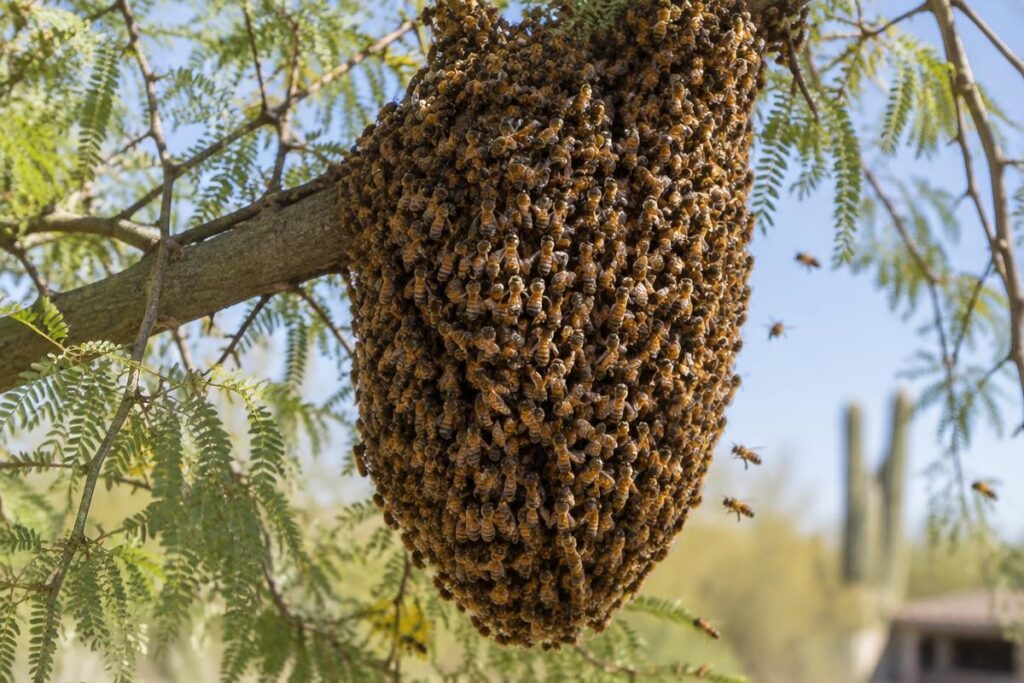
Killer bees are a real thing, they are in Arizona, and they have been here since June 1993. Almost everything else people believe about them is either wrong or pointed at the wrong detail.
The single most useful fact is this one: their venom is no stronger than an ordinary honey bee’s. Drop for drop it is the same. Every bit of the extra danger comes from behaviour and arithmetic — how many bees answer a disturbance, from how far away, and how long they stay angry afterwards.
This page is about where they came from, when they got here and what the evidence says about the risk. If there is a colony on your property right now and you want to know what happens next, that belongs on bee removal in Phoenix instead.
An accident in Brazil, in October 1957
The story is better documented than most pest origin stories, and the University of Arizona Cooperative Extension sets it out in its own information sheet on the subject.
Brazilian beekeeping in the mid-twentieth century had a problem. European honey bees, bred over centuries in colder and drier parts of the world, performed poorly in hot, wet, tropical conditions. In 1956 the Brazilian Agriculture Ministry asked a geneticist, Warwick Kerr, to bring back African honey bee queens for breeding work — the aim being a bee with African productivity and something closer to European temperament.
Kerr returned from South Africa with 63 live queens. By the end of 1956, 48 were still alive at a quarantine station near Rio Claro. Attrition reduced the working stock to 29, kept in hives fitted with queen excluders — a grille over the entrance with holes too small for a queen to pass but wide enough for workers, so the colony could forage without being able to swarm.
In October 1957 a local beekeeper walked past, saw the excluders, and took them off. Queen excluders are normally only used before a queen starts laying, so he may simply have been trying to help. The result was that 26 queens left with small swarms into the forest nearby, and nobody could work out where they had gone.
Kerr’s assumption at the time was reasonable: the escapees would either die out or interbreed with European colonies until the African traits washed out. Within a few years the research station was instead fielding reports of feral colonies attacking livestock and people, and by the early 1960s it was clear the population was expanding fast.
What made the spread so quick was how they travel. Extension puts it plainly: a European swarm might move a few miles and then look for somewhere good to settle, while an Africanized swarm will often move 60 miles at a hop and nest in whatever hollow log or rocky ridge it finds. By the 1980s they had reached Mexico.
June 1993, southeastern Arizona
The arrival in the United States is documented down to individual incidents.
In May 1991 Jesus Diaz became the first person attacked by them on US soil, mowing a lawn at a trailer court in Brownsville, Texas. The bees were apparently set off by the smell of petrol and the vibration of the motor. He jumped off the mower and ran, which Extension notes is exactly what he should have done, and he was treated for 18 stings.
On 15 July 1993, 82-year-old Lino Lopez became the first person to die from Africanized honey bee stings in the United States. He had been trying to remove a colony from a wall in an abandoned building on his ranch near Harlingen, Texas. He was stung 40 times.
Africanized honey bees entered southeastern Arizona the following month, in June 1993. Arizona’s first fatality came on 10 October 1995, when an 88-year-old woman in Apache Junction disturbed a large colony in an abandoned building on her own property.
Two of those three incidents share a detail worth sitting with. Both deaths involved somebody going near an established colony inside a disused structure. Not a swarm passing through a garden, not a bee at a picnic — a colony that had been quietly in place long enough to get large, in a building nobody was using.
The venom is identical, and that matters both ways
This is the part that gets reported wrongly more than anything else about them.
The University of Florida’s extension publication on the differences between European and African honey bees states it without hedging: the venom of the Africanized honey bee is no more potent than that of the European honey bee. It goes further and gives a figure — for a fatality to occur from venom toxicity alone, it would normally take around 10 stings per pound of body weight, from either type of bee.
Run that arithmetic for an average adult and it comes out somewhere above a thousand stings. Which sounds, at first reading, enormously reassuring.
Then set it against Lino Lopez, who died after 40. The two facts are not in conflict, and the gap between them is the thing to understand: the 10-stings-per-pound figure describes death by venom toxicity, and venom toxicity is not the only way a sting event kills. Allergic reaction and underlying health do their own work, and they do it at numbers nowhere near a thousand. Which is why the arithmetic is useful for understanding the insect and useless as personal reassurance.
We are a pest control company and not a medical one. Anything to do with an actual sting, a reaction, or how many is too many for a particular person belongs with a doctor, or with Poison Control on 1-800-222-1222.
What actually differs is the response
Same species, Apis mellifera, and the same sting. What changes is how a colony answers a disturbance, and the published comparison is stark.
European colony
Sends 10 to 20 guard bees, to disturbances up to 20 feet away. Usually calm again within one to two hours. A disturbed colony may produce 10 to 20 stings.
Africanized colony
Sends several hundred guard bees, to disturbances up to 120 feet away. May stay defensive for days. A disturbed colony may produce 100 to 1,000 stings.
Why that is the whole story
At identical venom potency, a hundredfold difference in sting count does all the work. The danger is the recruitment, not the chemistry.
The distance is the surprise
120 feet is further than the hundred-foot separation usually quoted as a safe margin, and it is measured from the colony, not from where you think the colony is.
Read down that comparison and the phrase “killer bee” stops describing a toxin and starts describing a response curve. A European colony registers you at twenty feet, sends a dozen bees, and has forgotten about it by lunchtime. An Africanized colony registers you at forty yards, sends hundreds, and is still agitated tomorrow.
Why Arizona ended up with so many of them
Three traits compound, and together they explain why feral colonies are ordinary here rather than remarkable.
They reproduce by splitting far more often. A European colony swarms once or twice a year. An Africanized colony can swarm ten or more times in the same period.
Those swarms are smaller, which sounds like a weakness and is the opposite. A European colony wants a cavity of around ten gallons, which in practice means a decent hollow tree. An Africanized swarm will set up in one to five gallons, and the supply of one-to-five-gallon cavities in a built-up desert city is effectively unlimited.
And they are far less particular about the cavity itself. European bees favour dry, protected, above-ground spaces. Africanized bees will use underground cavities with high moisture content, and will also build in the open, hanging from a branch. The consequence is the one that catches people out: because the colonies are small and the sites are odd, they frequently go undetected until something disturbs them.
That last point is the link back to the two fatalities. A colony in an abandoned building is not an unlucky coincidence. It is the predictable result of an insect that makes ten small swarms a year and will accept almost any void.
You cannot identify one by looking, and the name is wrong too
Africanized bees are roughly 10 per cent smaller than European honey bees. That is the entire visible difference, and UF extension describes it as nearly impossible to tell the two apart without specific measurements or laboratory testing. Identification is done with a morphometric screen called FABIS, the Fast African Bee Identification System, with a fuller test called USDA-ID used when the result is still unclear.
So any website promising to teach you to recognise one in your garden is promising something impossible. What you can read is behaviour and location, which is why our pest identification guide separates bees from the wasps people confuse them with rather than trying to split one honey bee from another.
The naming is muddled as well, and in an interesting direction. “Killer bee” is a popular-literature term. “Africanized” implies a hybrid between African and European stock — but the same publication notes there has been remarkably little introgression of European genes into the introduced population across South and Central America and Mexico, so the more precise description is African-derived. The bees that reached Arizona are closer to the original African subspecies than the hybrid name suggests.
So how dangerous is it, in proportion
Worth holding two things at once here, because most writing on this subject manages only one.
Nationally, deaths are rare and steady. CDC’s National Center for Health Statistics counted 788 deaths from hornet, wasp and bee stings across the United States between 2011 and 2021 — about 72 a year, ranging from 59 in 2012 to 89 in 2017. That is the whole country and all stinging insects, not Africanized bees in Arizona.
One figure in that dataset says more than the total does: 84 per cent of those deaths were male. That is not a fact about bees. It is a fact about who is on a mower, up a ladder, clearing a disused outbuilding or working outdoors — which is to say the risk tracks what people are doing, not bad luck. The same logic is why vacant units and yards behind commercial premises accumulate colonies that nobody has walked past in months.
So the honest proportion is this. A mass stinging event is uncommon, and it is also not random. It follows a recognisable sequence: a small colony establishes somewhere nobody looks, grows for months unnoticed, and then somebody starts a motor or opens a wall within its response radius. Every stage of that is visible in advance, which is the one genuinely good piece of news on this page.
What to do about a colony once you have found one — and why the comb has to come out rather than just the bees — is on our bee removal page.
Questions we get about killer bees in Arizona
Are there really killer bees in Arizona?
Yes. University of Arizona Cooperative Extension records Africanized honey bees entering southeastern Arizona in June 1993, and they have been established across the low desert ever since. The state recorded its first death from them two years later, in Apache Junction.
Is killer bee venom stronger than a normal bee’s?
No. UF extension is explicit that it is not, and applies the same toxicity threshold to both types. Drop for drop a sting from either delivers the same thing. The whole difference is in how many bees respond, from how far, and for how long afterwards.
How many bee stings is dangerous?
There is no single number, and the published toxicity figure misleads on its own. UF extension puts the venom-toxicity threshold at roughly ten stings for every pound a person weighs — but the first US death from these bees came after 40, because allergic reaction and underlying health operate at far lower counts. This is a question for a doctor or for Poison Control on 1-800-222-1222, not for a pest control company.
Can you tell an Africanized bee by looking at it?
Not reliably. They are about 10 per cent smaller than European honey bees, which UF extension describes as nearly impossible to distinguish without specific measurements or laboratory testing. Confirmation uses a morphometric screen called FABIS, backed up by a fuller test called USDA-ID.
Why are there so many wild bee colonies around Phoenix?
Because of how they reproduce. An Africanized colony can swarm ten or more times a year against one or two for a European colony, and each swarm needs only a one-to-five-gallon cavity rather than around ten. They will also nest underground in damp cavities and out in the open. Small colonies in unlikely places tend to go unnoticed until something disturbs them.
Are killer bees, Africanized bees and African bees all the same thing?
In popular use, yes, they all refer to the same insect. Technically “Africanized” implies a hybrid, and UF extension notes there has been remarkably little introgression of European genes into the introduced population in the Americas — so African-derived honey bee is the more accurate term. All of them are the same species as the familiar honey bee, Apis mellifera, in a different subspecies.