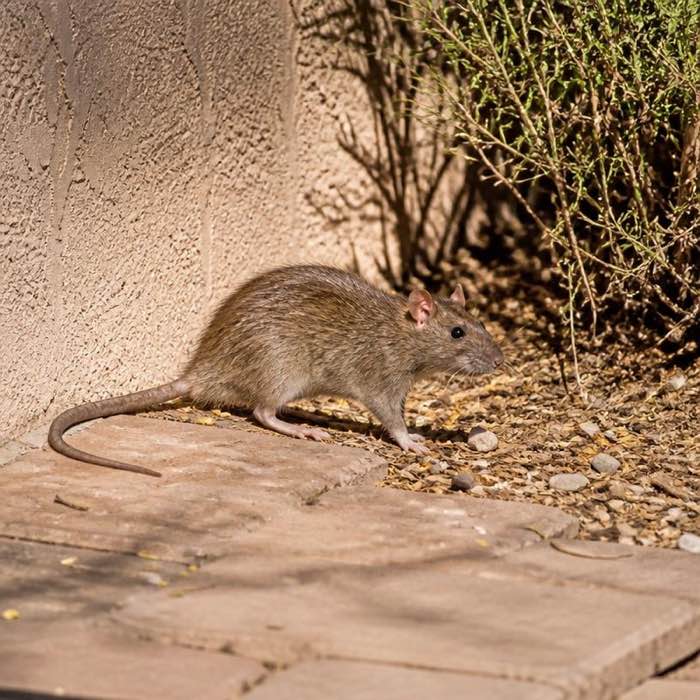
A box of rat bait costs about twelve dollars and sits at the end of an aisle in every hardware store in the Valley. It is the first thing most people try, and for a problem in an attic it is usually the wrong first thing. Not because it does not kill rats — it does — but because of what happens in the four to ten days between the rat eating it and the rat dying, and because of where the rat is when that happens. This page is what we would tell you on the phone if you asked whether to buy it.
The short answer
Indoors, trap. Outdoors and in a bait station, poison has a place. That is not our house opinion — it is what the University of Arizona’s own Cooperative Extension publication on roof rat control says, in almost exactly those terms: trapping is especially recommended for control indoors, because rats killed with poison baits indoors may retreat to inaccessible locations to die, and that leaves an odour problem which is difficult to remove.
Everything below is the reasoning behind that sentence. If you only take one thing from this page, take the order: seal the building first, trap what is already inside, and treat bait as the last and most carefully placed tool rather than the first and cheapest one.
What the poisons actually are, and which ones you can even buy
Almost every rodent bait on a shelf is an anticoagulant. It works by interfering with the blood’s ability to clot, so the animal dies of internal bleeding rather than of anything sudden. That single fact explains most of what follows, including the timing, the smell and the problem further up the food chain.
There are two generations of them, and the difference matters more than the brand on the box. The second-generation anticoagulants — brodifacoum, bromadiolone, difenacoum and difethialone — are the potent ones, and the US Environmental Protection Agency has already taken them off the consumer market. In the EPA’s wording they are no longer registered for use in products geared toward consumers, and are registered only for the commercial pest control and structural pest control markets. The reason the EPA gives is the one this page keeps returning to: these products pose greater risks to non-target species that might feed on bait only once, or that might feed upon animals that have eaten the bait.
So the strongest rodenticides are already professional-only by law. What you can buy over the counter is a first-generation anticoagulant, and the EPA also restricts where it can go: consumer ready-to-use bait stations are labelled for indoor use, or for outdoor use within fifty feet of a building. Everything beyond that is a label violation, not a grey area.
First generation
What you can buy retail. Slower, and the animal generally has to feed on the bait across several days before a lethal dose accumulates.
Second generation
Brodifacoum, bromadiolone, difenacoum, difethialone. Removed from consumer products by the EPA. Professional and structural markets only.
Where it may go
Consumer ready-to-use stations are labelled for indoors, or outdoors within fifty feet of a building. Tamper-resistant stations wherever children under six, pets or wildlife can reach.
What happens between eating the bait and dying
This is the part the packaging is quietest about. Anticoagulant baits are slow-acting, and the Arizona Cooperative Extension notes they may require the rat to feed on the bait across several days before death occurs. There is no moment where the bait is taken and the problem is over. There is a window, measured in days, in which a rat that has eaten a lethal dose is still moving around your building, still climbing, still going wherever it normally goes.
Two practical consequences follow. The first is that you cannot tell from the outside whether the bait is working, which is why people re-bait, and re-bait again, and end up with far more poison in the building than they intended. The second is that the rat chooses where it is when the window closes. Nobody else gets a say in that.
One more detail from the same publication, and it is the kind of thing only experience surfaces: roof rats cache food. They carry things off and store them. Loose pellets do not necessarily stay where you put them, which is part of why paraffin blocks secured inside a station are the safer formulation, and part of why an open tray of bait in a garage is a genuinely bad idea in a house with a dog.
Where the rat dies, and the myth that says otherwise
Ask around and somebody will tell you that rat poison makes the rat thirsty, so it goes outside looking for water and dies in the open. It is repeated confidently, often by people selling bait. It is not true, and it is worth being blunt about because it is the belief that sends poison into attics.
Anticoagulants cause internal bleeding. They do not cause thirst, and no rodenticide drives a rat out of a structure. Orkin, which has no commercial reason to talk anyone out of using bait, puts it plainly: rats only leave if their nest is outside the building, and if the nest is inside, they die inside the building. There is no way to predict where the animal will die, and often it is somewhere inaccessible — inside a wall, or in an attic.
That is the whole case against baiting an occupied roof space. A rat that nests in your attic will, on the balance of probability, die in your attic, in a wall void, above a bathroom ceiling, or somewhere between a joist and a run of ducting where nobody can reach it without cutting. The Arizona Cooperative Extension adds the detail people forget: the carcass does not only smell, it attracts insects.
Getting the smell out once it has happened
If you are reading this because it has already happened, the honest answer is that there is no spray that fixes it. Odour neutralisers and ozone machines mask or oxidise what is in the air; they do nothing about the source, and the source is what keeps producing it. The only reliable fix is removing the carcass, and everything else buys a few hours.
What actually helps is narrowing the search. The smell is strongest directly below or beside the animal, it peaks and then fades over a period of days to a few weeks depending on the size of the animal and how warm the void is, and in a Phoenix summer an attic accelerates all of it. Flies appearing in one room, or a small cluster of them at a ceiling light, usually marks the spot more accurately than your nose does. If it is behind drywall, a small inspection cut in the right place is a far better outcome than waiting it out, and it is a far smaller repair than people expect.
This is the cost nobody prices in when they compare a box of bait to a professional visit. The bait is twelve dollars. Finding and cutting out a carcass above a hallway ceiling is not.
What eats the rat next
A poisoned rat that dies outdoors does not stop being poison. It becomes a slow, easy meal for whatever hunts or scavenges in your neighbourhood, and the anticoagulant it is carrying transfers with it. This is what toxicologists call secondary poisoning, and it is not a theoretical worry.
The US Geological Survey summarises controlled work in which owls fed rats killed with bromadiolone, brodifacoum or diphacinone died of haemorrhaging themselves, with sublethal bleeding in owls fed rats killed with difenacoum. Field studies find the same thing in wild populations rather than in experiments: one survey of barn owls in Kentucky found that a third of the birds examined had been exposed to one or more anticoagulant rodenticides, and brodifacoum accounted for the overwhelming majority of those positive results. A larger database assembled from raptor carcasses across the United States and Canada now runs to several hundred birds.
There is a local edge to this. Great horned owls, barn owls and hawks all hunt across the Valley, and a rat is exactly the meal they are looking for. The bird that would have taken several rats out of your yard for free, over a season, is the bird most likely to be killed by the bait you put out to do the same job. That is a poor trade even if you care about nothing beyond your own attic, and it is why the EPA’s own stated reason for restricting the strongest products is the risk to animals that feed on animals that have eaten the bait.
Glue boards, and why we do not use them
Glue boards are sold for rats and they do catch them. We do not put them out, and the reasons are practical as much as anything else. A glue board does not kill; it holds. Whoever finds it has to deal with a live, distressed animal, which most homeowners are not prepared for and which is a genuinely unpleasant thing to walk into. They also catch whatever else crosses them, which in a Phoenix garage can mean a lizard or a songbird rather than a rat.
And a rat caught by a foot frequently drags the board somewhere before anything else happens, which puts you back in the same position as the poison: an animal you cannot find, in a place you cannot reach. If the point of avoiding bait was to keep control of where the animal ends up, a glue board gives that control away again.
What actually works, in the order it works
The Arizona Cooperative Extension lists four effective approaches — exclusion, habitat modification, trapping and poison bait — and is clear about the order of value: traps and baits give short-term control of a problem you already have, while exclusion and habitat modification are what prevent the next one. Sealing the building is the part that actually ends it, and our rodent control page covers how that survey and the sealing work run, including which gaps matter and what happens in the attic afterwards.
For the animals already inside, trapping is the method that keeps the carcass where you can find it. Rat-sized wooden snap traps work, and the versions with an expanded plastic treadle are noticeably better than the bare metal ones. Peanut butter, nutmeats, fruit or gumdrops all work as bait, and traps set along a runway — treadle end into the run, against the wall the rats are already using — sometimes catch without being baited at all.
The single most useful technique on this page is the one almost nobody does. Roof rats are wary of anything new in their environment, so a freshly set trap is often avoided for days. The fix is pre-baiting: put the traps out baited but unset, leave them until the rats are feeding from them confidently, and only then set them. The Extension notes this markedly improves trap success and helps prevent rats becoming trap shy. It feels like doing nothing for three days. It is the difference between catching the population and catching the one careless individual while the rest learn to avoid your traps permanently.
Two things to skip entirely. Chemical repellents and electronic devices are both explicitly not recommended by the Extension, and on repellents the position is simple: no chemical repellent is registered for rat control. The ultrasonic plug-in is the most reliably disappointing purchase in this category.
If you are going to use bait anyway
Sometimes bait is the right tool — an exterior population, a detached structure, a situation where trapping cannot keep up. If you are going to use it, use it the way the label and the Extension describe rather than the way the internet does.
Follow the label explicitly; it is a legal document and it specifies how, where and under what conditions that particular bait may be used. Put it in a tamper-resistant station wherever children under six, pets or non-target wildlife could reach it, which outdoors in a Phoenix neighbourhood is essentially everywhere. Use paraffin blocks secured to the rod inside the station rather than loose pellets that can be carried off. Expect the station to sit unvisited for several days, because the same wariness that slows traps slows bait stations too. And keep it out of occupied roof spaces, which is where this page started.
If you have already put bait down and you have pets, or you keep chickens, or there are children in the house, the thing worth doing today is finding the packaging, reading the active ingredient off it, and keeping that box. It is the first question a vet will ask, and the answer is printed on the label.
Rat poison questions
Do poisoned rats go outside to look for water?
No. This is the most persistent myth in the category. Anticoagulants cause internal bleeding, not thirst, and no rodenticide makes a rat leave a building. Rats leave only if their nest is outside it; if the nest is in your attic, that is where the animal will die.
How long does rat poison take to work?
Anticoagulant baits are slow-acting and generally require the rat to feed across several days before a lethal dose accumulates. There is no immediate effect, and no way to tell from outside whether it is working — which is exactly why people over-apply it.
Why can I not buy the strong stuff any more?
Because the EPA removed it. The second-generation anticoagulants — brodifacoum, bromadiolone, difenacoum and difethialone — are no longer registered for consumer products and are restricted to the commercial and structural pest control markets, on the grounds that they pose greater risk to animals that eat the bait once, or that eat something which has.
How do I get rid of the dead rat smell?
By removing the carcass. Sprays and ozone treat the air rather than the source, so the smell returns. Narrow the location by where the odour is strongest and by where flies appear, then get access to that spot — a small inspection cut is usually a smaller repair than people fear, and far better than waiting weeks.
Is rat poison dangerous to my dog or cat?
Treat it as if it is, both directly and through a poisoned rodent. That is the stated reason the EPA requires tamper-resistant stations wherever pets, wildlife or children under six have access. If you think an animal has been exposed, that is a vet call rather than a pest control call — take the packaging with you, because the active ingredient is what they will need to know.
Do ultrasonic repellers work on rats?
No. Electronic devices and chemical repellents are both explicitly not recommended by the Arizona Cooperative Extension, and no chemical repellent is registered for rat control at all. Money spent there is money not spent on sealing the gap the rats are using.
Related services
Rodent Control
The practical companion: which species you have, how they are getting in, what gets sealed and what happens in the attic afterwards. Rodent control.
Pest Identification Guide
Droppings, gnaw marks and nests — how to tell a rat from a mouse before you spend a cent. Start with the species.
Commercial Pest Control
Restaurants, warehouses and multi-unit buildings, where bait placement is a documentation and compliance matter as much as a pest one. Commercial pest control.
Rats in the roof, and not sure what to put down?
Describe the noise and the room it is coming from. We will say whether this is a trapping job, a sealing job or both — including when it is something you can handle yourself.