Search for what termites look like in Arizona and you will be told there are three types. Or four. The pages saying so do not agree with each other and none of them cites anything. The real number, from the University of Arizona, is that at least seventeen termite species live in this state and only three are of any significant economic importance — and the one you are most likely to actually notice is not among them. This page is about telling them apart before anybody sells you a treatment.
Seventeen species, and the three that matter
Worldwide there are roughly 2,761 named termite species across 282 genera. About forty-five of those occur in the continental United States, and close to thirty of them damage wood or wood products. Arizona holds at least seventeen. Three of them are worth a homeowner’s attention, and the University of Arizona’s Cooperative Extension is blunt about the rest.
Everything gets sorted into three groups by where it lives: dampwood, drywood and subterranean. In Arizona the dampwood group is not a widespread problem, drywood turns up under particular conditions, and the subterranean group is what the Extension calls one of our major urban pests. Termites in general it ranks as Arizona’s number one urban pest, which is not a sentence written about scorpions or roaches.
Desert subterranean
Heterotermes aureus. The most common and by far the most destructive termite in this state. Pale yellowish brown, about three eighths of an inch without wings.
Arid-land subterranean
Reticulitermes tibialis. Naturally lives on creosote and greasewood. Dark brown to black with almost colourless wings and dark legs.
Drywood
Incisitermes minor and Marginitermes hubbardi. Larger than the subterranean species, two-toned, and found in wood that never touches the ground.
The arid-land species explains something people find unfair. It lives out in the desert quite happily on creosote and greasewood bushes. Build a house on that ground, clear the creosote, and you have removed the food supply from an established population that is still there. The structure is what is left.
That is worth sitting with, because it reframes the whole subject. A termite problem in a new Valley subdivision is not usually something that arrived. It is something that was already living on that half-acre before anyone graded it, eating creosote, and then had its diet replaced with a house. Which is also why the age of the building tells you far less here than people expect, and why a property built in the last fifteen years is not automatically safer than one built in the seventies.
The one you are most likely to see, and why it is harmless
Here is the part that saves people money, and it is the reason this page exists.
There is a fourth termite out there called Gnathamitermes perplexus, and depending on the survey it is either the most common or the second most common termite in Arizona. It is also the one you are most likely to spot with your own eyes, because of what it builds. It feeds on dead plant material — desert plants, dead grass, twigs, fence timber, even dried cow dung — and it works by laying a thin, pale, plaster-like coating of earth over the surface and scraping the dead wood away underneath.
So you walk out one morning and find a wooden fence post, a palm trunk or a patch of dead grass wearing a crust of dried mud. Break a piece off and small pale insects scatter and vanish into the ground. It looks exactly like what everybody has told you to dread.
It is not a structural pest. The Extension’s position is plain: these termites are not pests and should not be treated for unless they are found inside a structure. They are doing in your garden exactly what they do across every square mile of desert around it, which is recycling dead plant material. If the mud crust is on a fence, a palm or the ground, the honest answer is to leave it alone.
There is even a way to confirm it under magnification, if you are the sort of person who owns a hand lens. The soldiers of this species have jaws that curve inward and carry an obvious tooth on the inner edge. That tooth is the feature used to separate the harmless desert termite from the damaging ones, whose jaws are slender and nearly straight.
Telling a termite from a flying ant
This is the single most common identification question in the category, and it is settled by two features you can see without any equipment at all.
Count the wing sizes
A termite has four wings of equal length that fold back over the body. An ant has two pairs of unequal size — the front pair noticeably longer than the back. The order name Isoptera literally means equal-winged.
Look at the waist
Behind the wings, an ant is pinched sharply inwards. A termite is completely straight from end to end, with no narrowing at all. This is the quicker of the two tests.
Check the antennae
A termite’s antennae are straight and look like a string of small beads. An ant’s are bent, with a distinct elbow partway along.
Termites are sometimes called white ants, which is unhelpful on both counts, but the nickname does point at something true: a pale insect that looks ant-shaped and is coming out of a tube of mud is a termite, because ants do not build those.
What the different castes look like
A colony is not one kind of insect. It contains three, they look nothing alike, and knowing which one you are holding changes what it tells you.
Workers are what almost every homeowner actually sees — pale, soft, small, and the ones doing everything. They build and repair the tunnels, forage, feed the colony, groom each other and help the others through each moult. If you break open a mud tube, these are what pour out.
Soldiers exist to defend against ants and against termites from other colonies, and they do it with a pair of large opposing jaws. They are also the caste that matters most for identification, which is why anybody serious about naming your species will ask for soldiers rather than workers. On the two damaging subterranean species the jaws are slender and close to straight, and separating those two from each other properly means examining the mandibles in detail — they are genuinely difficult to tell apart.
Reproductives, also called alates, are the winged adults that leave to start new colonies. They range from light tan through reddish brown to nearly black depending on species, have properly developed eyes, visible jaws and membranous wings. They are the ones that end up on your porch, and they are the second-best specimen for identification after a soldier.
One figure worth holding on to, because it reframes a swarm from a disaster into an event: of the millions of alates that fly in Arizona every year, usually fewer than one per cent survive to found a colony. A cloud of them at your window is not a cloud of future infestations.
Mud tubes, pellets and what each one tells you
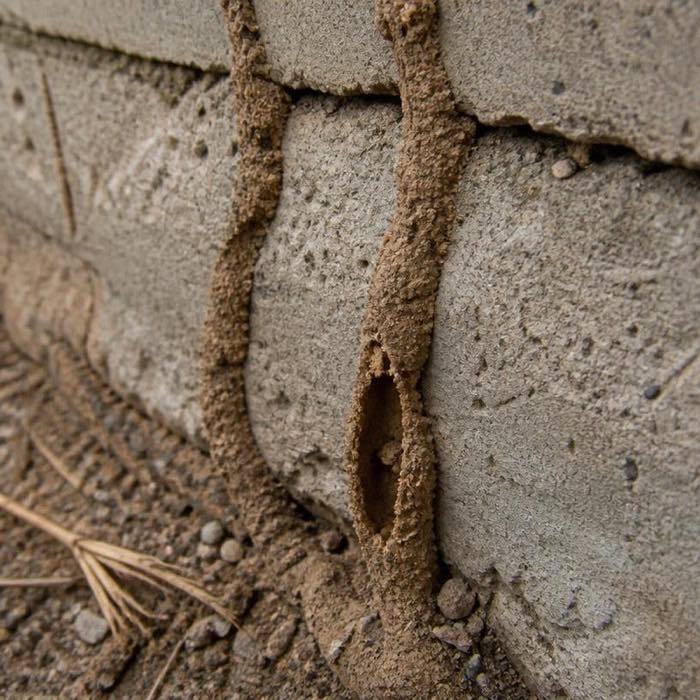
You will almost never meet the insects. You meet what they leave, and the two main kinds of evidence point at completely different animals.
Subterranean species have to stay in contact with soil for moisture, so to reach wood above ground they build a covered road to get there, made of soil, soft faecal matter and chewed wood. That is the mud tube, and on a Phoenix house the classic place to find one is running up the outside of the stem wall. Its presence tells you the colony is in the ground and is commuting.
Drywood termites build nothing of the kind, because they live entirely inside the wood and never touch the soil. What they leave instead is faecal pellets — hard, dry, and accumulating in small heaps below whatever they are in. Under magnification each pellet is distinctly dimpled, rather like a dried kernel of corn. Piles of those near a door frame or a windowsill are the drywood signature, and door and window joinery is where these infestations most often turn up.
The asymmetry is worth stating plainly. A drywood termite is the easier insect to identify and the harder infestation to find, because nothing it does shows on the outside of the building until the pellets appear. A subterranean colony announces itself with a tube, but the tube only tells you where it crossed — not how far it has gone.
The swarm calendar, and what the timing alone tells you
This is the part almost nobody writes down, and it is the most useful thing on this page after the harmless-species section. In Arizona, when the winged adults appear narrows down what they are before anyone looks at an insect.
July to September, after rain
Desert subterranean — the destructive one. Its flights come during the monsoon and generally follow a rainfall. If something swarms the evening after a storm, this is the first candidate.
January to March
Arid-land subterranean, below about 4,000 feet. Higher than that and the same species shifts to June and July, which is why advice written for Flagstaff does not work in the Valley.
June to August, bright and dry
Drywood. These fly on clear sunny days and are pointedly not timed to rainfall, which separates them from everything else on this list.
The harmless desert termite flies too, usually after a summer rainstorm, and does it in the morning or evening rather than the middle of the day. So a July swarm after rain could be either the species that will eat your roof timbers or the species quietly recycling your fence. That is precisely why the insect itself still has to be looked at — but the calendar has already cut the field down.
One behaviour links all of them: the alates are drawn to lights, and that is where pairing starts. A porch light during a swarm window is the reason they arrive at your door rather than somebody else’s, and shed wings on a windowsill or in a pool skimmer are often the first evidence anybody finds.
Looking for them on a Phoenix house
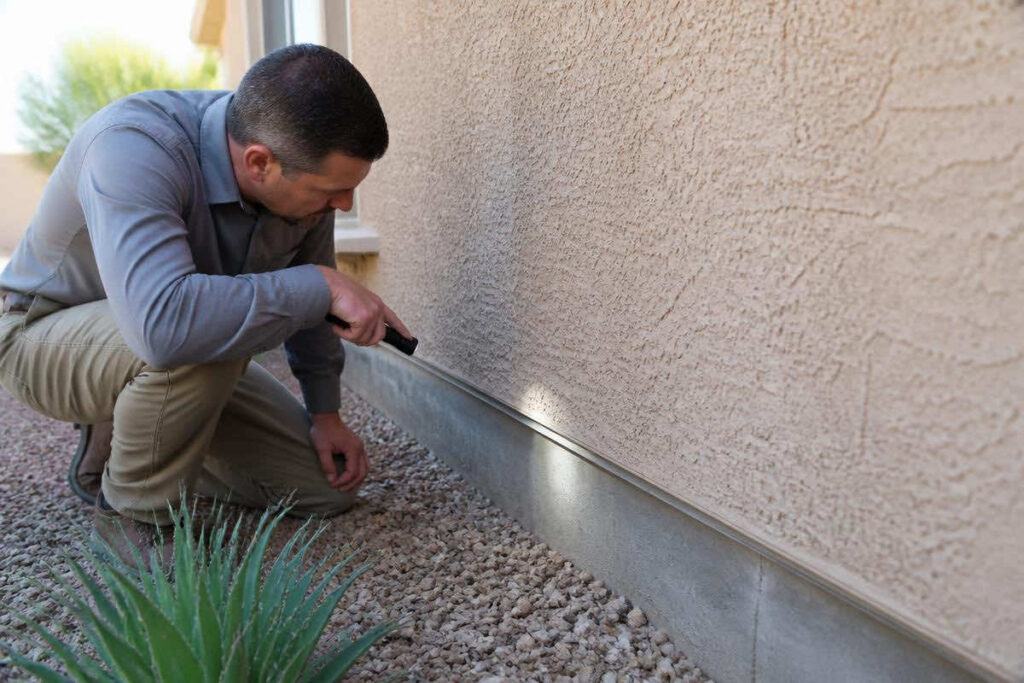
If you want to check your own property, there are four places worth a torch and ten minutes, and they are not evenly likely.
Start at the foundation wall where it meets the soil, and walk the whole perimeter looking for tubes running up the stem wall. Then the cracks in concrete floors, and every point where a pipe or a duct comes up through the slab — those penetrations are a route in and they are easy to overlook in a garage or a utility cupboard. Then door and window joinery, looking for small heaps of dry pellets rather than tubes. And finally the wood itself: tap along it every few inches with a screwdriver, listening for a hollow note, and in a badly damaged section the screwdriver may go through into the galleries.
Termites are secretive by nature and spend nearly all their lives inside soil or inside wood, so a clean ten-minute inspection is reassuring rather than conclusive. What it is very good at is finding the obvious thing early, which is the difference between a contained problem and an expensive one.
Two habits make that ten minutes worth far more. Do it at the same time each year rather than when something worries you, because what you are really looking for is change — a tube that was not there last spring means something a tube you have never looked for does not. And when you photograph something ambiguous, lay a ruler or a key alongside it. Size does an enormous amount of the work here — a quarter-inch body and a half-inch body belong to different groups entirely — and a close-up with nothing around it for reference throws that information away. A shot that includes the surrounding timber or wall is worth more than a sharper one that does not.
What to do when you find something
The first instinct is usually to take a photograph and the second is to spray something. Reverse them, and do neither until you have done this. Collect it, and collect the right thing. Soldiers are the most useful specimen and winged adults the next most useful; workers, which are what you will most easily catch, are the hardest to name. Drop them into alcohol rather than trying to keep them alive, and note exactly where they came from, because a tube on a stem wall and a pile of pellets under a window mean different species and different conversations.
Then do nothing in a hurry. Termites are slow — structural damage generally takes years, not weeks, which is the one genuinely calming fact in this subject. That is time enough to identify what you have properly and get more than one opinion, and it is why the Extension advises against trying to treat them yourself.
If it does turn out to be one of the three that matter, our termite control page sets out what treatment actually involves and the two routes you might be offered, and the termite inspection page covers what an inspection includes and when Arizona requires a formal report. If you are still not sure what you are looking at, the pest identification guide covers the rest of what turns up in a Phoenix house.
Termite identification questions
How many types of termites are there in Arizona?
At least seventeen species, but only three are of real economic importance. They fall into three habitat groups — dampwood, drywood and subterranean — and in Arizona it is the subterranean group that does nearly all the damage. The pages telling you there are three or four types are counting something narrower without saying so.
How do I tell a termite from a flying ant?
Two things, both visible without a lens. A termite has four wings of equal length; an ant has two pairs of unequal size. And a termite’s body runs straight from front to back, while an ant is sharply pinched behind the wings. The antennae help too — beaded and straight on a termite, elbowed on an ant.
There is dried mud all over my fence post. Is that termites?
Probably, and probably the harmless kind. A thin plaster-like crust of earth over a fence, a palm trunk or dead grass is the work of the desert termite, which eats dead plant material and is not a structural pest. The Extension’s advice is not to treat for it unless it is found inside a building.
What is the difference between mud tubes and pellets?
Different insects. Mud tubes are built by subterranean termites that must stay in contact with soil, so they build a covered route up to wood above ground. Pellets are drywood termite droppings, pushed out of wood they live entirely inside, and they collect in small heaps — often under door and window joinery.
Swarmers appeared after a monsoon storm. What does that mean?
Flights that follow rain between July and September point at the desert subterranean termite, which is the most destructive species here. It is worth getting identified. It could also be the harmless desert termite, which flies after summer storms too, so the timing narrows it down without settling it.
I found a swarm. How urgent is this?
Urgent enough to identify, not urgent enough to panic. Fewer than one per cent of swarming alates ever found a colony, and structural damage builds over years rather than weeks. That is time to collect a specimen, find out what it is and take more than one opinion before anybody treats anything.
Which insect should I catch for identification?
A soldier if you can get one, a winged adult if you cannot. The pale workers that spill out of a broken tube are the easiest to catch and the hardest to name. Put whatever you collect into alcohol and record where it came from.
Related services
Termite Control
Once you know which species you have, this is what dealing with it actually involves — and the two routes you may be offered. Termite control.
Termite Inspection
What an inspection covers, and when Arizona requires a formal report rather than a quote. Termite inspection.
Pest Identification Guide
Everything else that turns up in a Phoenix house, and how to rule it in or out. Identify what you found.
Send us a photograph before you treat anything
A clear picture of the insect, the mud or the pellets, plus where on the property you found it, is usually enough for us to narrow down which of the seventeen you are dealing with — and we will say so plainly if the honest answer is that no treatment is warranted.