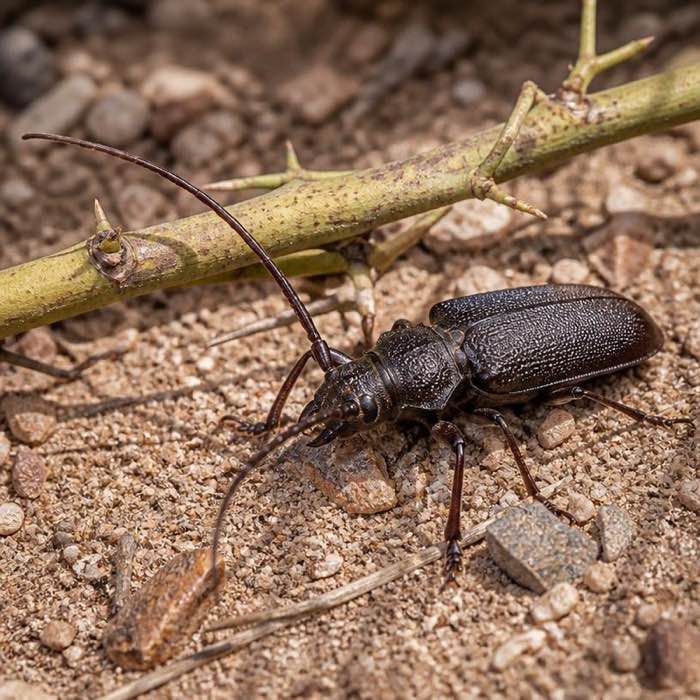
Arizona has more beetle species than any other group of insect, and almost every one people ask us about falls into one of three buckets. The ones that frighten you are outdoors and harmless. The ones that cost you money are indoors, under a quarter of an inch, and nobody notices them until the damage is done. Here is how to tell which you have.
Arizona beetles sort into three groups, and the group answers the question
Most guides work species by species, which is fine if you already know roughly what you are looking at. For something that has just landed on the patio table, placing it in a group first is faster, because the group settles what to do long before the species does.
Group one is the large outdoor beetles: half an inch to four inches, met in the garden, on a wall at night or flying at you in August. The Sonoran Desert has plenty, they generate most of the phone calls, and essentially none threatens a person or a building.
Group two is smaller and outdoors: one beetle to keep your hands off, two quietly doing you a favour. Group three is indoors, tiny, and the only group with a bill attached. Nearly all of what follows comes from two University of Arizona Cooperative Extension publications, on backyard insects and on indoor pests.
The big ones outdoors, and why none of them is a problem
These are the beetles people photograph. Four account for most of what reaches us between May and October; the palo verde beetle, the giant everyone already knows, is covered on our pest identification guide, and turns up again as a look-alike in Jerusalem crickets in Arizona.
Fig beetle
Cotinis mutabilis, family Scarabaeidae. About an inch, green with pale margins, and active in daylight rather than at dusk. It feeds on mesquite sap and damaged fruit and gathers in large shiny groups. Extension notes it makes a noise when startled, which is usually what people describe first.
Cactus longhorn beetle
Moneilema gigas, family Cerambycidae. Around an inch, glossy black, native to the Sonoran Desert, and found on cholla and prickly pear. It is flightless as an adult, so if it is walking on a cactus and cannot get away from you, this is probably it.
Dung beetle
Canthon imitator, family Scarabaeidae. An inch, around from July to October. The female lays her eggs inside the ball itself, so the larvae eat their way out. Where there are horses or livestock nearby there are usually these.
Stink beetle
Eleodes obscurus, family Tenebrionidae — one of the darkling beetles, and a relative of the pinacate beetle most people here know by its headstand. Its larvae are the mealworms sold as reptile food, which surprises almost everybody.
What unites them is diet: plants, sap, dung or other insects — not your house and not you. A beetle on a wall in Phoenix is passing through.
The fig beetle causes more confusion than the rest combined
Of everything on that list, Cotinis mutabilis prompts the most puzzled messages, and it earns its own section because the errors run in two directions.
It gets called a June bug, a loose term covering several scarabs that tells you nothing. It also gets reported as a palo verde beetle, which it is not: that one is long-bodied, dark brown, several times the size, and flies at dusk. The fig beetle is a short, rounded, metallic green scarab with pale edges, out in full daylight, about an inch.
Behaviour is the real giveaway. Fig beetles gather around the same food source — mesquite sap runs, split or fallen fruit — so you rarely see one alone. They are loud and clumsy in flight and buzz audibly when alarmed; half the people who describe one lead with the noise rather than the colour.
Nothing needs doing about them. If the numbers bother you the lever is the fruit, not the insect: clearing windfall and picking damaged fruit early removes what they are gathering for. Spraying a tree to stop beetles reaching sap is effort without end.
The one Arizona beetle worth not picking up
Almost everything in this guide can be handled safely. The iron-cross blister beetle is the exception, and it is the one paragraph worth committing to memory.
Tegrodera aloga (Meloidae) appears in mid to late spring, runs to about an inch, and is marked boldly enough that you will not miss it — the bright pattern is a warning, and looks like one. Extension puts it plainly: the beetle can squeeze a liquid from its leg joints that blisters the skin of anyone who gets it on them. The same guide, which cheerfully says yes to handling most of its insects, answers this one with a flat no.
So do not pick it up, and do not let a child pick it up. Brush one off rather than crushing it against skin, because the fluid comes out under pressure. If someone does get blistered, that is a question for a doctor rather than for us.
It is a spring insect, not a structural pest. There is nothing to treat and no programme worth selling. Knowing what it looks like is the whole defence.
Two beetles that are working for you
Two of the commonest garden beetles are predators, and killing them costs more than leaving them alone.
The convergent lady beetle, Hippodamia convergens (Coccinellidae), is about a quarter of an inch and around from March to November. Extension calls it a voracious predator as both larva and adult, feeding on aphids and scale insects. The larva looks nothing like the adult — longer, darker, spiky — and gets squashed by people who have no idea what it is.
The predatory ground beetle, Calosoma peregrinator (Carabidae), reaches an inch and a half and is out from February to October. Its other name is the caterpillar killer, which is a fair description of its work. It has a gland at the rear of the abdomen that releases a foul compound at its own predators, and a large one can pinch.
Both belong with the spiders we routinely tell people to leave alone: they are eating the insects that would otherwise be the reason you call anyone.
If twigs are dropping off your mesquite, that is a beetle
This one is worth knowing because the evidence turns up long before the insect does, and looks like disease.
Twig girdlers, Oncideres rhodosticta in the family Cerambycidae, appear in monsoon season. The female chews a ring right around a mesquite branch, a job that Extension says can take her two days, and lays her eggs in the ring. The larvae then develop inside the severed twig until they pupate. The girdling kills the twig, which is the point: it stops the eggs being drowned in tree sap.
What you see is a scatter of small branches under a mesquite, each cut almost cleanly through as though someone had used secateurs. The tree is neither diseased nor dying. Gathering and binning the fallen twigs removes the next generation, and it is the only control that does anything. Pick up the beetle itself and Extension promises it will squeak at you.
The beetles that actually cost money are indoors and tiny
Here is the turn. Everything above is between half an inch and four inches, lives outside and damages nothing. The beetles that do real harm in Phoenix homes are a tenth of an inch, live in a cupboard or wardrobe, and are usually found weeks after they started.
Two kinds matter: the ones that eat fabric and the ones that eat food. They behave differently and turn up in different rooms, but in both cases what ends it is finding the source rather than treating the room.
Carpet beetles: the larvae do the damage, and they come in from the yard
Carpet beetles are dermestids — skin beetles, in Extension’s other name for them — and three species are recorded as pests in Arizona: varied, furniture and black carpet beetle.
Size separates them roughly: varied and furniture adults run about a tenth of an inch, black carpet beetle adults an eighth to three-sixteenths. But the adults are not the problem. All three pass through a larval stage and Extension is explicit that this is when they are most destructive. The larvae are visibly hairy, which matters because a small hairy shed skin in a drawer is often the only thing anybody finds.
The route in rarely gets written down anywhere, and it explains a lot of otherwise baffling cases. Outdoors, the adult females go looking for spider webs and the nests of bees, wasps and birds, and lay eggs there, because those places are full of dead insects, beeswax, pollen and feathers — exactly what the larvae eat. A bird nesting in a roof vent or a soffit is therefore a plausible origin for damage to a wool rug two rooms away, and clearing old webs and abandoned nests off the structure does more than anything you can spray indoors.
Indoors they feed on fabrics, carpets, furs, stored food and preserved specimens. One more thing: carpet beetle larvae can cause a rash mistaken for bites, which is a regular source of mistaken bed bug calls — our bed bug control page covers how we separate the two before anybody treats anything.
What is in the cupboard is probably one of two things
Stored product beetles arrive in packaging rather than through the door, which is why a spotless kitchen gets them as readily as an untidy one. Two account for most of what we see.
Sawtoothed grain beetle
Oryzaephilus surinamensis. Roughly a sixteenth to an eighth of an inch, flat and brown. Extension puts it nearly level with the Indianmeal moth for how often it turns up, in bird seed, breakfast cereal, chocolate, dried fruit and nuts. Under a hand lens it is unmistakable: a row of pointed teeth along each side of the thorax, just behind the head.
Red flour beetle
Tribolium castaneum. An eighth to three-sixteenths of an inch, flattened, dark cherry to dark brown, with antennae that thicken gradually towards the tip. It cannot eat whole intact grain at all — the grain has to be damaged or milled first — so flour, meal and mixes are where it lives.
That last detail is more useful than it sounds: if you have flour beetles, the infested item is already broken down, so the whole-grain rice is probably fine and the open bag of flour behind it probably is not. Extension’s rule for the group is the one we would give — find and remove the source, because nothing else stops it. Use older packages first, and keep dry pet food and bird seed in sealed containers.
Telling which group you are in, in about ten seconds
Two questions settle it almost every time, and neither needs a species name.
First: where was it? Outdoors — a wall, the garden, flying at a light — puts you in groups one and two, where the answer is almost always that nothing needs doing. A cupboard, wardrobe, drawer or pantry puts you in group three, where something does.
Second: how big? Anything whose legs you can see without leaning in has wandered or flown in, and will leave or can be carried out. Anything you had to squint at, or noticed only because there were several, is a resident — and residents have a source still producing them.
The exception is the spring blister beetle: outdoors, obvious, and still not to be touched. It is the only case here where the size-and-location rule misleads you.
What we treat, and what we will tell you to leave alone
We do not run a beetle programme, and inventing one would be dishonest.
For the outdoor species there is nothing to sell. They are seasonal, they are not breeding in the structure, and a perimeter treatment aimed at insects that fly over it is money for very little. A heavy palo verde emergence is information about a stressed tree, and belongs to an arborist rather than to us.
Carpet beetles and stored product beetles are proper work: finding the source, which is frequently not in the room with the damage, clearing harbourage, treating cracks and voids rather than open surfaces, and dealing with whatever outside is feeding the cycle. With pets or small children in the house, how that is done matters — our pet-safe pest control page sets out what changes.
If you just want to know what you found, send a photograph with something for scale. Most are identifiable from a phone picture, and most of the time the answer is that it can go back outside.
Arizona beetle questions we get asked
Are any Arizona beetles dangerous to people?
One: the iron-cross blister beetle, Tegrodera aloga, in mid to late spring. It releases a fluid from its leg joints that blisters skin, and the Extension guide that says yes to handling most backyard insects says no to this one. Nothing else here is a medical concern, though several can pinch.
What is the big green beetle flying around my yard in summer?
Almost certainly a fig beetle, Cotinis mutabilis: about an inch, metallic green with pale edges, out in daylight, noisy in flight, and usually several at once around mesquite sap or fallen fruit. Harmless. Clearing windfall reduces the numbers.
Small branches keep falling off my mesquite. What is cutting them?
A twig girdler, Oncideres rhodosticta. The female chews a ring right round a branch and lays eggs in it; the twig dies and drops with the larvae inside. The tree is not sick, and binning the fallen twigs removes the next generation.
I keep finding tiny beetles in the pantry. Where did they come from?
In with the shopping, rather than through a door. The two commonest are the sawtoothed grain beetle and the red flour beetle, and the second cannot feed on whole intact grain, so look first at anything milled or already opened. Treating the cupboard without finding the item achieves nothing.
How do carpet beetles get into a house?
Usually from outside. Adult females seek out spider webs and the nests of bees, wasps and birds, which hold the dead insects, pollen and feathers their larvae eat. An old nest in a vent is a realistic origin for damage to a rug indoors, which is why clearing webs and nests off the structure beats anything sprayed in the room.
Do mealworms turn into a beetle I would recognise?
Yes. Mealworms are the larvae of darkling beetles — the family that includes the stink beetle Eleodes obscurus and the pinacate beetle known here for its headstand. The ones sold for reptiles are a related species in the same family.
Should I kill ladybirds and the big black ground beetles?
No. The convergent lady beetle eats aphids and scale as both larva and adult, and the predatory ground beetle is called the caterpillar killer for good reason. Both reduce the insects that would otherwise bring you to us, and the lady beetle larva gets squashed constantly because it looks nothing like the adult.
Is there a treatment for beetles in the garden?
Not one worth paying for. The outdoor species are seasonal and are not breeding in your structure, so spraying a perimeter against insects that fly over it is poor value. Indoor carpet and stored product beetles are the opposite: genuine work, and the job is finding the source.