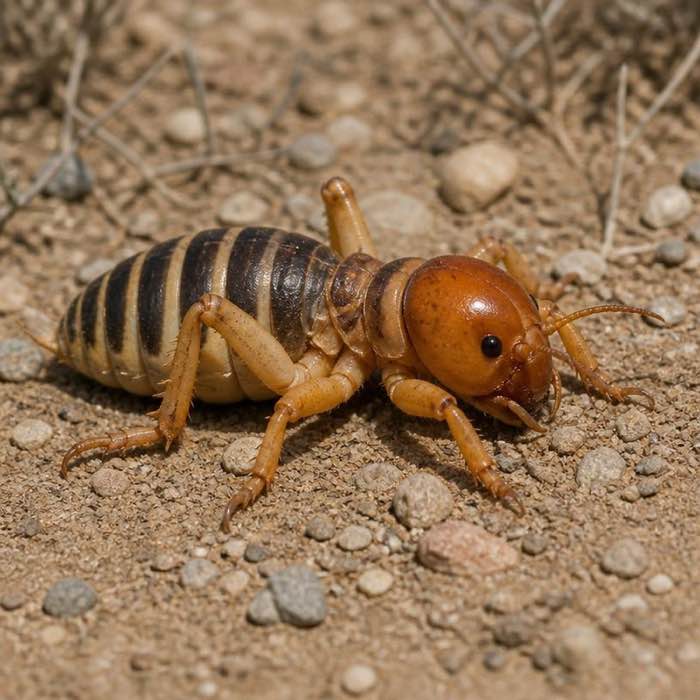
More people in Arizona search for this insect than for scorpions, termites or bed bugs. The University of Arizona’s own publication on it runs to a single paragraph, and that paragraph opens by saying they are rarely found in Arizona. Almost everything written about the child of the earth online is a close-up photograph with the word nightmare attached. Here is the animal instead.
The most-searched insect in Arizona is one you will probably never meet
Of every pest term people type in this market — scorpions, termites, roaches, bed bugs — none is searched more often than this one, and it is not close. The University of Arizona Cooperative Extension’s own publication on crickets covers it in a short paragraph, and the first thing that paragraph says is that they are rarely found in Arizona.
That gap, between how hard people look and how little there is to find, is most of the story. This is a large, slow, heavy-headed insect that spends its life below ground and comes up at night. Extension’s description of who meets it is precise: seldom seen, except by gardeners digging in the soil. And it does not come into houses.
So if you are reading this at midnight with something in a jar, there are two likely situations. Either you were digging, or what you have is not one of these at all — which is far commoner than people expect, and is dealt with further down.
Nobody knows where the name came from
This is the part that surprises people. The name is not a quirky bit of trivia with a tidy answer at the end of it. It is an unsolved problem that entomologists have argued about in print.
The leading accounts all run through nineteenth-century Franciscan missionaries in the Southwest. In one, “Jerusalem!” was a startled oath of the period — the sort of thing said on turning a spade and finding this looking back at you — and the exclamation attached itself to the animal. In another, missionaries heard Navajo speakers describe a skull-headed insect and connected that to Skull Hill, the traditional site of the crucifixion. A third proposes a straightforward blend of Navajo and Christian vocabulary, carried through the same Franciscans’ work compiling a Navajo dictionary.
Two papers in American Entomologist in 2005 set out the competing cases, one of them titled, with some feeling, “Jerusalem! Cricket?” Neither closes the question. The weaker explanations do not survive much scrutiny: a supposed resemblance to the Jerusalem cross, and a link to Jerusalem artichokes, which is unlikely given the plant does not grow where the insect does.
The other common name causes a practical problem rather than a historical one. “Potato bug” is also the name of the Colorado potato beetle, a striped, half-inch leaf-eater that is a completely different animal on a completely different part of the garden. Searching that term returns both, which is one reason people struggle to put a name to what they are holding.
It is not a cricket, and probably not the genus you were told
True crickets sit in the family Gryllidae. These sit in Stenopelmatidae, which is a different family, and the relationship is distant enough that the shared word does more harm than good.
There is a second correction worth making, because almost nobody makes it. Consumer articles and a good many pest control sites label the Southwestern animal Stenopelmatus. That genus is primarily Central American. The genus native to the western United States and parts of Mexico is Ammopelmatus, and Stenopelmatus was once much larger and held most of the species that now sit in it. The split has not reached the popular write-ups. One of the Ammopelmatus species is named navajo.
The counts give you a sense of how settled any of this is: nineteen valid species in Stenopelmatus with thirteen more of uncertain status, and twenty in Ammopelmatus. “Uncertain” is doing real work in that sentence. This is a group whose taxonomy is still moving.
The face, and the names people gave it
Extension explains the reaction precisely, and in rather good prose for a 1998 government publication: the oversized, round head with two bead-like black eyes gives a fancied resemblance to a miniature child. Every folk name this animal carries comes out of that one impression.
In Spanish it is niño de la tierra, child of the earth, and cara de niño, child’s face. The standard form is niño, although a great deal of writing uses niña. Those names are descriptive rather than fearful. They name a resemblance, not a danger.
The Navajo names go the other way, and they go to the skull. Recorded forms include c’ic’in lici, red-skull, c’os bic’ic lici, red-skull bug, and wo se c’ini or yo sic’ini, skull insect, which is also given as sand cricket. Transliterations vary considerably between sources, which is worth saying plainly rather than picking one spelling and presenting it as settled.
Physically, adults reach two to three inches, shiny and wingless, with a rotund abdomen and that bulbous head, running from light tan to dark mahogany. Extension describes the Arizona ones as pale yellow to brown, with large stout legs ending in spines, which are digging tools rather than weapons.
In Hopi it is a katsina
The detail most worth knowing about this insect in Arizona has nothing to do with pest control.
The Hopi name is Sösööpa, and the insect holds a place in the Hopi katsina pantheon — the subject of a 2005 paper in American Entomologist devoted to exactly that. There is a Hopi descriptive name as well, qalatötö, shiny bug.
It is a useful corrective to the way this animal is usually presented. A great deal of what circulates about it online is a close-up photograph with the word “nightmare” attached. An insect that has been named, carved and given a place in a ceremonial tradition by people who have lived alongside it far longer than any of us is owed a more careful look than that.
It talks by drumming, and it cannot hear you
This is where the animal gets genuinely strange, and it is the part most write-ups get only half right.
They find each other by beating the abdomen against the ground. Each species has its own pattern, and the patterns are distinct enough that drumming is used as a species-level character in taxonomy, alongside body structure, DNA, geography and chromosome counts. One recent revision described fourteen new species partly on that evidence.
The twist is at the receiving end. No species has sound-producing structures on its wings, and evidently none has any structure it could use to hear airborne sound at all. What they have instead are subgenual organs in all six legs, which read vibration travelling through the ground. So the drumming is not a song in the way a cricket’s chirp is a song. It is a signal sent through soil, to an animal that in the ordinary sense is deaf.
Whether any of it reaches you through the air is less settled than you will read elsewhere. One assessment judges the signal is probably picked up through a mixture of substrate and airborne transmission; another holds that it is felt rather than heard. Specific figures about how far away a drumming insect can be heard circulate widely and have nothing behind them, so they are not repeated here.
What it is doing down there
Mostly, very little, very slowly.
They spend the majority of their lives below the surface and are active at night. The diet is largely dead organic matter together with other insects, and the burrowing takes them through decaying roots and tubers, which is where “potato bug” came from in the first place. They are not regarded as serious agricultural pests.
The life cycle is drawn out for an insect of this size. Nymphs moult up to ten times across one to two years before reaching adulthood, and the adult then lives only two to six months. Almost the entire life is spent as an immature animal in the dark. The one you turned up has very likely been under that bed longer than you have had the bed.
Extension’s verdict is worth quoting because it runs directly against the way these are usually sold to you: unlike other crickets, they are useful predators, catching and eating many other insects and spiders. They are also a significant night-time food source for birds, bats and mammals. On the balance sheet of a Phoenix garden, this is not a problem species.
Is it dangerous, and what it does when frightened
No venom. That is the short answer and it carries no qualification.
What it does have is a powerful jaw, and a large one can deliver a genuinely painful nip if handled carelessly. That is a mechanical bite rather than anything injected, and the animal is not coming for you — essentially every account of a bite involves a hand.
The threat display is worth recognising, because it looks far worse than it is. A frightened one will flip onto its back, snap its mandibles and kick upward with those spined hind legs. Some can produce a hiss by rubbing the hind legs against the sides of the abdomen, which appears to be aimed at predators rather than at other insects of its own kind. There may be an unpleasant smell. All of it is bluff built around one real weapon, and all of it stops the moment you stop handling the animal.
What you probably actually found
Given how rarely the real thing turns up here, it is worth ruling in the commoner candidates first. Four things account for most of the photographs people send us under this name.
Palo verde beetle
Enormous, dark, and equipped with antennae that look too long for it. The decisive difference is that this one flies, usually straight at a porch light and usually into someone. An adult Jerusalem cricket has no wings whatsoever, so if the thing was airborne you can stop there. Our guide to beetles in Arizona covers it and the rest of the group.
A field cricket
Dark brown to shiny black, a little over an inch, long thin antennae, and it jumps and chirps. Jerusalem crickets do neither. These are the ones actually worth attention, because they feed scorpions.
Colorado potato beetle
If “potato bug” is the term you searched, this may be what you have: a striped beetle under half an inch, found on plants rather than under them. Same nickname, unrelated insect.
A beetle grub
Pale, soft, C-shaped, with a darker head, turned up by the spadeful in irrigated beds. Big-headed and pale enough to read as a “child of the earth” at a glance, and much commoner here.
The fastest test is wings and jump. An adult Jerusalem cricket has neither. It does not fly, it does not spring away from you, and it does not chirp. It walks, and given any opportunity at all, it digs.
What to do with one, and why we will not sell you a treatment
Nothing, mostly. That is the honest answer and it is the whole recommendation.
If it is in the garden, leave it where it is; it is eating the insects you would otherwise be ringing somebody about. If you have turned one up while digging, put it back under cover and it will have seen itself out by morning. If one is somewhere you genuinely do not want it, a container and a stiff piece of card will move it without anybody being bitten.
We do not treat for these, and we would rather say so than invent a service for an animal that does not need one. They do not infest, they do not come indoors, they do nothing to a structure, and they are uncommon enough in Arizona that in practice the call is an identification question rather than a pest one. Send a photograph and you will get an answer.
Where it does matter is the misidentification. If what you have is a true cricket population in the yard, that is a different proposition with a real consequence attached, and our cricket control page explains why. If you are turning up things in the soil generally and want to put names to them, our pest identification guide names the rest of that group.
Jerusalem cricket questions we get asked
Will a Jerusalem cricket hurt me?
It has no venom at all. It does have a strong jaw and a large one can give a painful nip, but only to a hand that is holding it. The dramatic part — flipping onto its back, snapping the mandibles, kicking with the spined hind legs, sometimes hissing or producing a smell — is a display aimed at predators, and it stops as soon as you put the animal down.
Why is it called a Jerusalem cricket?
Nobody has established it. The candidates all involve nineteenth-century Franciscan missionaries in the Southwest: that “Jerusalem!” was a startled oath that stuck to the insect; that missionaries linked a Navajo description of a skull-headed insect to Skull Hill; or that the name is a blend of Navajo and Christian vocabulary from the Franciscans’ dictionary work. Two 2005 papers in American Entomologist argue the cases and neither settles it.
Is a Jerusalem cricket the same thing as a potato bug?
It is one of the things called a potato bug, which is the problem. The Colorado potato beetle carries the same nickname and is a striped beetle under half an inch found on plants. If your search results look like they are describing two different animals, that is because they are.
Do they come into the house?
The University of Arizona Cooperative Extension states plainly that they do not. They live below ground and are met almost entirely by people digging. Something large and pale indoors is very unlikely to be one of these.
What does the Spanish name mean?
Niño de la tierra is child of the earth and cara de niño is child’s face. Both come from the oversized round head and the two bead-like black eyes, which Extension describes as giving a fancied resemblance to a miniature child. The standard form is niño, though niña is very widely written.
Do Jerusalem crickets scream?
No. Some can hiss, by rubbing the hind legs against the sides of the abdomen, and it seems to be a defence against predators. The communication that matters to them is not sound at all: they drum the abdomen against the ground and read the vibration through organs in their legs, having no apparent means of hearing airborne sound.
How long do they live?
Longer than people assume. The nymph moults up to ten times over one to two years, and the adult then lives only two to six months. Nearly the whole life happens underground and out of sight, which is part of why the adult seems to appear from nowhere.
I dug one up in the garden. Should I kill it?
We would not. Extension describes them as useful predators that catch and eat other insects and spiders, and they are a significant food source for birds, bats and mammals. Put it back under cover and it will be gone by morning. If you want it identified first, photograph it rather than handling it.