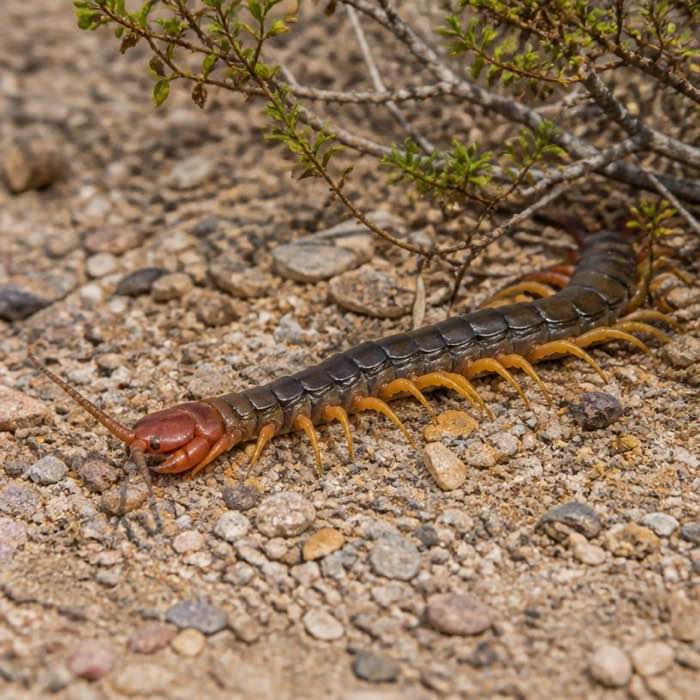
Almost nobody calls us about a centipede in the garden. They call about the one in the hallway at eleven at night, moving faster than anything that size has a right to. Outdoors, a centipede is a predator eating the insects you would otherwise ring someone about. Indoors and more than once, it is not really a centipede problem — it is a message about whatever it came in to hunt.
Three centipedes, and only one of them can live in your house
The Arizona-Sonora Desert Museum counts two centipedes in the Sonoran Desert: the giant desert centipede and the common desert centipede. University of Arizona Cooperative Extension, writing for north central Arizona rather than the valley, counts three common up there — higher ground, a slightly different mix. In Phoenix, those two desert species plus the house centipede account for nearly everything anyone shows us.
Both desert species share a build: flattened, many segments, one pair of legs on each segment except the first and last, one pair of antennae. The house centipede is a separate problem with a separate answer.
Giant desert centipede
Scolopendra heros. Six to eight inches, and Extension records individuals reaching eight and a half. Orange or reddish body, dark head and tail, banding across the segment joins. Outdoors only. The one people photograph.
Common desert centipede
Scolopendra polymorpha. Four to five inches, tan and brown, banded. Sold to you under three different names — common desert, banded and tiger centipede — which is most of why identification goes wrong. Outdoors.
House centipede
Scutigera coleoptrata. Body an inch to an inch and a half, dwarfed by fifteen pairs of very long banded legs. Three dark stripes down the back. The only centipede that can complete its whole life indoors.
What it is not
A millipede, if it ran. A scorpion, whatever the back end looks like. Not an insect either — centipedes are class Chilopoda, which sits beside insects rather than inside them.
The giant desert centipede is the one that gets photographed
Scolopendra heros is behind most of the alarmed messages. The Desert Museum puts it at six to eight inches; Extension says often six, reaching eight and a half, across much of Arizona and the wider southwest. At that size, on a wall at night, it needs to do nothing else to get attention.
Descriptions of its colour differ, and that is worth knowing rather than smoothing over. The Desert Museum describes an orange body with a black head and tail; Extension describes a reddish-yellow animal with darker bluish-black stripes across each point where one segment meets the next, and a head usually red-orange. Both are accurate. The colour varies and the banding does not, so if you are matching a photograph, match the banding.
Extension also takes on the reputation directly. These animals are often reported as vicious and almost a foot long; in truth, the guide says, they are not vicious unless harassed.
The tiger centipede and the common desert centipede are one animal
More identification goes wrong here than anywhere else, and it is a naming problem rather than a biological one.
Scolopendra polymorpha answers to common desert centipede, banded desert centipede and tiger centipede — all one species. The Desert Museum gives it as tan and brown, four to five inches, noticeably smaller and plainer than its giant relative. The banding across the segment joins is where the tiger name came from, and the species name does the rest: polymorpha means many forms, and the colour genuinely varies between individuals.
The practical cost of three names is that people search one and read about the other. Somebody who finds a four-inch banded centipede in Ahwatukee, searches for tiger centipede and lands on a description of an eight-inch orange animal will reasonably conclude they have something else. Size and ground colour separate the two desert species far more reliably than any name does.
The house centipede is a different animal carrying a different message
If what you found was small, pale and seemed to be mostly legs, it was neither desert species. Scutigera coleoptrata is built on a different plan.
Clemson Cooperative Extension puts the body at one to one and a half inches excluding legs and antennae — the measurement that matters, because the legs roughly triple the apparent size. There are fifteen pairs, long and fine, banded and paler towards the tips, carrying small barbs that help hold prey. The body is brown and yellow-tan with three dark stripes down its full length, and the eyes are large and multi-faceted. Ohio State University Extension adds that the last pair of legs can exceed twice the body length and works as a set of rear-facing antennae.
Two behaviours give it away: it moves in darts and freezes, and its legs detach easily when struck — Ohio State records a shed leg twitching for minutes afterwards, which accounts for a fair amount of panic.
The part that matters for a homeowner: Clemson describes it as the only centipede species that can live and reproduce inside houses, and places it in the high-humidity rooms — bathrooms, laundry rooms, closets, crawl spaces. Ohio State adds that indoors it feeds mainly on spiders and cockroaches. So it is not a visitor from the yard but a resident, reporting two things about the room it is in: moisture, and something to eat.
A caveat worth stating rather than burying: Arizona Extension’s own centipede guide does not cover this species. The description above is Clemson and Ohio State, flagged rather than passed off as local.
Neither end of a centipede is what it appears to be
Two misreadings account for most of the fear, and both are about legs. Start at the back: Extension notes that the final segment of a giant desert centipede carries a pair of legs regularly mistaken for stingers. There is no venom in them. They are prehensile legs used for gripping and for seizing prey, so an animal that seems to be pointing a weapon at you from behind is in fact walking on it.
Now the front. On the first segment behind the head, Extension describes hollow tubes with openings at their sharpened tips, working as fangs and attached to venom glands. Ohio State University Extension describes the same structure as a first pair of legs rotated forward around the mouth, each ending in a hollow claw connected to a poison gland. The Desert Museum calls them gnathopods and the result a pinch rather than a bite.
Put the two together and you get something that is genuinely strange: a centipede neither stings nor, strictly speaking, bites. It grips you with modified legs that happen to be hollow and loaded. One detail from Extension that settles how seriously to take them — those tips are sharp enough that they could potentially penetrate leather gloves.
Centipede or millipede, settled in one look
Extension gives the test that always works: count the legs on one body segment. A centipede has a single pair; a millipede has two, and on some segments four. If it will not hold still, speed decides it — a centipede’s legs mount on the sides of the body rather than underneath, so they can be longer without colliding. Millipedes are slow grazers on decaying plant matter. The thing that shot across the tiles was a centipede.
Centipedes dry out, which explains nearly everything about where you find them
One fact from Ohio State sits underneath almost everything else on this page: a centipede’s exoskeleton has no waxy coating, so it loses water easily and has to stay somewhere damp to survive.
Everything follows from that. They are nocturnal and spend the day hidden — the Desert Museum places them underground or beneath rocks, bricks and potted plants, out of the sun, and Extension puts them in moist spots where crickets and other prey shelter, and under outside lights where moths gather. That guide also notes that the smaller soil and stone centipedes die quickly once inside a dry building, which is why a single dead one on a tiled floor is an ordinary find rather than a warning.
In Phoenix that means a short list worth checking: under pots on a shaded patio, beneath flagstone and landscape rock, along a damp irrigation line, in leaf litter behind the shed. Clemson adds the one most people miss — overwatering, or sprinklers aimed at the house, keeps a band of soil permanently damp exactly where the wall meets the ground.
What a centipede bite actually does
Extension sets the benchmark: about as serious as a bee sting, with secondary infection from other pathogens as an additional factor to weigh. Clemson arrives at the same place — comparable to a wasp sting, not deadly to adults or children, and centipedes carry no serious diseases. Ohio State adds that bites from the larger species are very infrequent and generally produce short-lived swelling or pain.
Two things follow. A painful bite and a dangerous one are different claims, and the pages telling you a desert centipede could kill you are supported by none of the sources above. And it is infection, not venom, that Extension actually flags.
Where a reaction goes beyond local pain and swelling, that is a call for a medical professional rather than a pest control company. What we can tell you is how not to get bitten: Extension is explicit that these animals are not aggressive unless harassed, and almost every bite we hear about followed someone picking one up or reaching somewhere they could not see. Wear gloves around firewood and rock piles, and if one has to leave the house, use tongs or heavy gloves and a large covered container.
Repeated sightings indoors are a message about something else
Extension’s advice for centipedes turning up inside repeatedly is not to treat for centipedes. It is to inspect carefully for insect populations within the house, because centipedes commonly eat roaches and crickets, and managing those should see the centipedes decline. Ohio State University Extension says it from the other end: large numbers indoors suggest abundant prey. Both guides treat the centipede as a symptom.
That matches what we find. A house with centipedes in the hallway usually has crickets in the garage. Those are the pages that will do you more good than this one: cricket control and cockroach control. That guide also suggests sticky traps as the cheap way to learn what is walking about at night, and they are worth doing before anybody treats anything.
The distinction that matters is one-off against repeated. One centipede in August, the night after a monsoon storm, is weather. The same thing three times in a fortnight is a food supply you have not found yet.
Keeping them out is a sealing job, not a spraying job
Extension is blunt about how they get in: centipedes are very fast and slip through very small openings under doors, around windows and through cracks. Its prevention advice is correspondingly physical — maintain screens and weather stripping, caulk visible cracks. Nothing about spraying.
Ohio State fills in the yard: keep old boards, rotting wood, compost, grass clippings, leaves and loose stone away from the foundation, clear a three-foot strip around the house so that soil sees air and sunlight, seal the foundation cracks you find, and ventilate anything damp. The same guide is dismissive of total-release aerosols, which is worth repeating — a bug bomb leaves no residue and rarely reaches where centipedes sit. Our write-up on sealing the gap at the foundation covers the structural side.
Where we are useful here, and where we are not
There is no centipede programme on our price list, and building one would mean charging for the wrong thing.
Extension classes centipedes as beneficial once they are outdoors, and that is the correct call. They work through a long list of insects that would otherwise end up as somebody’s callout, and the Desert Museum records owls, coyotes, ringtails, bobcats and badgers feeding on them in turn. Extension is equally clear that they damage neither food, clothing nor furniture — only the composure of whoever met one in a hallway.
Two jobs move the needle, and both are ones we do: dealing with the prey species drawing them in, and closing the gaps they use. With pets or young children at home the method matters as much as the product, and our pet-safe pest control page explains how we adjust it. Unsure what you have? A clear phone photo with a coin in frame for scale usually settles it — the pest identification guide shows what else turns up here, the Jerusalem cricket among them, which surfaces after the same rain.
Common questions about centipedes in Arizona
Are Arizona centipedes dangerous?
Painful, not dangerous. University of Arizona Extension rates the bite at about a bee sting and flags secondary infection as the thing to watch; Clemson puts it level with a wasp sting and says centipedes carry no serious diseases. Any reaction beyond local pain and swelling is a question for a doctor.
Is a tiger centipede different from a desert centipede?
No. Tiger centipede, banded desert centipede and common desert centipede all name Scolopendra polymorpha, tan and brown, four to five inches. The giant desert centipede, Scolopendra heros, is the separate larger orange one at six to eight.
Does the back end of a centipede sting?
No. The appendages on the last segment that look like a stinger are prehensile legs, used for gripping and holding prey. The venom is at the front, in a modified pair of legs working as hollow fangs.
I keep finding centipedes indoors. What does that mean?
Usually that something they eat lives with you. Extension’s advice is to inspect for insect populations indoors rather than treat for centipedes, since they feed heavily on roaches and crickets and decline once those are dealt with.
What is the small one with enormous legs in my bathroom?
A house centipede, Scutigera coleoptrata — an inch or so of body and fifteen pairs of very long legs. Clemson calls it the only centipede that can live and breed indoors, and places it in humid rooms. Harmless, and reporting moisture plus something to hunt.
How do I tell a centipede from a millipede?
Count the legs on one body segment: a centipede has a single pair, a millipede two or in places four. If it will not stay still, go by speed — side-mounted legs let a centipede move far quicker than any millipede.
What keeps centipedes out of the house?
Sealing, not spraying. Extension names intact screens, sound weather stripping and caulked cracks, because centipedes move fast and fit through very little. Ohio State adds clearing wood, leaves and loose stone off the foundation, and ventilating damp spaces.
Should I kill a centipede I find in the garden?
No good reason to. Extension classes them as beneficial outdoors, and they are prey in turn for owls, coyotes, ringtails, bobcats and badgers. If one needs moving, Extension suggests tongs or heavy gloves and a covered jar.