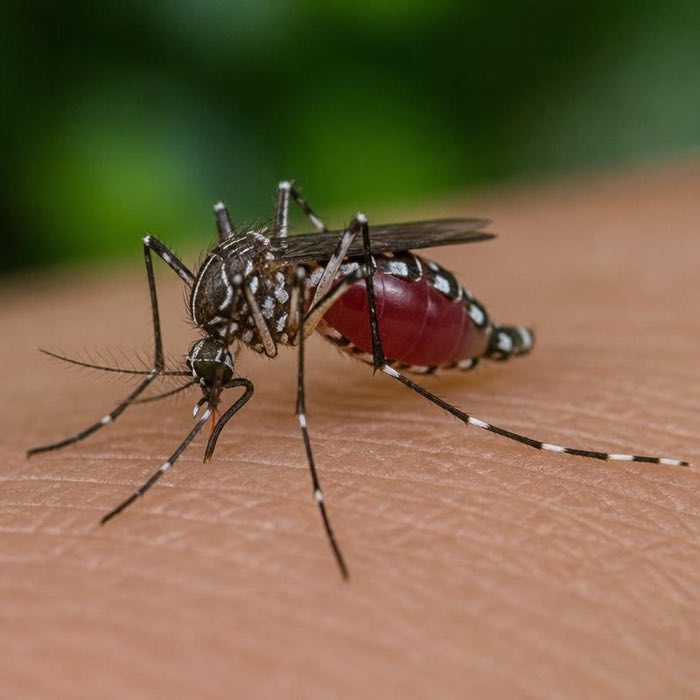
A mosquito that gets indoors and finds nothing to feed on is usually dead inside a week. One that finds a person can keep going for a month. And the awkward part, if you pay to cool a house in the Valley: your thermostat sits closer to the temperature at which a mosquito lives longest than anything happening in your yard in July.
The short answer
Ask three sources and you get three answers, all of them correct. The American Mosquito Control Association puts adult females at two to three weeks, rising to six months in the species that overwinter as adults. The University of Florida’s Aedes aegypti profile — that is the daytime biter doing most of the indoor work in Phoenix — says two weeks to a month, citing Maricopa County’s own material. A 2025 climate-chamber study of Cambodian Aedes recorded female longevity peaking at 66.7 days. Males live shorter lives in every study that separates them.
Indoors, the figure that matters is not the ceiling but the floor, and the floor is set by food. In a field-cage study of Culex house mosquitoes run through an Argentine winter, between 68 and 100 per cent of unfed females died in the first week. Give the same cohort sugar and they survived into the sixth; sugar and blood, and some were alive in the fourteenth.
So the one whining round your bedroom at two in the morning has roughly a week if it never reaches you and never finds anything sweet, and much longer if it does. Which half you are in is decided by meals, not by species.
Why those numbers disagree
Lifespan is not a species constant. It is an outcome of three things: temperature, what the adult manages to eat, and whether something kills it first. A caged female at a steady 25 degrees Celsius, food always present, no spiders, no lizards, no wind, no dry afternoon, has nothing left to shorten her life. A female in a Phoenix yard in July has all of them at once.
That is why the lab ceiling and the field average sit so far apart, and why the useful question is never how long a mosquito lives but how long this one, here, lives. For an indoor mosquito the answer leans towards the lab, because a house removes most of what kills mosquitoes outdoors.
Why your living room suits a mosquito better than your yard does
Everything a mosquito does runs on temperature, and the response is a peak rather than a slope. That 2025 study ran Aedes aegypti from 15 to 40 degrees Celsius in five-degree steps. Female longevity was highest at 25 degrees — 77 Fahrenheit — with the optimum for female survival predicted at 27.1, about 81 Fahrenheit. Egg hatching peaked at the same 25 degrees, just under 98 per cent.
Push past that and development speeds up while survival falls: at 35 degrees the immature stages finished faster but died more often, and at 40 — 104 Fahrenheit — larvae of both species tested could not get past the first stage at all.
Hold those numbers against a Valley summer. On the afternoons when Phoenix is above 104, water sitting in a sun-exposed container is not a nursery, it is a kill zone. A thermostat set to 77 or 78 sits almost exactly on the longevity peak measured in that chamber.
Humidity pulls the same way. A 2015 Journal of Medical Entomology experiment compared adult survival at 77 and at 44 per cent relative humidity and found Aedes aegypti more resistant than Aedes albopictus to the life-shortening effect of the dry regime — a sideways confirmation that the effect is real for both. Separate work across temperature and humidity found that at 20 and at 30 degrees, egg and adult survival both rose as humidity rose. And a model built by two University of Arizona researchers with a CDC co-author only matched real trap counts once it accounted for humidity’s effect on adult survival alongside rain-triggered egg hatching.
A dry pre-monsoon afternoon here can sit in the low teens for relative humidity or below. An occupied house, with showers and cooking and a cooling system running, does not.
One caveat, because it matters: nobody has measured mosquito survival in a Phoenix living room. The chamber work used Cambodian populations; the humidity work was done in Florida and Pakistan. What the curves support is a direction rather than a day count — a mosquito that gets inside has escaped both the heat that kills larvae and the dryness that shortens adult life, so the indoor ceiling is higher than the one outside. That is not the same claim as sixty-six days in your bedroom, and it is the one the evidence will carry.
What the one in your bedroom is actually doing
Most of a mosquito’s day is spent not flying. Culex adults rest where it is cool, dark and humid — thick vegetation outdoors, and indoors a wardrobe, the underside of a bed, a laundry pile, the gap behind a toilet. The mosquito control association notes that a garage is a favoured resting spot, and that the usual ways in are a damaged screen, an attic soffit and a bathroom vent rather than the front door standing open. Height is no obstacle: Asian tiger mosquitoes have been recorded in apartments twenty-one storeys up.
Feeding is separated from resting by hours. A female takes blood, spends several days digesting it and developing eggs, then goes looking for water. Males never bite; they live on sugar, which is why a male indoors is on a very short clock. The insect you swat at midnight is one of three: a female newly arrived and hunting, a fed female waiting out digestion, or a male that got in by accident and is already running out of time.
Yes, it can breed indoors, and here is where
Aedes aegypti is listed by the CDC as living indoors and outdoors, and Florida’s profile divides the species into three forms, of which the domestic one “breeds in urban habitat, often around or inside houses”. The yellow fever mosquito also bites during the day and indoors as well as out. This is a mosquito that does not need your garden. Both Valley species are photographed side by side in our pest identification guide when you want to tell one from the other.
What it needs is a few millilitres of water standing still for a week: the reservoir of a cut-flower vase, the saucer under a houseplant, a drip tray beneath a fridge or water heater, a bucket in the laundry, a pet bowl nobody empties, a self-watering planter, a seldom-used bathroom with water sitting in the trap.
The egg-laying detail is the one that catches people out. Aedes females do not drop eggs onto water; they stick them to the inner wall of the container above the waterline, singly, spread over two or more sites rather than all in one clutch. So emptying a vase does not finish the job — the eggs are on the glass, waiting. Rinsing will not do it either; the wall needs scrubbing.
Culex is the opposite and easier to beat indoors: it lays rafts of a hundred to three hundred eggs flat on the water surface, and if the water goes before the larvae finish developing, the brood dies with it. Tipping the container out ends a Culex problem. With Aedes it is half the job.
Egg to adult in a week: the four stages, timed
Mosquitoes are holometabolous: four distinct stages with a complete rebuild in the middle — egg, larva, pupa, adult. The same pattern on a different clock runs the house fly. The CDC gives seven to ten days from egg to adult for both Aedes and Culex, and the stage-by-stage numbers are worth having, because they tell you how much slack you have.
Culex eggs hatch twenty-four to thirty hours after they are laid. The larvae then need five to eight days to finish developing at 30 degrees Celsius, passing through four instars and feeding on organic material in the water. At the end of the fourth they stop eating and become pupae, and the adult emerges about thirty-six hours later at 27 degrees.
Aedes runs a similar clock with a different opening: eggs developing in as little as two days in warm climates against up to a week in cooler ones, very little time in the first three instars and up to three days in the fourth, then roughly two days as a pupa. Males develop faster and pupate earlier, which is why the first adults out of a container skew male.
Egg
Culex rafts hatch in 24 to 30 hours. Aedes eggs are cemented above the waterline and can sit dry for months, hatching only once water returns.
Larva
Four instars, feeding in the water. Culex needs five to eight days at 86°F; Aedes can spend three of its days in the fourth instar alone.
Pupa
No feeding at any point. A Culex adult leaves the pupal case about 36 hours later at 81°F; Aedes takes roughly two days.
Adult
Two to three weeks in the field, two weeks to a month for Aedes aegypti, and longest of all where it is cool and humid.
Notice the temperatures those figures were measured at: 30 degrees is 86 Fahrenheit and 27 is 81. Those are not laboratory abstractions in this city — they are a July night and a September morning. The published development times for these two mosquitoes were recorded at temperatures the Valley holds for months on end, which is the real reason a weekly habit beats a monthly one. The inspection side of that — which containers on a Phoenix property hold water long enough to matter, and how larvicide stops a brood that cannot be tipped out — sits on our mosquito control page.
The eggs are the part that outlasts everything
One fact from this page is worth keeping above the rest: the adults are the short-lived stage, and the eggs are not.
Aedes aegypti eggs survive desiccation for months and hatch once they are submerged again. The CDC puts the outer figure at up to eight months dried out, and notes they can survive a winter in the southern United States. A dry container is therefore not an empty one. A container tipped out in March can still hold viable eggs on its inside wall when the first monsoon storm refills it in July — which is why a wave of biting after a storm arrives within days rather than being built from scratch.
That also explains the pattern people read as treatment failure. A barrier application kills adults; it does not consult the eggs. If the containers went untouched, the next generation is already glued to them and arrives on its own schedule regardless of what was sprayed.
The flip side is useful. Because Aedes aegypti will only fly a few blocks in its entire life, and mosquitoes breeding around houses have flight ranges of roughly three hundred feet, an indoor Aedes problem is a profoundly local one. Repeated daytime biting inside means the water is in the house, under a window, or next door. It is not drifting in from the far side of the suburb.
Do they die in a Phoenix winter?
Mostly, no. They thin out.
Culex quinquefasciatus, one of the two Arizona species that transmit West Nile virus effectively, is confined to warmer latitudes partly because it lacks the strong overwintering diapause its northern relatives have. It does not shut down for the cold; it simply cannot survive where the cold is severe. The Valley’s mild winter is a reason this mosquito is at home here, not a season it has to get through.
The Argentine field cages are the closest thing to a controlled look at what a mild winter does, and the fit is closer than you would expect: mean minimum and maximum temperatures of about 8.9 and 18.7 degrees Celsius — 48 and 66 Fahrenheit, roughly a Phoenix January. Under those conditions sugar-fed females were still alive in week six and blood-fed females into week fourteen. Species that do overwinter as adults can last as long as six months, sheltering in garages, culverts and attics.
So a mosquito in your house in January is neither an anomaly nor an escapee from somewhere warm. It is an adult that was never obliged to die, in a building warmer and wetter than the desert outside it. On the west side, where the Gila River keeps permanent water in the picture, the biting season barely closes at all — Goodyear is the clearest case of it in the metro.
What this changes about what you do
Four things follow, and they are all cheap.
Make it weekly, not monthly. Egg to flying adult is seven to ten days, so anything emptied fortnightly is a nursery for half the time. Weekly is the only interval that beats the clock.
Scrub, do not just tip. For Culex, emptying the water ends the brood. For Aedes, the eggs are cemented above the waterline and survive drying for months, so the inside wall wants a brush taken to it.
Count indoor sightings rather than single mosquitoes. One is traffic. Three in a week in the same room is a breeding site within a few hundred feet, quite possibly inside.
Treat the adult and the source as two separate jobs. Swatting the one in the bedroom settles a single insect and leaves the eggs on the glass untouched. For the personal end of it — which repellents hold up and which shelf products have already failed in testing — see our repellent guide.
And if every obvious container is accounted for while the biting carries on, look at the things that do not read as water: a plant that waters itself, a tray under an appliance, a trap in a room nobody goes into. Tell us which room and what time of day, and we can usually narrow it down before anyone turns up — ask for a free quote.
Mosquito lifespan questions from Phoenix homeowners
How long do mosquitoes live in your house?
An adult female generally lives two to three weeks, and Aedes aegypti, the species most likely to be indoors here, is put at two weeks to a month. Indoors, food decides it: in field cages, 68 to 100 per cent of unfed Culex females died in the first week, while sugar-fed ones survived into week six.
Can a mosquito survive in a house without biting anyone?
For a while. Both sexes feed on plant nectar, and only females need blood, and only to make eggs — so a female can persist on sugar without biting at all. Sugar-fed females in those field cages reached week six; unfed ones mostly died in the first. Males never bite and live the shortest adult lives of all.
Can mosquitoes breed inside the house?
Aedes aegypti can, and the CDC lists it as living indoors as well as outdoors. It needs only a little still water held for a week — a flower vase, a plant saucer, a drip tray, an unused bathroom. The eggs are glued to the container wall above the waterline, so emptying the water is not enough; the surface has to be scrubbed.
Do mosquitoes die off in the Phoenix winter?
Not reliably. Culex quinquefasciatus lacks the strong winter diapause of its northern relatives, which is part of why it is confined to mild-winter regions — the Valley suits it rather than threatening it. In field cages averaging roughly 48 to 66 Fahrenheit, females given sugar were still alive six weeks on, and those that had taken blood as well reached fourteen. Numbers fall sharply in the cool months; the species does not switch off.
How long does it take a mosquito egg to become an adult?
Seven to ten days for both Aedes and Culex, per the CDC. For Culex: eggs hatch 24 to 30 hours after laying, larvae need five to eight days at 86 Fahrenheit, and the adult leaves the pupa about 36 hours later at 81 Fahrenheit. Those are Valley temperatures for much of the year, which is why water left standing a week is enough.
Why is there one mosquito in my room every single night?
Because something close by is producing them one or two at a time rather than in a swarm, and a mosquito resting in a dark, humid corner is easy to miss until it flies. Aedes aegypti covers only a few blocks in an entire lifetime, so a nightly single mosquito points at a source very near — often inside.