Walk into any hardware store in the Valley in July and you will be offered about a dozen ways to stop being bitten. Roughly four of them work. The rest are sold in enormous numbers anyway, because the research that tested them is not printed on the box. This page sorts one group from the other, using what the EPA registers, what the CDC actually recommends, and what happened when university researchers put the popular gadgets on a bench and counted.
The short version
On your skin, use an EPA-registered repellent. On your clothes, use permethrin, and never put it on skin. In the yard, get rid of standing water. Everything else on the shelf — the wristbands, the ultrasonic plug-ins, the zapper, the citronella candle, the bat house — ranges from “does very little” to “actively counterproductive”, and there is published work behind that sentence rather than opinion.
What actually makes them come to you
A mosquito looking for a meal is following the carbon dioxide you breathe out, then your body heat as it gets closer. That is the mechanism, and almost every useful and useless product on the market makes more sense once you know it.
It explains why a repellent on your skin works: it does not kill anything, it interferes with the mosquito’s ability to locate and settle on you. That distinction matters more than it sounds. A repellent is not reducing the mosquito population in your garden by a single insect — it is making one particular person harder to find. Two people standing together, one treated and one not, will have very different evenings, and the untreated one is not unlucky. They are simply the easier target of the two.
The same mechanism explains why the yard work and the skin work are genuinely separate jobs rather than alternatives, and why doing one well does not excuse skipping the other. And it explains, more than anything else on this page, why the bug zapper fails so comprehensively — because mosquitoes are not drawn to light in the first place.
It also explains the thing people ask most often, which is why one person in a group gets bitten and the person beside them does not. Output of carbon dioxide and body heat varies between people and within the same person hour to hour, which is enough on its own to produce the difference you are noticing. There are more colourful explanations in circulation. We would rather point you at the two variables that are established than at the ones that make a better story.
What the EPA registers, and what the CDC actually names
The US Environmental Protection Agency registers eight active ingredients for skin-applied insect repellents: DEET, picaridin, IR3535, oil of lemon eucalyptus, para-menthane-3,8-diol (PMD), oil of citronella, catnip oil and 2-undecanone. Registration means the manufacturer submitted technical data on safety and on effectiveness against mosquitoes and ticks, and that the EPA reviewed it.
The number of registered products behind each one tells you something the ingredient list does not. DEET has more than five hundred. Picaridin has around forty and IR3535 around forty-five. Oil of lemon eucalyptus and PMD have six each, oil of citronella three, catnip oil four, and 2-undecanone exactly one.
The CDC’s own bite-prevention guidance names a shorter list: DEET, picaridin (also sold as KBR 3023 or icaridin), IR3535, oil of lemon eucalyptus, PMD and 2-undecanone. That is six of the eight. If you want the simplest possible rule, buy something whose active ingredient appears on that CDC list, and ignore the front of the bottle entirely.
The two workhorses
DEET and picaridin. Between them they account for the overwhelming majority of registered products, and both appear on the CDC list.
The plant-derived ones
Oil of lemon eucalyptus and PMD are the credible botanical options and are EPA-registered. They are not the same thing as an untested essential oil.
The hard safety line
The CDC says plainly: do not use products containing OLE or PMD on children under three years old. That one is worth remembering.
Picking one, and using it properly
Most repellent failures we hear about are application failures rather than product failures. The bottle is fine; it went on in patches, or on top of something else, or on one arm an hour before the other.
Cover the skin that is actually exposed, and cover all of it — a mosquito will find the strip of ankle between a sock and a hem without any difficulty. Reapply on the schedule the label gives rather than the schedule that feels right, because a Phoenix evening in monsoon season involves sweat, and sweat carries repellent off skin faster than a mild evening anywhere else does.
Concentration is the other thing people get wrong, usually by assuming more is stronger. For the registered actives, a higher concentration generally buys you a longer window rather than a more complete barrier — the difference between a product that lasts a couple of hours and one that lasts most of an evening, not the difference between working and not working. The EPA is careful to note that stated protection times vary because testing conditions vary, so treat the number on the label as a guide rather than a guarantee, and match it to how long you will actually be outside. For twenty minutes on a patio you do not need what a five-hour hike needs.
And there is one sequencing rule almost nobody knows, straight from the CDC: if you are using sunscreen, put the sunscreen on first and the insect repellent second. In a place where people are outdoors at dusk after a day in the sun, that order comes up far more often than it does elsewhere, and getting it backwards undermines both products.
Permethrin goes on clothing, never on skin
Permethrin is the one that confuses people, because it sits on the same shelf and looks like the same category. It is not a skin repellent. The CDC describes it as an insecticide that kills or repels mosquitoes, and the recommendation is to wear clothing and gear treated with permethrin — shirts, trousers, socks, boots, a hat, the outside of a tent.
Treated clothing and a skin repellent are complementary rather than alternatives: the fabric handles what lands on fabric, the lotion handles what lands on you. For anyone working outdoors through the hot months, or hiking around the preserves, treated clothing is the single most underused item in this entire category. Follow the label, treat the garment rather than yourself, and let it dry before wearing.
The things that do not work, and how we know
This is the part worth reading before your next purchase, because the evidence here is old, consistent and almost entirely ignored by the people selling the products. None of what follows is a close call or a matter of interpretation. In each case somebody put the device in a yard, counted what it caught or who got bitten, and published the result — in some cases decades ago. The products remain on sale because they sell, not because the question is open.
Bug zappers. Rutgers’ vector biology group summarises it flatly: mosquitoes make up a very small percentage of bug zapper collections. The underlying counts are startling. In one overnight test a single zapper killed roughly ten thousand insects, of which eight were mosquitoes. A separate study found thirty-one biting insects out of 13,789 trapped. Worse, the catch is not neutral — researchers found close to half of it was harmless non-biting aquatic insects, with predators and parasites making up a further thirteen per cent, and estimated that these devices kill something in the order of seventy-one billion non-target insects across the country every year. Comparison trapping has found no meaningful difference in mosquito numbers between yards that have one and yards that do not. You are paying to run a light that kills the wrong insects.
Ultrasonic repellers. The same group is equally blunt: scientific studies have repeatedly shown that electronic mosquito repellers do not prevent host-seeking mosquitoes from biting. Not “work less well than advertised” — repeatedly shown not to prevent biting. This is the same product category that fails against rodents, sold into a second market.
Wristbands and clip-ons. The problem is geometric rather than chemical. Whatever the band emits, it is emitting it around your wrist, and the mosquito on your calf is unaffected. Protection from a skin-applied repellent is protection of the skin it is applied to, which is exactly why patchy application fails; a band is patchy application taken to its logical extreme.
Citronella candles and citronella plants. Here you have to be careful, because two different things share a name. Oil of citronella is a genuine EPA-registered skin repellent — there are three registered products using it. A candle burning on a patio table in a breeze is a different proposition entirely, and so is a living plant. On the plants specifically the testing is direct: trials in Florida found that Citrosa plants did not reduce the number of bites received by test subjects. That is worth knowing in this market, because at least one well-known Phoenix nursery is currently recommending live citronella and lemongrass for exactly this purpose.
The bat house and the purple martin box
These deserve their own heading because the people who buy them are usually doing something thoughtful, and the disappointment is specific.
Both are sold on the same premise: install habitat for a mosquito predator, and the predator handles your mosquitoes. The premise fails at the diet. Insectivorous bats are opportunistic feeders, and mosquitoes make up a very small percentage of what they actually eat. Purple martins are the same story — ornithologists put mosquitoes at an insignificant portion of the diet, and would generally agree the birds play a limited role in controlling mosquito populations.
None of which is an argument against having bats or martins around. They are good things to have for their own sake, and a bat house in the right spot is a fine addition to a desert property. Just do not buy one as mosquito control, and do not let it replace the thing that actually works, which is removing the water they are breeding in.
What Maricopa County is already doing
A surprising number of people in the Valley do not realise there is a public programme running underneath all of this. Maricopa County’s Vector Control division carries out year-round mosquito surveillance, collecting and testing mosquito samples on a weekly basis. It is not a seasonal response to complaints; it runs continuously, and the testing is what tells the county where pressure is building.
Two things follow that are worth acting on. The county investigates citizen complaints about mosquitoes, flies and non-native rodents, so a persistent source that is not on your property — the neglected pool two doors down being the classic Phoenix example — is something you can report rather than something you have to absorb. That matters because of the arithmetic: a single untreated pool can out-produce every other source in a street combined, and no amount of work on your own side of the wall will fix a problem being manufactured on the other side of it.
The county also runs a fogging notification list that residents can register on, so you are told in advance when your area is scheduled for treatment. If you keep bees, have a pond, or simply want the windows shut and the dog inside that evening, that notification is the difference between knowing and finding out. It is free, it takes a minute, and almost nobody we speak to is on it.
The order that actually matters
If you do nothing else from this page, do it in this sequence, because the sequence is where most of the wasted money goes.
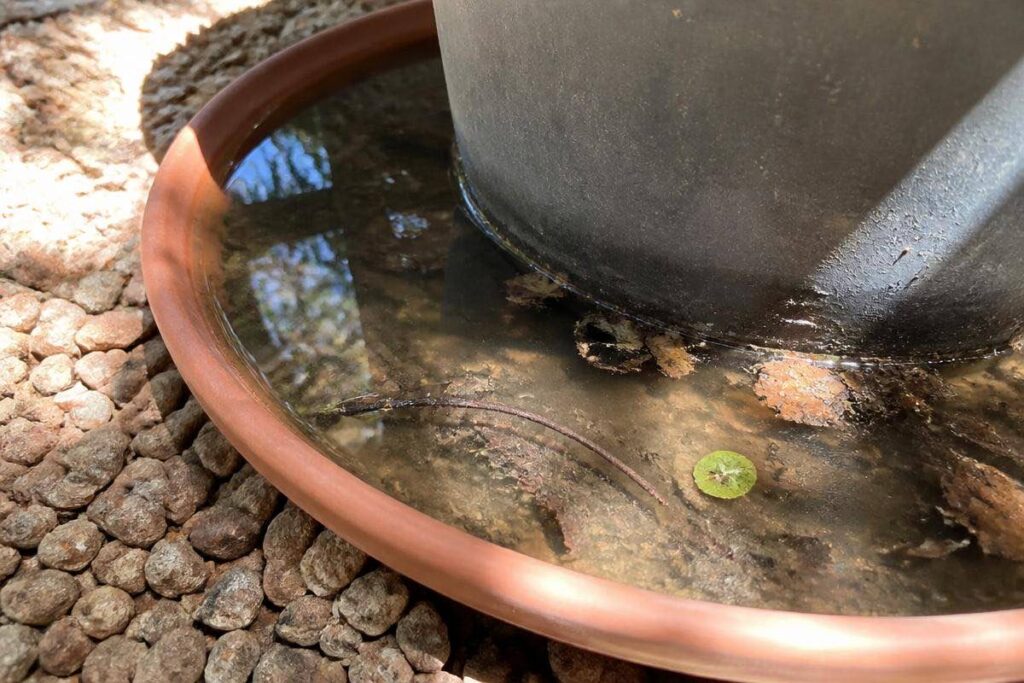
Water first. A mosquito problem is a water problem, and no product applied to a person or a patio substitutes for getting rid of the place the next generation is growing. Our mosquito control page covers where that water actually hides on a Phoenix property, what a barrier treatment does and does not do, and how larvicide works when the water cannot be removed. The related question — how long a mosquito actually lives indoors — is answered separately.
Skin second: one EPA-registered active, applied properly, reapplied on the label’s schedule. Clothing third, treated with permethrin if you are outdoors often. And the gadget aisle last, which in practice means not at all.
The order is not a matter of taste. Done the other way round — a zapper on the patio, a wristband on each child, and the water left where it is — you have spent a few hundred dollars and changed nothing about how many mosquitoes hatch in your garden this week. Done in the right order, the first step is usually free and does more than everything below it combined.
Mosquito repellent questions
Do bug zappers work on mosquitoes?
No. In one overnight test a zapper killed about ten thousand insects and eight of them were mosquitoes. Mosquitoes are not attracted to light in the first place — they follow exhaled carbon dioxide. Most of what a zapper kills is harmless, and a good deal of it is predatory insects you would rather keep.
Do mosquito repellent bracelets work?
Not in any useful way. A skin-applied repellent protects the skin it is applied to, so a band protects roughly your wrist. The mosquito landing on your ankle is not affected by anything happening at the other end of your arm.
Is there a natural repellent that actually works?
Yes — oil of lemon eucalyptus and PMD are plant-derived, EPA-registered and named by the CDC. That is a very different thing from an untested essential oil blend. Note the CDC’s restriction: do not use OLE or PMD products on children under three.
Do citronella candles or citronella plants keep mosquitoes away?
Keep the two apart. Oil of citronella applied to skin is an EPA-registered repellent. A candle on a breezy patio is not the same thing, and on the plants the testing is direct — Florida trials found Citrosa plants did not reduce the number of bites test subjects received.
Why do mosquitoes bite me more than other people?
The two things that are established are carbon dioxide output and body heat, both of which vary between people and across a single evening. That is enough to explain most of what you notice. Plenty of other explanations circulate; we would rather point you at the variables you can do something about.
Can I put permethrin on my skin?
No. Permethrin is for clothing and gear, not skin. Treat the garment per the label, let it dry, and use a separate EPA-registered repellent on exposed skin. The two are meant to be used together.
Will a bat house reduce the mosquitoes in my yard?
Not meaningfully. Insectivorous bats are opportunistic feeders and mosquitoes are a very small part of what they eat. The same applies to purple martin boxes. Put one up if you want bats, not if you want fewer mosquitoes.
Related services
Mosquito Control
The other half of this: where the water hides on a Phoenix property, what a barrier treatment reaches, and when larvicide is the right answer. Mosquito control.
Pest Identification Guide
Not sure the thing biting you at dusk is even a mosquito? Rule it in or out first. Work out what it is.
Scottsdale
Irrigated lots, pools and green belts change the picture street by street across the east Valley. Pest control in Scottsdale.
Still being bitten after doing all of it?
Then the water is closer than you think, and usually it is not where people look. Tell us which part of the yard and what time of day, and we will tell you where to start.